
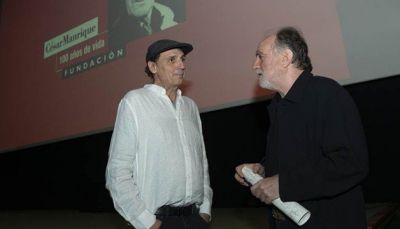
"Like a 19th century traveler". This is how the director of the César Manrique Foundation, Fernando Goméz Aguilera, considers that the filmmaker José Luis Guerin approached 'From an Island', a film produced by the FCM that premiered this Tuesday night at the Atlántida Cinemas in Arrecife. A "geological drama" that provides a vision of an island that is "pre-logical and cave-like, a previous island" and that, in the words of Goméz Aguilera, Guerin shot "as if he were seeing the island for the first time".
For the director of the FCM, 'From an Island' is "a beautiful and austere cinematographic poem", "an epic song that evokes the fragile depth of beauty" and that "makes a decisive contribution to the construction of Lanzarote's imaginary". "It is cinema in its purest form", he said.
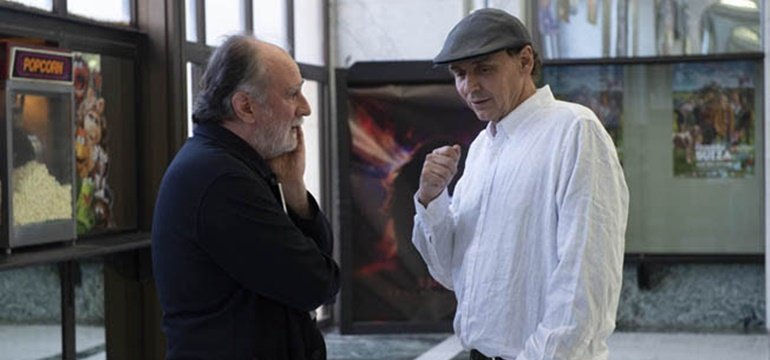
In 'From an Island', Guerin portrays in 25 minutes a personal vision of Lanzarote that was born from a commission from the FCM. "It is a work that I feel is mine because I do not differentiate between commissioned works and those of my own initiative, but rather whether or not I get involved, and I have been involved as in the most intimate of my films", explained the director to the public after the screening. "I wish I had more commissions of this nature", he added.
Guerin said that he has created his own cinematographic island. In the film there is hardly any human presence. It tells a story, supported by subtitles, about a territory that, except for minimal details and its final shot, could have been shot, effectively, in the 19th century. As he detailed, he conceived the film for a universal audience because cinema, "however minority the film may be, and this is the case, should reach any viewer equally".
A "landscape detective"
The filmmaker explained that he had wanted to do "something very free" and that he wondered to what extent the Foundation would allow him that freedom. Thus, he related how he was warning that he would like to make "a strange film", in "black and white" and "as if it were silent". "Good", they answered. "They were not intimidated by my wishes", said José Luis Guerin, who wanted to explore the island and take it to the ultimate consequences "because making films allows you to experience things intensely".
José Luis Guerin became a "landscape detective", which he does not consider as an ornament, but as significance and even as drama. According to him, there is a craft claim in his film and that is why it is shot on celluloid, not digital. That is why he wanted to see the texture and the glazes of light, "the matter", as César Manrique liked.
According to the filmmaker, there was a challenge, that of statism, facing "the immobility of the mineral" because cinema is movement. Thus, he introduces in the film shadows of the clouds but also artificial elements such as mists, smokes and haze "because there is no vegetation that can read the wind in a world of stones". He also said that he used the chaining of images to give an idea of the extinction "which is a very powerful one on this island" and because he wanted to make visible those populations hidden by the volcanic eruptions.
"Sincerely Impressed" with the FCM
Finally, he said he had enormous gratitude towards the FCM and said he was "sincerely impressed" by its scope and its commitment to preserving César's activist legacy, even reaching the courts, when it could "comfortably dedicate itself to taking care of its paintings" without earning hostilities. "In that dimension I was impressed by the Foundation", acknowledged the filmmaker.
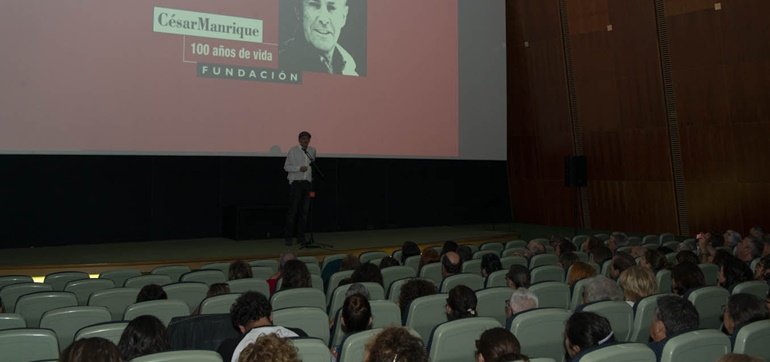
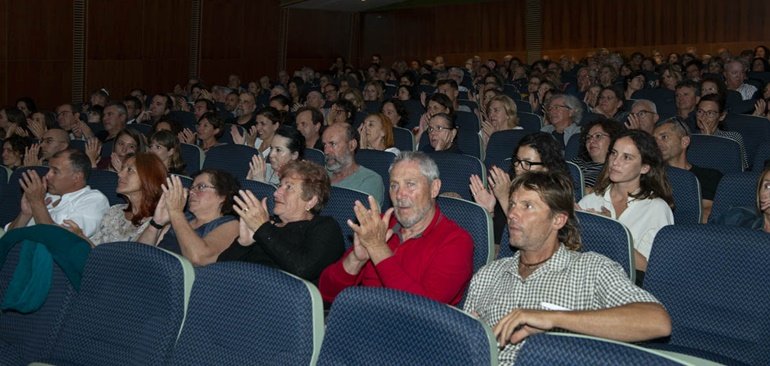
Before the screening of the film, the president of the FCM, José Juan Ramírez, welcomed the attendees, thanked the Spínola Group for the transfer of the room and said that it was a pride and an honor that Guerin agreed to collaborate and that he makes an important contribution to the filmography of Lanzarote.
The director of the FCM, Fernando Gómez Aguilera, presented the film and the author, of whom he reviewed his filmography and to whom he referred as the maximum exponent of European auteur cinema with an "elegant, nonconformist and innovative cinema halfway between fiction and reality" and far from the market.
About the film, he pointed out that it suggests "a poetic cosmogony, creates an atmosphere of emotion and distances itself from the codified aesthetic fascination of Lanzarote", in addition to "challenging the visual cliché of the island" and being "an antidote against the psalmody". "Guerin (who does not illustrate reality but reveals it) returns to Lanzarote its immanent properties", said Gómez Aguilera.


