
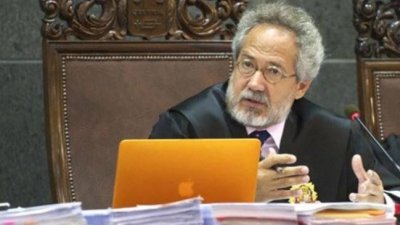
The president of the Provincial Court of Las Palmas and also of the Sixth Section, Emilio Moya, was the one who decided to act to stop the unsealing of Stratvs that had been ordered by his colleague in the Chamber, Judge Salvador Alba. On January 13, Moya signed an order annulling a previous resolution by Alba, warning that executing it could cause "irreparable damage."
Salvador Alba had issued that order after receiving a phone call from the lawyer of Juan Francisco Rosa, who is the owner of the winery and the main defendant in the case. In that call, the lawyer asked that Seprona be ordered to remove the seal, to comply with the order that lifted the precautionary measure of closure. That order, which is not yet final, was issued by the Sixth Section of the Court and the rapporteur was also Salvador Alba.
The judicial secretary reported that call to Judge Alba in writing, through a record of evidence, and the magistrate agreed to the businessman's request. Thus, on November 9, he issued an order ordering Seprona to proceed with the "immediate unsealing" of the facilities. However, four days later, the president of the Sixth Section decided to intervene and annul that order.
First he went to the Civil Guard
The first thing Emilio Moya did was to ask, through another order, that the Civil Guard be contacted by telephone, to find out if Seprona had already carried out the unsealing ordered by Alba. And once he confirmed that it had not yet been executed, he issued another resolution, "in order to avoid irreparable damage," rendering that order ineffective.
In his order, Judge Moya explains that he adopted this decision "in view of the appeals filed against the order dated December 22, 2016, by which the lifting of the precautionary measure of closure of the Stratvs winery was agreed." These forceful appeals were filed by the Public Prosecutor's Office and by the popular accusation, represented by Urban Transparency.
In its writing, the Prosecutor's Office describes as "unjustifiable", "absolutely incoherent", "unfounded" and "lacking adequate legal reasoning" the order issued by Alba, since it understands that it was based only on reports and documents provided by Rosa's defense, "obviating" all the evidence for the prosecution and the expert reports that appear in the case. Similar arguments were also made by Urban Transparency, which has also decided to challenge the three magistrates who endorsed the order, asking that they be removed from the procedure, since they are also the ones who must judge the case.
Alba, investigated in a case in which Rosa's lawyer intervenes
Although Urban Transparency has requested the recusal of the three members of the Sixth Section of the Court, it places special emphasis on the role of Salvador Alba, who was the rapporteur of that order. Regarding him, it points out that he is being investigated in a criminal case for his intervention in another procedure. And in that case in which Alba is being investigated for several crimes, the lawyer of Juan Francisco Rosa, José Antonio Choclán Montalvo, intervenes. Specifically, the lawyer represents the businessman Miguel Ángel Ramírez, who was the one who recorded a compromising conversation with Salvador Alba, which is what gave rise to that criminal case.
"This circumstance alone should be enough for Mr. Alba Mesa to refrain from intervening in any procedure in which Mr. Choclán Montalvo acted as a lawyer," says the popular accusation, which considers that this circumstance "inevitably has to weigh on the spirit of the aforementioned magistrate, compromising his impartiality." In addition, he considers it "quite unusual" that Alba issued an order ordering the unsealing of Stratvs due to a "phone call from the lawyer", and that he did so "attending to such an extravagant request in a hasty manner, since the deadline for formalizing the appeals that could be filed against the order had not even passed."
In fact, that is the reason that led the president of the Section to annul that order, days before this recusal writing was known. Thus, he agreed to leave the unsealing order without effect, until the appeals filed by the Prosecutor's Office and the popular accusation are resolved, since until then the order is not final.
Change of criteria with the same rapporteur
The precautionary closure of Stratvs was ordered by the investigating judge of that case, Silvia Muñoz, in December 2013. Since then, all the appeals filed by Rosa trying to annul that precautionary measure have been rejected in the different judicial instances that have had to rule. Even Salvador Alba himself endorsed the closure in 2014.
"The consequence of an activity that is not authorized, a construction that is not authorized, that can endanger the environment and the landscape itself in a protected natural space is none other than the precautionary and provisional sealing of the activity and the complex in its entirety," said Judge Alba in that first order, in which he did analyze in detail what he defined as a "large evidentiary and/or probative material on the existence of several crimes that can be attributed to BTL Lanzarote SL or Juan Francisco Rosa."
However, according to the Prosecutor's Office, the new order lifting the precautionary measure "is based on what the applicant alleges and forgets everything that contradicts it and that has been previously assessed." And in this way, the Public Prosecutor's Office questions in its appeal that the opening of facilities that are "illegal and unlegalizable" is allowed, and that are not "covered by any enabling title." And it is that beyond the alleged environmental crime for polluting spills, which was the main trigger to order the precautionary closure of the winery -and which is what Alba questions in his latest order, based only on reports from the defense-, in the case many other crimes are also being investigated, including urban planning, against heritage, fraud and occupation of land that was not even owned by Juan Francisco Rosa.


Add La Voz de Lanzarote as a preferred Google source.
Stay informed with the latest current news.