Tourism has generated 47.6% of the growth of economic activity in the archipelago since 2019, contributing an additional 7,757 million euros to reach in 2025 a Gross Domestic Product (tourism PIB) of 23,375 million euros, equivalent to 37.7% of the total regional economy.
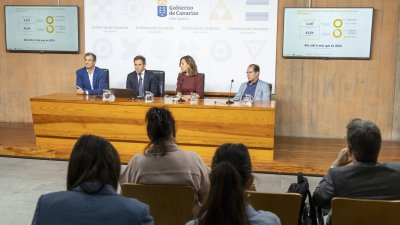
This is reflected in the Impactur study for the Canary Islands, which analyzes, based on 2024 data, the economic impact of tourism on the economy and employment of the autonomous community and which has been presented by the Minister of Tourism and Employment of the Government of the Canary Islands, Jéssica de León, and the executive vice president of the Alliance for Tourism Excellence (Exceltur), Óscar Perelli.
The regional official remarked that the sector created 76,574 new direct and indirect jobs between 2019 and 2025, reaching 413,064 employed people and representing 42.3% of the total employment in the Canary Islands.
The counselor explained that "we are talking about a sector that continues to lead GDP, a contribution based on the increase in the value of the tourism sector and not on quantities." "In recent times," she continues, "it was particularly important to transform the obsolete accommodation facilities into a higher quality product, in which more than 1,000 million on average have been invested in the Canary Islands since 2023, last year 1,175 million euros to reconvert hotels and apartments from three and four stars to five-star hotels, which implies much higher quality and a more important customer target."
He also highlighted the record of tourist spending at the destination, with an average of 177 euros per person per day, and the creation of SMEs and micro-enterprises linked to the experiences sector "so that the offer also has to do with commerce, agriculture, tradition and culture, in addition to the other way of presenting the Canary Islands, much more than just sun and beach". For Jéssica de León, "the data show that we are achieving this, and the challenge lies in the digital divide so that these companies can continue to grow and contribute value and that tourist spending per day can continue to increase in the coming years".
The Minister of Tourism and Employment referred to the contribution of the Canary Islanders with "2 billion euros to domestic tourism spending and tourism continues to increase by more than 12 percent per year," she concluded.
For their part, the executive vice president of Exceltur, Óscar Perelli, highlighted the public-private collaboration between Exceltur and the Government of the Canary Islands and the great social contribution of tourism in the Canary Islands, "23 billion euros of added value, one out of every two jobs in the tourism sector directly and throughout the value chain, and an increase in fiscal contribution of more than 4 billion euros".
The taxes paid by tourism in the Canary Islands are equivalent to 95% of regional health spending, according to Exceltur
“During this period, tourism generated 4,107 million euros in tax revenue, which represented 43.2% of public revenue in the Canary Islands.” Perelli recalled that these revenues contribute to the budget with which the main public services are financed. 95.3% of healthcare spending (4,309 million euros), the entire education budget (2,155 million euros), more than five times the spending on social assistance (774 million euros), and investment in infrastructure (558 million euros).
Another of the key contributions of tourism that the report highlights is its high multiplier effect on the economy as a whole. For every 100 euros of added value in the tourism sector, an additional 44.5 euros were generated in other productive sectors, and for every 100 tourism jobs, 38.5 jobs were created in other economic areas such as agriculture, commerce, logistics, construction, or energy.
Impactur also points to the strong investment drive of the sector, which reached historic highs with 1,179 million euros in 2025, a growth that reflects a clear commitment to improving the quality of tourist products and diversifying the available offer.
The report emphasizes the increase in tourism spending, both by international visitors and those from the peninsula. In the case of foreign tourism, this item reached 17,422 million euros in 2025, which represents an increase of 7.1% in the last year and 61.6% compared to 2019. This growth is mainly explained by tourists spending more money during their stay in the Canary Islands, especially on food and tourist activities. For its part, peninsular tourism increased its contribution to 1,778 million euros, 23.6% more than in 2019, also driven by the increase in average daily spending per visitor.
This greater dynamism in spending is directly related to the process of repositioning the tourism offering in the Canary Islands towards higher categories. Investment in product improvement allowed for a 30.7% growth in five-star hotel rooms between 2019 and 2025, while rooms of lower categories have been reduced. In fact, last year this process occurred in a context of zero growth in accommodation capacity, with a reduction of 2,688 rooms in one- to three-star establishments compared to the incorporation of 1,781 new five-star rooms, which reflects a commitment to raising the quality of the tourism offering on the islands.
Do you usually read us to find out what's happening in Lanzarote? Choose La Voz de Lanzarote as one of your preferred sources on Google
Add La Voz de Lanzarote as a preferred Google source.
Stay informed with the latest current news.