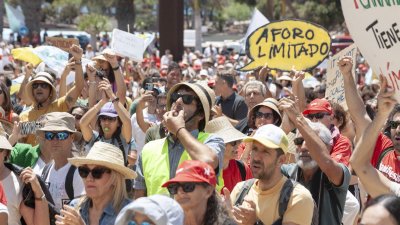
The documentary 'La hora robada. Turismo, capital y desarraigo en Canarias' premieres this Thursday in Las Palmas de Gran Canaria to show the reality of the impact of tourism on the community and with a phrase repeated by the protagonists: "We feel like foreigners in our own land".
The Galician Association for Communication for Social Change (Agareso) has been carrying out, for fifteen years, training aimed at journalists to talk about hate speech and how to do journalism for change, a work that has led participants to pass through points like Morocco or Senegal, until arriving in Gran Canaria last year.
There, according to the project coordinator, Pablo Santiago, explains to EFE, the idea was "to work on the migratory routes to the Canary Islands", but once at the point they saw "that there was a lot of social mobilization around housing and different extractivisms".
They noted that the impact of tourism was important and that "an extractivist and colonial vision" was imposed, so they informed themselves and spoke with several associations "already mobilized and very well mobilized" that confirmed that first impression.
"There is a lot of being fed up with the abuses of tourism and there are many injustices from different points of view, such as the environmental one," summarizes.
In the area they saw "projects of great magnitude that people don't quite understand", in their opinion, as an initiative to "desalinate water and raise it 900 meters" (the Salto de Chira).
"There is an idea that was repeated throughout the entire documentary. They tell us: we don't want to be foreigners in our own territory, but we feel that way; we feel like tourists in our land," he continues.
What they observed, above all, is that "there are many people who work for tourism and are poor at the same time", in "one of the communities with the most severe poverty" in which many people "cannot pay the rent".
"They say that tourism gives wealth, but it doesn't feel that way"
All this is in all points of the island, also in the rural areas, and the positive thing is that "the people are very well organized".
"We found people who were wondering if tourism brings wealth, why it doesn't feel like that. Why rent is increasingly expensive, increasingly more tourist housing that cannot be rented and we continue to charge so little," he adds.
For the documentary, they have counted on the participation of those affected by the project of the hydroelectric power plant Chira-Soria, with floor and hotel maids, with residents of the Guanarteme neighborhood, in Las Palmas de Gran Canaria, very affected by the speculation, and with residents in a village that does not have water or basic resources, but has a 1,500-bed hotel project.
With all this, Agareso has prepared a documentary that "more than a cultural product, it is a political product to make political impact" and which premieres this Thursday at the Casa de la Cultura of the Tamaraceite neighborhood, in Las Palmas de Gran Canaria.
"Several entities are organizing different screenings with discussions. It should serve for them to talk, for them to organize the struggles they already have, and for them to be able to raise awareness among people who are not yet aware," he concludes.
Agareso is already working this year on a new course, which has started and ends on March 31: "It is probable that we will do a similar theme to that of Gran Canaria, but bring it to Galicia. We will surely talk about housing and extractivisms, which are a global problem", concludes.
Add La Voz de Lanzarote as a preferred Google source.
Stay informed with the latest current news.