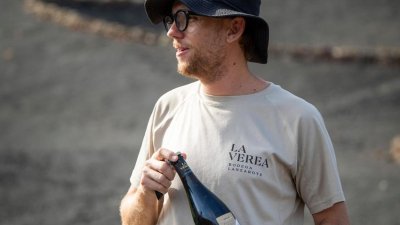
Sergio Cabrera from Lanzarote, with a long career in wine sales and several generations of his family producing it, decided to open his own artisanal winery, La Verea, three years ago.
In an interview with the radio program Más de Uno Gourmet on Radio Lanzarote-Onda Cero, he explains his career and the four references of his latest wine production.
-
What has been your career path before starting the winery?
It has been a great step in my life, both personally and professionally. It is a tough sector, but a very beautiful one. In my family, there are up to four and five generations who have made wine in the Tinajo and La Geria area, and I believe I had an obligation to maintain that tradition.
I have been dedicated to wine sales, so it is a sector I have known for many years, and since I was little, the family business has instilled in me a love for tradition.
-
How was La Verea born?
I had made the decision many years ago to open a small artisanal winery with minimal intervention to make the wine I wanted to make. The winery was born in 2023. I released the second vintage this year. They are wines for aging, white and sparkling, which require a little more time.
Our wine has tremendous evolution in the bottle with good aging and then the bubbles, which is my passion.
-
What is La Verea wine like?
It is a wine not very different from what is on the market because it is comfortable, pleasant, it has a very rich acidity, characteristic of our wines. I always looked for a wine that would be for everyone, but that would be special.
-
Did you study enology?
No, I am self-taught, but I always have external help. When you have a doubt, you call one person, you call another, and you always get different opinions, and you draw the final conclusions and move forward until you achieve the wine you want.
-
Tell us about the four references from the winery…
There are two lines, one for aging white (Tabaiba) and rosé (Malvarrisco) associated with endemic Canary Islands plants, and another for sparkling wines called Nubium, there is a Nubium white and a Nubium Brut Nature Rosé. But every year I change, every year I do research and R&D.
-
Isn't it more difficult to sell rosé wine?
I love rosé, it is a very fresh, very rich wine, suitable for many dishes we taste in restaurants in Lanzarote, and it is a wine that, honestly, is yet to be discovered nationally. In France, for example, a lot is consumed.
-
And why Nubium?
Nubium comes from Mare Nubium, which is the face of the moon that resembles Timanfaya a little. It is a word that I liked and that can be pronounced in any language. We do it with an ancestral method, first fermentation. The last vintage with 70% Listán Negro and 30% Malvasía Volcánica.
-
How many bottles come out of each wine?
They are very small productions. From Tabaiba there are 2,209 bottles, from Malvarrisco 114, from ancestral 516, and from Brut Nature 98.
-
Where can it be tried?
There is nothing left in the cellar. They can try it in hospitality, in restaurants in Lanzarote.
What feedback are the restaurants giving you?
Positive, many of the restaurateurs tell me that customers who have tried the wine, when they return, repeat.


Add La Voz de Lanzarote as a preferred Google source.
Stay informed with the latest current news.