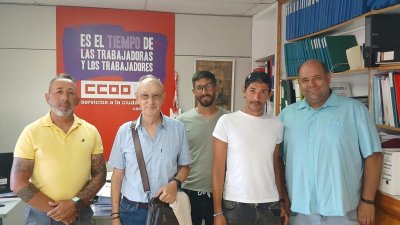
The Federation of Services to Citizens of Comisiones Obreras Canarias (FSC-CCOO), FeSMC-UGT, and the Association of Canary Island Companies for Beach Rescue and Surveillance have reached an agreement to launch the first Sectoral Collective Agreement for Professional Aquatic Surveillance, Rescue, and Lifeguarding in Natural Aquatic Spaces of the Canary Islands.
The agreement, valid between 2026 and 2029, provides the sector for the first time with its own homogeneous labor framework for the entire archipelago. FSC-CCOO highlights that the agreement will help combat precariousness, improve staff stability, and address the shortage of professionals affecting numerous rescue services on the Canary Islands coasts.
Salaries and protection against CPI
The agreement sets an annual working day of 1,695 effective working hours and establishes a minimum base salary of 1,400 euros per month for beach lifeguards, equivalent to 16,800 euros annually. Boat skippers and supervisors will receive 1,625 euros per month; zone managers, 1,712.59 euros; and technical directors, 1,926.68 euros.
These amounts will be updated annually according to the real evolution of the CPI recorded by the National Institute of Statistics, with a minimum guaranteed increase of 2.5% annually.
In addition to salaries, there is a hardship bonus of 217 euros gross per month to compensate for continuous exposure to sun and wind, as well as the physical effort developed on sand, rocks, and other natural environments. Personnel assigned to La Gomera, El Hierro, and La Palma will also receive an island supplement equivalent to 20% of the base salary.
Work on Sundays will incur a 15% surcharge per hour. The agreement also establishes the closure of services on the afternoons of December 24th and 31st, or, when services must remain operational, equivalent compensation for workers.
Breaks and psychological support
One of the main improvements in occupational risk prevention is the incorporation of a paid break of 30 minutes for every two consecutive hours of surveillance from a tower or during patrol duties. This period will be considered effective working time and aims to reduce thermal overload, fatigue, and loss of attention.
Companies will also have to finance an urgent psychological assistance service, which will have to be activated during the first 48 hours after interventions with great emotional impact, such as drownings, deaths, or especially traumatic rescues. The assistance will also include subsequent follow-up of the affected personnel.
Protection against the weather and job stability
The staff will be mandatorily provided with clothing with UPF 50+ sun protection, wide-brimmed hats, polarized glasses approved for the marine environment, and appropriate nautical footwear.
During official episodes of intense dust, heatwaves, sea storms, or other adverse weather phenomena, companies will have to adapt shifts and may suspend static surveillance without any impact on salary.
The agreement finally establishes the mandatory subrogation of staff when there is a change of awarded company. The new concessionaire must retain the personnel, respecting their seniority and consolidated working and salary conditions.
FSC-CCOO considers that this first agreement represents a historic step forward in recognizing the qualifications, responsibility, and risks assumed by those who guarantee the safety of residents and visitors on the beaches and natural aquatic spaces of the Canary Islands.
Add La Voz de Lanzarote as a preferred Google source.
Stay informed with the latest current news.