
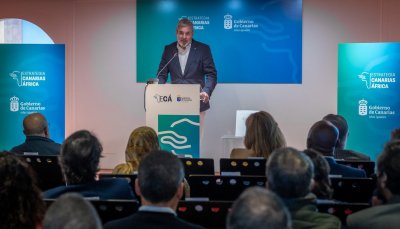
The president of the Canary Islands, Fernando Clavijo, presented this Monday the first Canary Islands-Africa Strategy, a roadmap launched with the participation of more than a hundred entities whose fundamental objective is to contribute to the social and economic growth of the territories on both sides of the Atlantic.
The document proposes to promote institutional, economic, knowledge and cooperation alliances for the benefit of both shores, said Clavijo, who highlighted that África “is a continent of challenges and opportunities, and we want to work together on solutions to the challenges and share the opportunities.”
African demographics represent a driver of transformation with direct impact on the archipelago. According to United Nations projections, in 2050 the population in Africa will reach almost 2.5 billion people -just over 25% of the world's population- with an average age of 24 years. Furthermore, between 10 and 12 million people join the labor market each year.
The demand for employment, education and ordered mobility opens opportunities for cooperation with Canarias in all areas, such as university and professional training, youth entrepreneurship or the creation of academic and labor pathways on both sides of the Atlantic.
As for the economic growth (4.3% in 2025), it favors the emergence of a middle class that could exceed 1 billion people by 2060. For Canarias this means a large expanding market that becomes a potential consumer of its goods and services.
These data place the archipelago in a privileged position as a logistics hub to offer solutions in strategic sectors for the development of the continent, such as transport, health, education, port management or digital economy.
Create a space of economic prosperity
The document highlights that the first aspect to understand why the Canary Islands must rely on a strategy towards Africa is geographical proximity. Derived from this first consideration, there is the importance of a territorial integration as a European region close to the continent.
Likewise, Canarias undertakes the commitment to create a space of economic prosperity, further supported by the capabilities it can transfer to the countries in our surroundings, in addition to offering our competitive advantages, from legal certainty to infrastructures.
Canarias has seen its role strengthened as a platform for business internationalization towards Africa, supported by institutional stability and air and maritime connectivity that positions it as a logistics and services hub in the mid-Atlantic.
In addition, the archipelago has relevant academic, scientific, and technical capabilities that have driven training, research, and knowledge transfer programs with African partners, especially through the ULPGC and the ULL. In a complementary way, development cooperation and humanitarian action have contributed to consolidating ties of solidarity and technical cooperation.
Thus, among the priority objectives of the Canarias-Africa Strategy is to strengthen territorial and neighborhood cooperation and, with the support of the European Union, increase cooperation in innovation, competitiveness, sustainable development, energy efficiency, and green, blue and circular economy.
In this mutual collaboration, this line of action represents an opportunity to diversify the Canarian economy and promote the internationalization of Canarian companies in Africa, while boosting new opportunities that generate mutual benefit in sectors such as tourism, technology, fishing, renewables, etc.
A strategy with five axes
The Director General of Relations with Africa, Luis Padilla, detailed the structure of the Canary Islands-Africa Strategy and highlighted that it is based on five pillars interrelated and complementary that allow for an integral approach to the dimensions institutional, economic, social, educational, scientific, cultural and human of the relationship between the Canary Islands and Africa.
This roadmap, he said, defines a comprehensive framework for ordering and empowering multi-actor action, led by the Government of the Canary Islands which focuses its attention on the closest countries combining consolidation and geographical diversification.
Thus, the document is developed through an institutional and political axis, oriented towards strengthening coordination, governance, and external projection; the economic and commercial axis, focused on internationalization, investment, and business cooperation; territorial cooperation and cooperation for development, aimed at maximizing the impact of social, solidarity, and humanitarian action; the educational and scientific axis, focused on training, research, and knowledge transfer; and a fifth axis centered on the cultural and sports aspect, conceived as an instrument of social cohesion, intercultural dialogue, and external projection.


