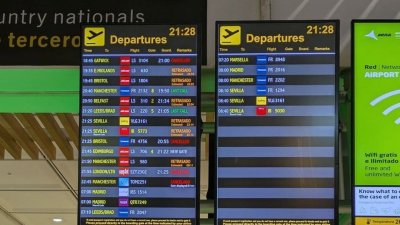
The recent wave of false bomb threats registered on commercial flights destined for or transiting through European airspace has begun to be reflected in the airport operations of Spain and the Canary Islands, generating adjustments in flight times and disruptions in inter-island and peninsular connections.
According to preliminary investigations by security forces, the origin of these incidents is due to mass email transmissions directed at control towers and airports.
Although all inspections carried out by explosive ordnance disposal teams in Spain and the rest of the continent have confirmed that they were false alarms, the deployment of mandatory security protocols has had a direct impact on air navigation.
The application of these aircraft review and inspection protocols has generated average delays of about 20 minutes in the affected flights, as well as occasional diversions to alternative airports in the network.
In recent days, more than 35 aircraft have been affected across European airspace, forcing technical inspections on the ground and the reassignment of scheduled take-off and landing slots.
Among the most recent incidents, the alert received on a flight from Manchester destined for Murcia, which forced the activation of the emergency protocol and the diversion of a Binter flight operated from Gran Canaria to Alicante airport.
This episode adds to the previous incidents recorded in the archipelago at the end of last month, when a flight originating from Barcelona and destined for Gran Canaria had to be isolated upon arrival for a complete inspection of the aircraft.
Lanzarote, an island particularly vulnerable to air crises
Within the archipelago, Lanzarote is positioned as one of the islands operationally most exposed to this type of European crisis.
This greater vulnerability is due to its intense dependence on direct medium-range connections with the United Kingdom and Northern Europe, the main points from which the cyber alerts are being issued.
Unlike the capital airports, which better absorb incidents thanks to dense inter-island traffic, Lanzarote airport depends directly on the rotation of aircraft arriving from the continent.
This exposure is aggravated by the operating model of the airlines connecting the island, characterized by very tight rotation chains where the same aircraft makes multiple daily trips.
When a security inspection or a diversion holds up an aircraft at a European airport, the delay is transferred in a domino effect throughout the day, with the outbound or return flight to Lanzarote being the one that ends up absorbing the longest delay or the eventual cancellation at the end of the day.
Along with the disruption for passengers and the rescheduling of layovers, airport managers and companies must face the logistical extra cost of fuel adjustments and additional taxiing time on the runway.
Meanwhile, civil aviation authorities and the Aena network maintain reinforced controls at the terminals, awaiting the progress of international investigations into the origin of the emails.



Add La Voz de Lanzarote as a preferred Google source.
Stay informed with the latest current news.