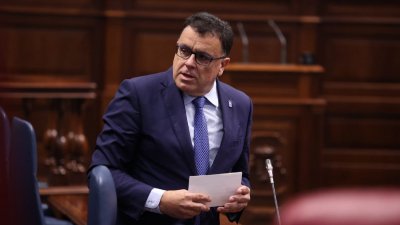
The Governing Council of the Canary Islands has approved this Monday the definitive text of the project to update the Law on Land and Natural Spaces of the Canary Islands. This is a legislative initiative promoted by the Ministry of Territorial Policy, Territorial Cohesion and Water, whose head, Manuel Miranda, has described it as "a key tool for the Canary Islands to face a good part of the challenges before it".
The document, initially approved in June, was the subject of a report by the Consultative Council in September and will now be sent to the Parliament of the Canary Islands to continue its processing.
Miranda has highlighted that the proposal aims to "continue with the philosophy of the Land Law" of 2017, a regulation that he has described as "good and that has allowed more than 250 planning modifications to be promoted", but which had to be "adapted to the new reality of the Archipelago, conditioned by several challenges, such as housing, demographics or regulations aimed at mitigating the effects of climate change". Among other measures, the update of the law foresees an increase in the availability of land for public housing, which could be up to 40% of the land under certain circumstances. Specifically, in developable land it goes from 30% to 40% and in consolidated urban land from 10% to 20%.
The minister recalled that the text is the result of a broad participation process that lasted more than a year and in which 700 professionals participated in a total of seventeen forums. Miranda has pointed out that the text has now been improved by the Consultative Council, especially to provide the text with "greater clarity and precision regarding the conditions of environmental assessment, projects of insular or autonomous interest, and new plans for the renewal of industrial land".
The Government's proposal revolves around five axes, as explained by the minister. According to his information, these are: "Greater protection of the territory, with tougher sanctions; streamlining of planning, with 40% less documentation; promotion of public housing construction, with more available land; support for municipalities in the face of the demographic challenge; and reinforcement of the primary sector, providing it with greater legal certainty".
Among other proposals, the harshest sanctions could reach 600,000 euros and there will be more time for their processing, with the aim of preventing them from expiring. In addition, a 30% reduction in processing times for planning instruments has been calculated.
On the other hand, the document contemplates other measures to favor population retention in demographic challenge municipalities, such as their priority access to aid or subsidies to update their planning.
Likewise, the primary sector is reinforced, where single-family homes are allowed in agricultural settlements as long as they are linked to a real agricultural activity.
“The Land Law is a key instrument for improving access to housing. We must work together to improve the availability of properties for society,” said the counselor.
The document will now be sent to the Parliament of the Canary Islands for debate and approval, although Miranda has reported that “the spokespersons for the political groups in the parliamentary commission have already had it since this summer, in order to give them more time for its analysis” and to be “as transparent as possible with this norm”.



Add La Voz de Lanzarote as a preferred Google source.
Stay informed with the latest current news.