
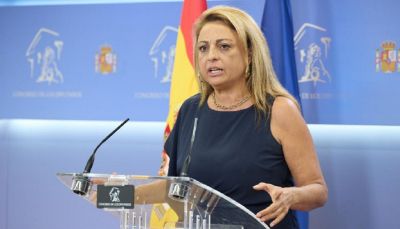
The deputy of Coalición Canaria in Congress, Cristina Valido, has obtained the support of the Lower House for a non-law proposal to demand from the Government of Spain "an effective response" to the situation of migrants arriving by sea to the Archipelago.
With the majority support obtained in the Lower House, with all parliamentary groups voting in favor, except Vox, the Committee on Labor, Social Economy, Inclusion, Social Security and Migration urges the state Executive to solve, above all, the situation caused by the arrival of thousands of unaccompanied children who continue to be welcomed on the islands after their arrival by sea.
With this majority political support, the Congress of Deputies assumes the entire content of the Canary Islands Pact for Immigration promoted by the President of the Canary Islands, Fernando Clavijo, and which was already signed by all political groups with representation in the autonomous Parliament, except Vox.
“It is essential that a consensual immigration policy be definitively applied,” said Valido, “to prevent an image of alarm and lack of coordination from continuing to be conveyed, which only contributes to intensifying fear among the population and fueling hate speech and crimes.”
In this sense, the proposal defended by the nationalist deputy that the Congress of Deputies has adopted assumes in its entirety the Canary Islands Pact for Immigration to demand that the Government of Spain, and the political groups that support it, promote “this process that culminates in the necessary regulatory modifications so that the powers of unaccompanied foreign minors are not the exclusive responsibility of the communities to which they arrive.”
Therefore, it asks the state Executive to “renew and expand the agreements reached in the Sectoral Conference on Childhood and Adolescence so that a co-responsibility reception mechanism is promoted among all the autonomous communities, coordinated by the Government, for the care of children and adolescents without close family references” who arrive in the Canary Islands without the company of an adult.
The Coalición Canaria proposal also proposes that “sufficient personnel and material resources be provided” to all the State Security Forces and Corps, to guarantee full coverage, especially in the areas of arrival and care of migrants.
Likewise, help organizations and entities that provide support such as the Spanish Red Cross and Civil Protection. “Due to the situation that is being experienced on the Canary Islands coasts, and taking into account that the weight of rescue operations for migrants is assumed by the crew members of maritime means,” the proposal states, “of Salvamar and Guardamar type units, the Government must maintain the entire current device of means in the Canary Islands to attend to salvage emergencies at sea, guaranteeing efficient operability permanently complying with the legislation regarding guard hours.”
At the European level, as also stated in the Canary Islands Pact for Immigration, the CC proposal assumed by Congress demands that contingency and emergency plans continue to be developed to provide a rapid and adequate response to the needs of care and protection of people from mixed immigration flows.
“It is necessary to raise a request to the European Commission to carry out a greater deployment of Frontex in the Canary Islands and enable the necessary funds and resources to address the humanitarian drama that is currently being experienced in the Canary Islands,” said Cristina Valido, stressing that, only in the first 15 days of February, 2,832 migrants have arrived in the Canary Islands, almost three times more than in 2023 (1,046 people), and that so far in 2024, 11,704 people have arrived, which is 630% more than in the first ninety days of last year.
Regarding the legislative application linked to the migratory situation, the support achieved by Coalición Canaria in the Congress of Deputies also asks the Government of Spain that, in application of article 6.1 of Law 50/1997, undertake the modification of the Delegate Commissions for the recovery of the Commission for Migration Affairs to “guarantee coordination” between different competent departments regarding the migratory crisis that is being experienced in the Canary Islands and future migratory processes. Likewise, that from the state Government “a permanent coordination system be established” for the management of the various aspects that derive from migration and that is currently entrusted to various bodies in the Administration.
“This dispersed system,” defends CC, “causes deficiencies in management that should be resolved to be able to combine the various interests at stake, since it is about seeking a model of integration and coordination of different organizations involved,” both of the General State Administration and in autonomous communities and municipalities. “This model,” urged the Canary Islands deputy Cristina Valido, “should include a budgetary fund of mixed State-Autonomous Communities allocation to properly address their powers in the matter, especially reinforced in those communities where there is a greater presence of foreign people.”


