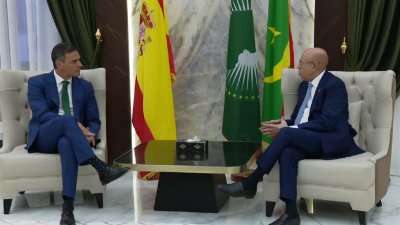
Spain promoted this Tuesday the path of circular migration with Mauritania as a way to counter irregular migratory movements that reach the Canary Islands coasts and have this country as their main starting point.
The decision for Mauritania to join the list of countries with which Spain has circular migration agreements was made on the occasion of the visit of the Spanish Prime Minister, Pedro Sánchez, to Nouakchott as part of a three-day African tour that will also take him to Gambia and Senegal.
Circular migration consists of training and hiring workers in their country of origin so that they go to perform a specific job in Spain on a seasonal basis and, at the end of it, return to their country.
Until now, there were seven countries with which Spain had agreements to promote this type of legal migration (Morocco, Senegal, Colombia, Honduras, Ecuador, Argentina and Uruguay) and from now on Mauritania is added and this Wednesday Gambia will also do so after the signing of another agreement for this during Sánchez's visit.
The promotion of this type of formula, Sánchez considered, in a joint appearance with the Mauritanian President, Mohamed Ould Ghazouani, is the commitment that Spain must make as an alternative to illegal migratory movements that, in addition, involve serious risks for the people who carry them out.
Migration as wealth
The President of the Government took advantage of his intervention in Mauritania, the country from which most of the canoes that arrive to the Canary Islands coasts come, to make a strong defense of legal migration, since he considered that it is fundamental for the economy because it means "wealth, development and prosperity".
In addition, he highlighted its contribution to the maintenance of Social Security or the public pension system and that migration is not a problem, but "a necessity that implies certain problems".
Spanish government sources emphasize in this regard that legal and safe migration is therefore necessary and recall estimates that suggest that Spain will need 200,000 to 250,000 migrant workers until 2050 to sustain the welfare state.
This is a figure that has been referred to on several occasions by the Minister of Inclusion, Social Security and Migration, Elma Saiz, who accompanies Sánchez on his African tour.
The Government is aware that circular migration alone cannot solve the problem of illegal migration, but it does believe that it is a relevant element and therefore intends to continue promoting it.
Almost 21,000 workers have arrived in Spain this year in these circular migration initiatives and the intention is that the figure will continue to increase.
Companies have an essential role to play in this, and the Spanish Government hopes that more and more companies will be interested in this type of seasonal hiring.
More security
Another relevant aspect in the fight against illegal migration is security, and Spain and Mauritania signed an agreement in this area.
On the occasion of Sánchez's visit, the Spanish-Mauritanian Business Committee was launched, which the President of the Government said will serve to significantly increase trade and economic relations and very especially between the Canary Islands and Mauritania.
There are about 3,000 Spanish companies that have activity in Mauritania and 10% of them are from the Canary Islands.
In addition to agreeing to hold bilateral summits from 2025, when it will be held in Mauritania, Sánchez's visit led to the announcement of the opening of a Cervantes Institute center in this country.
In the same way, Sánchez announced that Spain is going to make a contribution of half a million euros for a training initiative in defense and security in Mauritania.
For his part, the Mauritanian president (who in the previous meeting praised, according to Spanish sources, Sánchez's decision to promote the recognition of Palestine as a State) assured that he is united with the head of the Spanish Government by a "spirit of solidarity and shared responsibility".
In the same way, he thanked the Spanish collaboration in favor of legal migration.


Add La Voz de Lanzarote as a preferred Google source.
Stay informed with the latest current news.