Organizing the departure of a cayuco bound for the Canary Islands does not require an especially complex operation. It is enough to find someone willing to take the initiative and gather among several migrants the necessary money to buy a boat. The fear of dying at sea also does not seem sufficient to stop the departures.
"It is no longer a matter of fear; it is a matter of survival," summarizes Saliou Diouf, president of the Senegalese association Boza Fii, which supports migrants and relatives of missing persons.
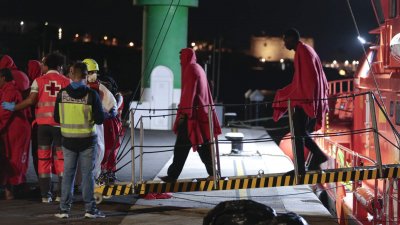
The activist's testimony comes at a time of rebound of the Atlantic Route. This Monday, six precarious boats were rescued on the Spanish island of El Hierro and two others arrived in Tenerife with 815 people on board, including 48 minors.
According to data from the Government of the Canary Islands, nearly 13,000 migrants have arrived in the Spanish archipelago this November on board 130 precarious boats.
"When a person is within a circuit where they want to leave, organizing the departure is easy. It is enough for someone to take on the commitment," Diouf explains in a telephone interview with EFE.
The mechanism, he assures, does not require an especially complex structure. If a boat costs one million CFA francs (about 1,500 euros), it is enough to find five people willing to contribute 200,000 francs (about 300 euros) each to gather the necessary money to buy it.
"Once the necessary number of people is gathered, the boat is bought. It is not really complicated."
The normalization of death
Behind this apparent simplicity, however, lies a much more dramatic reality: the normalization of deaths and disappearances on a route where shipwrecks are repeated year after year.
"The tragedies, the deaths, and the disappearances are not something new. They are situations that are repeated every year: people keep leaving, some die, and others disappear," he continues.
In Diouf's opinion, fear has ceased to act as a deterrent, even with the possibility that those who organize the crossings may be arrested and imprisoned. "They are no longer afraid of the captains being arrested, of criminalization, or of organizers being put in prison. It is the people themselves who take the initiative to leave."
The activist refers to the shipwrecks recorded in Lompoul and Yenne, two towns on the Senegalese coast. First, the Lompoul shipwreck occurred, and barely a week later, another boat capsized in Yenne.
"The people who were on that boat already knew that a great tragedy had occurred in Lompoul. And, even so, they left. It is no longer a matter of fear; it is a matter of survival," he states.
Diouf knows Lompoul well. The Boza Fii association organizes awareness caravans every year that travel through the most remote villages in Senegal to raise awareness about the risks of irregular migration and preserve the memory of those who have died or disappeared during the journey.
This year, the caravan coincided in Lompoul with the tragedy of November 6, when 42 people died in the shipwreck of a pirogue. During those days, the members of the association also participated in the recovery of bodies and helped to rescue at least eight bodies, Diouf explains.
Criticism of the EU
For the activist, responses focused on surveillance, the militarization of coasts, and the persecution of those who organize departures do not address the root causes of the problem. Diouf particularly questions the cooperation between African governments and the European Union when, in his opinion, it is aimed at strengthening controls and criminalizing migration.
"Migration is a right. People have the right to move freely and safely," he states.
If there were mechanisms that allowed people to travel legally and freely, no one would have to risk spending a week, or even two days, at sea aboard a precarious vessel, he continues, denouncing the inequality of opportunities between Europeans and Africans when crossing borders.
"When Europeans come here, they don't have to take the risks of getting on a boat, because they have passports that don't even require them to apply for a visa. That's the reality. It must be said clearly," he said.
Diouf argues that emigrating does not necessarily mean permanently breaking ties with one's country of origin and recalls his own experience.
"Not everyone is going to leave forever. I myself left and returned. People who settle there can also come back. Whether they return with money or without money is not the problem," he states. The truly important thing, he insists, is to guarantee human rights and, among them, the right to mobility and to travel without endangering one's life.



Add La Voz de Lanzarote as a preferred Google source.
Stay informed with the latest current news.