
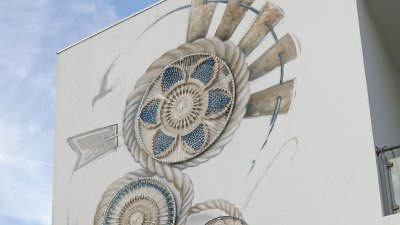
This November 24, Lanzarote's memory turns its gaze towards one of Haría's most valuable and, at times, least recognized heritage assets: that of its artisans. For decades, the hands of its women carried rosettes and openwork to European markets, while masters of wood, palm, clay, and iron preserved knowledge passed down from generation to generation.
Behind each piece was a story of work, ingenuity, and survival; also proper names and trades that today are part of the municipality's cultural memory.
The rosette makers who took the name of Haría to Europe
The history of Haría's craftsmanship has one of its most surprising chapters in the early decades of the 20th century, when textile work done by women from the municipality began to be incorporated into commercial circuits that reached Germany and other European markets. Rosettes, openwork, vainicas, and lace ceased to be solely domestic tasks and became products with commercial value, capable of connecting the economy of a town in northern Lanzarote with foreign businessmen and distributors.
Research by Antonia Sáenz Melero and Francisca María Perera Betancort, titled Benno Franken, Maximino Feo and the rosette makers of Haría, 1903-1934, reconstructs this activity based on commercial documentation and correspondence preserved by the family of Maximino Feo Rosa. The study allows us to follow the relationship between the Haría merchant and the German businessman Benno Franken, as well as to understand the difficulties that accompanied the production and export of those pieces.
The first documentary references date back to 1903, when an invoice related to an order of textile crafts from Lanzarote appears. In January 1904, a letter is preserved that alludes to a previous shipment. From then on, the correspondence allows us to reconstruct a commercial relationship that lasted for years. Franken visited Lanzarote in 1910 and maintained contact with Maximino Feo, while documents from 1912 and 1913 mention different orders for openwork, rosettes, vainicas, and lace.
The activity was not limited to occasional exchanges. There was a commercial organization that connected the producers with intermediaries and foreign markets. The pieces could reach merchants in Tenerife and Gran Canaria before continuing their journey to England and Germany. The documentation also records operations related to other destinations, including the United States.
Behind that activity were the women of Haría. They made the pieces in their homes, balancing textile work with family responsibilities and, in many cases, with agricultural tasks. The system was organized by delivering materials and later collecting the finished works. The economic conditions were not always favorable: the remuneration could be scarce and, in certain operations, payment was made with products from local trade instead of money.
The history of these "roseteras" reveals a reality that deserves recognition: the textile craftsmanship of Haría was not only a cultural manifestation but also an economic activity sustained fundamentally by female labor. The women provided the production and technical knowledge, while the merchants organized the orders and a good part of the distribution to foreign markets.
Maximino Feo Rosa and Benno Franken: an international commercial network
One of the protagonists of this story was Maximino Feo Rosa, a merchant from Haría who played a prominent role in the commercialization of textile work. His career allows us to connect craftsmanship with other economic transformations in Lanzarote, especially agricultural trade and the development of maritime communications.
The documentation also places him in the public life of the municipality and in various island economic initiatives. His relationship with Benno Franken is one of the most relevant proofs of the connection between Lanzarote's artisanal production and European markets. The preserved letters show that the business was subject to difficulties in the supply of thread and fabrics, shipping delays, customs problems, and buyer demands.
In 1928, a factory called "Toquillas, manteletas y prendas análogas" (Shawls, small tablecloths, and similar garments) was registered, owned by Maximino Feo Rosa. This information confirms that textile work had reached a degree of organization that went beyond isolated production in homes. However, in the following years, commercial difficulties were documented, which ended up affecting the continuity of that export activity.
The figure of Maximino Feo helps to understand how production carried out mainly by women could be integrated into international trade networks. It also forces us to remember an essential difference: the artisans provided manual labor and specialized knowledge, while the intermediaries controlled a large part of the commercial organization and the relationship with the markets.
Women who kept the tradition alive
The artisanal memory of Haría preserves the names of women who dedicated a large part of their lives to maintaining textile work and other traditional specialties. Their stories allow us to move from commercial documents to the personal history of those who learned the trades in their families and passed them on to other generations.
Carmen Betancor Montero is one of the most representative examples. A resident of Ye, she learned to make rosettes by observing her mother-in-law and other women around her. In an interview published in June 2024, she explained that she had started working on this specialty after getting married and moving to Haría, approximately 64 years earlier. Her work was not limited to small, isolated pieces: she also made tablecloths, curtains, bread baskets, shirts, cloths, and dresses.
Her testimony helps to understand the time and dedication each piece required. A rosette could take several hours of work, and despite this, the remuneration was low. It was a contribution to the family economy, although it could hardly become a means of independent livelihood. In that interview, Carmen recalled that she still went to the Haría craft market to sell her work.
Another prominent figure was Nélida Martín Martín, a resident of Punta Mujeres, who specialized in making palm dolls, rope camels, purses, and other objects. She began this activity in the early seventies and founded her workshop in 1992. Her creativity allowed her to transform a traditional palm broom into a doll dressed in traditional attire, a type of craft that came to be sold in various places on Lanzarote and at fairs in the Canary Islands and other communities.
Nélida passed away in Arrecife on January 5, 2018, at the age of 77. Her career represents a unique contribution to the evolution of island crafts and the incorporation of new products from traditional materials.
Dolores Dorta Lasso also stands out, born in Haría in 1935 and passed away in 2017. She was a renowned master palm craftswoman who made baskets, hampers, brooms, palm mats, and other objects using completely manual techniques. In 1991, she joined the Municipal Craft Workshop, where she also worked as an instructor. Among her students were Esther Romero and Natividad Hernández. Her work contributed to maintaining a specialty closely linked to the use of the valley's plant resources.
Along with them, names such as Josefa Dorta, Esther Romero, María Dorta, Manuela Niz, Edelmira Pérez, Inmaculada Fernández, and María de los Ángeles Perdomo are part of the list of craftswomen who developed their activities at different stages of the Municipal Workshop.
Their careers demonstrate that crafts were also a form of female labor that deserves its own place in the economic and social memory of Lanzarote. Their knowledge was not always recorded in official documents, but it survived in homes, workshops, and through direct transmission between mothers, daughters, mothers-in-law, daughters-in-law, and neighbors.
Eulogio Concepción, the master of basket weaving
Among the craftspeople who best represent the resilience of traditional trades is Eulogio Concepción Perdomo, one of the great references in Lanzarote basket weaving. He was born in Güímar, Tenerife, on July 17, 1933, although he was officially registered on August 6 of that year. His birth outside of Lanzarote occurred because his parents had temporarily moved to Tenerife in search of work. His family roots were in Haría, where he spent a significant part of his life.
From a young age, he learned the work of the pírgano, the central rib of palm leaves which, once prepared, allows for the creation of different pieces through braiding techniques. Baskets, bread baskets, trays, large baskets, and small boats were part of a production that for decades had a direct utility in agriculture, transportation, and domestic life.
These containers were used to collect and transport grapes during the grape harvest, transport agricultural products, and move goods. Their presence was linked to an economy in which utensils were made from materials available in the environment and responded to specific needs.
For decades, Eulogio combined basketry with other occupations, including his work as a janitor for the Haría Society and agricultural labor. The trade did not always provide sufficient income to live exclusively from it, but his dedication made it possible to preserve a technique that ran the risk of disappearing.
The continuity of basketry encountered an additional obstacle in the availability of raw material. In 2021, the press reported the master's difficulties in obtaining fresh pírgano. The lack of pruning and regular supply of palm leaves threatened an activity that could not be sustained without access to adequate material. Added to this were the phytosanitary problems affecting palm trees, including the presence of the diocalandra.
The problem exposed a reality that affects numerous traditional trades: preserving knowledge is not enough if the natural resources necessary to practice it disappear.
In January 2019, Haría inaugurated a sculpture by Rafael Gómez González dedicated to Eulogio, located in front of the Municipal Craft Workshop. The recognition symbolized the importance of a career that had contributed to keeping one of the island's most characteristic trades alive.
His legacy found continuity in Ruymán de León, a resident of Los Valles who learned from him at the end of 2019. For approximately two years, he attended the master's workshop and learned the procedures for preparing and working with pírgano. His case represents a form of succession that does not always translate into professional dedication, but which is essential to prevent knowledge from disappearing.
Eulogio's connection to this activity continued to have a public presence in October 2026. The Haría City Council included him in the program of a conference dedicated to the past, present, and future of the Canary Island date palm, scheduled for October 23, where he was announced to speak alongside specialists in the traditional uses of this species.
Manuel Perdomo Cabrera: the memory of wood and of the old workshops
The story of Manuel Perdomo Cabrera allows us to recover another part of Haría's material culture. He was born on January 9, 1942, in the municipality and grew up in a family environment related to carpentry and blacksmithing. His father worked making and repairing tools and objects necessary for rural life, so from a young age he was in contact with manual trades.
At the age of 19, he moved to Las Palmas de Gran Canaria to work in the González Trujillo carpentry workshop. Later, he developed restoration and decoration work for cinemas. He returned to Lanzarote and opened his own establishment in Haría in 1973. In 1975, he began working with woodturning.
His career was also linked to teaching, as between 1997 and 2001 he provided training at the Haría Workshop School.
His most unique contribution was the recovery of objects related to agricultural work and daily life. He reproduced wheelbarrows, carts, wheels, wooden bicycles, Canarian ball games, and various tools that had been part of Lanzarote's rural landscape.
Wheelbarrows were essential instruments for transporting agricultural products, goods, and materials. They were used in grape harvesting, salt transport, dock unloading, and numerous domestic and rural tasks. The reproduction of these objects made it possible to preserve a part of the island's material memory.
In 2017, he received the Haría Award for his career and his contribution to the recovery of heritage related to the primary sector. In June 2025, his exhibition Ruedas. Arte y Tradición (Wheels. Art and Tradition), presented in the El Aljibe hall in Haría, once again publicly displayed his creations, including a collection of bicycles, wheels, and pieces made from fine woods. The exhibition documents his creative continuity at least until that date.
His work demonstrates that craftsmanship can also play a documentary role: reconstructing the instruments of a society that has changed profoundly in just a few decades.
Potters, blacksmiths, and shoemakers: the trades that disappeared
The economic transformation of Lanzarote progressively displaced activities that for generations had been necessary for the functioning of the towns. Haría was not immune to this process. Industrialization, the arrival of mass-produced products, and changes in consumption habits reduced the demand for numerous artisanal jobs.
Pottery is one of the most significant examples. Joaquín Reyes Betancort, known as Chichi, was one of the representatives of traditional ceramics linked to the municipality. His work with Lanzarote clay and the wood-fired oven maintained procedures far removed from industrial manufacturing. He passed away on April 3, 2026. The II Lanzarote Craftsmanship Awards, held that year, were dedicated to his memory and recognized his contribution to the preservation of this trade.
Blacksmithing also played a fundamental role in agricultural society. Blacksmiths manufactured and repaired tools, implements, and metal elements necessary for farm work. Among the representatives of this tradition was Marciano Acuña Brito, born in Haría in 1929 and considered one of the last traditional blacksmiths in the municipality. He preserved the forge in which he had worked for decades and continued to manufacture and repair tools and implements. He passed away on January 17, 2023, at the age of 93.
Shoemaking also had an important presence. Municipal records collected by the chronicler Gregorio Barreto Viñoly counted 17 shoemakers in Haría and one in Máguez in 1904. In 1924, six were registered in Haría, two in Máguez, and four in Mala. Data from 1950 still reflected the presence of numerous professionals between Haría and Máguez, although the chronicler himself warned of possible omissions in the records.
The replacement of repaired footwear with industrial products and the reduction in demand eventually affected this activity. Juan Betancor García was one of the last prominent cobblers in the municipality and stopped practicing in 2006, according to the historical reconstruction of Haría's trades.
Another practically forgotten trade was that of the lañador. The lañadores repaired earthenware and pottery containers using small metal staples that joined the broken parts. It was a technique that extended the life of objects and responded to a culture in which repairing was more economical than replacing.
Wool spinning and the artisanal elaboration of wheat starch complete the panorama of activities that disappeared or ceased to have continuity. Eleuteria Méndez Zerpa was the last documented representative of traditional wool spinning in Haría. She began working in 1930 and maintained the trade until 2002, carrying out the different phases of wool preparation, from washing and drying to obtaining the yarn and making garments.
The elaboration of wheat starch, documented until 1940, was also part of the relationship between agriculture and textile work. The procedure required soaking the wheat, grinding it, filtering it, and drying the resulting paste to obtain a product used in the treatment of certain garments. Its disappearance reflects how the loss of a trade could also drag down knowledge related to other domestic activities.
The Municipal Workshop: recovering a tradition that was disappearing
The desire to preserve this knowledge found an institutional response in 1991, when the Haría City Council launched the Municipal Craft Workshop. The project was set up in a renovated old house and organized to offer workspaces to different artisans, as well as facilitating the exhibition and sale of their pieces.
The workshop allowed for the gathering of very diverse specialties: rosettes, embroidery, palm, rush, doll making, ceramics, leatherwork, silversmithing, painting, macramé, and weaving, among others. Its importance lay not only in having a place to sell products but in creating a space for meeting and knowledge transmission.
The initiative was recognized in 2015 with a special mention in the Distinguidos del Turismo awards. Over time, the workshop came to bear the name of Reinaldo Dorta Déniz, incorporating another reference to the artisanal memory of the municipality.
The traditional and artisanal market, started in 2001, expanded that promotional work. The Haría square became a meeting place for artisans, producers, and visitors, where handmade pieces shared the spotlight with agricultural and gastronomic products.
In June 2026, the market celebrated its twenty-fifth anniversary with activities and tributes to the people who had contributed to maintaining it for a quarter of a century. The City Council awarded the Haría 2026 Prize to the collective of artisans and producers of the Haría Artesanal tourist experience, in recognition of their social, cultural, and economic contribution.
New generations to prevent the legacy from disappearing
The continuity of Haría's craftsmanship today depends on the ability to transmit knowledge that requires time, practice, and direct contact with those who master each technique.
Antonio Emilio Betancort Fernández represents one of the most significant examples of this succession. Linked to a family with several generations of rosette tradition, he began working in this specialty at the age of eleven and learned from his aunt Carmen and his grandmother Vicenta. His career has allowed him to project rosettes into new creative spaces, including the Mercedes-Benz Fashion Week Madrid in 2024, demonstrating that a traditional technique can find new possibilities in contemporary design.
His training activity is also documented in Haría. In 2025, he taught traditional rosette workshops at the Reinaldo Dorta Déniz Municipal Workshop. In 2026, he received the Award for Young Talent and Generational Succession at the II Lanzarote Craftsmanship Awards, a recognition of his contribution to the continuity of this specialty.
In ceramics, José Miguel Clavijo Robayna, known as Miguel, developed work related to the recovery of manual techniques and procedures linked to the aboriginal tradition of Lanzarote. His activity, documented in a 2020 interview, connected craftsmanship with research into archaeological heritage and knowledge of materials. A sufficiently recent public reference to confirm his current activity has not been found.
Aquilino Rodríguez Santana is another reference of the traditional pottery and ceramics of Haría. In 2024, he explained the importance of preserving artisanal procedures against industrial production. His career is recognized by the Government of the Canary Islands with the distinction of master artisan.
Continuity also requires solving problems that go beyond training. The lack of raw materials, the low profitability of certain specialties, industrial competition, and the difficulty of finding apprentices condition the future of trades. Pírgano basketry is a clear example: without an adequate supply of plant material, learning loses the possibility of becoming a sustainable activity.
In November 2026, the tribute to four Haría lacemakers —Margarita Zerpa, Teodomira Socas, Ana Margarita Betancor, and María del Carmen Betancor— during the XV Cultural Week once again focused on the women who have kept textile crafts alive. The exhibition inaugurated in the El Aljibe hall recognized their careers and the transmission of one of Lanzarote's most representative artisanal specialties.
The artisanal history of Haría cannot be understood solely through its workshops, markets, or recognitions. It is made up of the women who worked for hours in their homes, the masters who taught how to prepare palm and clay, the carpenters who rebuilt agricultural tools, and the professionals who maintained essential trades until economic changes displaced them.
More than a century after those first commercial operations with Germany, craftsmanship continues to be an essential part of the municipality's identity. Its future will depend on these skills not being reduced to an exhibition or an annual celebration, but finding materials, spaces, training, and economic opportunities to continue being practiced.
Because behind every rosette, every pírgano basket, every piece of clay, and every wooden object lies a part of Lanzarote's history: that of those who made their hands their main working tool and managed to make their trades survive the passage of time.
Main documentary sources
1. Study by Antonia Sáenz Melero and Francisca María Perera Betancort: Benno Franken, Maximino Feo and the rosette makers of Haría, 1903-1934.
2. Commercial documentation and correspondence between Benno Franken and Maximino Feo Rosa, kept by the latter's family. 3. Historical registers and census records of trades in Haría compiled by the chronicler Gregorio Barreto Viñoly. 4. Testimonies and interviews with artisans from Haría, including Carmen Betancor Montero, José Miguel Clavijo Robayna, and Aquilino
Rodríguez Santana. 5. Institutional documentation from the Haría Town Hall and the Government of the Canary Islands regarding the Municipal Craft Workshop, the artisanal market, and recognitions of master artisans. 6. Newspaper archive and publications from La Voz de Lanzarote on the history of craftsmanship, its protagonists, and the cultural activity of Haría.



Add La Voz de Lanzarote as a preferred Google source.
Stay informed with the latest current news.