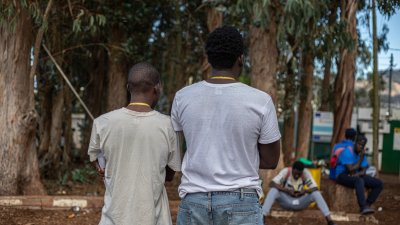
Ousmane, 26 years old, and Bai, 27 years old, were born in Gambia, the smallest country in continental Africa. Both grew up in villages in the Lower River Division, located south of one of the longest rivers on the entire continent, the Gambia River. Before they were born, their destiny was already sealed. Gambia is one of the poorest countries in the world, also the African country with the highest per capita rate of irregular migration to Europe.
The impoverishment of its population, especially in rural areas, has made emigration one of the economic engines of the country, the African country, due to the remittances that its emigrated compatriots send to their families and loved ones who remain in the territory. Faced with this reality, the possibility of migrating is the only future alternative perceived by its young people.
"It was a very hard journey, we were four days without eating, with body aches and drinking salt water," says Ousmane in Wolof, his mother tongue, during a conversation with La Voz. The two young men traveled from Gambia to Guinea in mid-September and from there they embarked together on a cayuco until they reached the Canary Islands. Ousmane's route, who dreamed of reaching Barcelona, has already continued to Madrid, but Bai is still waiting for his turn in a migrant camp in Tenerife.
Gambian is the second most frequent nationality among the survivors crossing the migratory route to the Canary Islands, only behind Senegalese, according to Frontex data collected by the UN Refugee Agency, with figures up to August 31. Behind Senegalese and Gambians, Moroccans and Malians are added.
The majority of migrations from Gambia occur from the most rural areas of the country, where employment opportunities for young people are very scarce. This is the case of Ousmane, who was a carpenter in Gambia, but did not earn enough to live and support his 20 siblings. His father married twice, as polygyny is a common practice in the country, and the money was not enough for the whole family. While Bai dreamed of studying at university, at nineteen he had to stop his education, driven by the need to find a livelihood for his family. Although he was a merchant in his country and had an animal farm, the money was also not enough.
Both arrived in the Canary Islands last September 23. A month after their arrival, Bai still shows traces of wounds on his legs and the marks the sea left on his skin. Nine days in the Atlantic Ocean took their toll and pushed him to go to the hospital upon disembarking.
Once on the southernmost island of the archipelago, the two were transferred to the Emergencia de Las Raíces reception facility in Tenerife, where they lived with other young migrants rescued on the coasts of Lanzarote and La Graciosa. Just in the same week this interview was being written, Salvamento Marítimo rescued in El Hierro a pirogue from Gambia with at least four deceased people, including a baby.
The backways and the danger of the Canary route
The migratory route to the Canary Islands is one of the deadliest in the world, but the danger is not only at sea. Sub-Saharan people trying to reach European borders also face dying in the Sahara desert or being kidnapped and forced into slave labor in Libya, as exemplified by the research Why do people migrate irregularly? Evidence from a lab-in-the-field experiment in West Africa, conducted by the Gender Department of the World Bank Group and the University of Lisbon.
For Bai, the danger of the journey did not come as a surprise; in his country, these trips to Europe even have their own term, they are known as "backway," referring to the back door as a way to enter the continent. While studying in Gambia, he never imagined he would end up embarking on a wooden canoe towards Spain.
Bai explains that, like many other companions, he knew the risk of dying at sea, but the economic situation in his country and the lack of opportunities pushed him to accept that possibility. Gambian researcher Tijan L. Bah and researcher Catia Batista warn in the aforementioned report that even though the Gambian population "overestimates" the risk of death on irregular routes to Europe, the intention to embark does not decrease. In fact, cases of compatriots who succeeded in their journey further increase their predisposition to migrate.
To embark for the Canary Islands, Bai and Ousmane had to pay 785 euros per person, approximately 65,000 dalasis, the local Gambian currency, a sum they did not have to pay in full. They made the payment to a contact who assured them he had a boat that would take them to Europe.
"We have given up asking for asylum," says Ousmane, who recounts that the reasons that led him to leave his home were economic. Both Bai and he formally renounced applying for international protection in Spain a few days ago, a legal mechanism that allows migrants to seek refuge if they are fleeing countries in conflict, are victims of violence or discrimination, sexual exploitation or torture, or have been forcibly recruited.
Despite not meeting the requirements to be granted refugee status, both are economic migrants and their goal is to find employment in Spain where they can "progress" and live peacefully. "I am a country boy who believes in hard work and responsibility," Bai concludes.


Add La Voz de Lanzarote as a preferred Google source.
Stay informed with the latest current news.