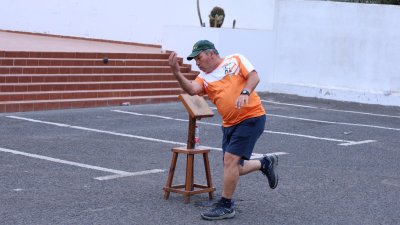
Continuing with the traditional handball game, Tiagua celebrated last Saturday, September 5, the XLVIII Partida Festas del Socorro 2026, in which the collectives of Tiagua, Soo, and Teguise participated, as well as other young people interested in learning and knowing this traditional sport.
In this edition, the participation of handball players has been especially noteworthy. The increase in participants coincides with the return to the town of some young students who have finished their studies and have returned to Tiagua.
Also participating, for another year, were the Physical Education teachers Darío and Inma, who are bringing this sport to their institutes and making their own "botes" (balls) themselves.
The game also featured the participation of two sons of David, a player from the Soo team. It had been some time since two generations were seen participating together in the ball game, the name given to the "cacha" (court).
This year, the great "botador" (server/thrower) from the Soo team, Mingo, could not participate due to injury. However, Óscar Betancort was able to observe him as the "botador" for the Tiagua team, after the teachings received in last year's edition.
The memory of handball in Fuerteventura
One of the particularities of this edition was the accompaniment of the septuagenarian Marcos Pérez, a native of El Cotillo (Fuerteventura), who witnessed the match held in El Cotillo in the seventies, when players from Lanzarote traveled to Fuerteventura to give an exhibition in Puerto del Rosario, Corralejo, and finally, in El Cotillo.
That match ended at Mariquita Hierro's house, where her famous grouper fish soup was tasted.
The modality practiced in Fuerteventura, called "juego del bote" (game of the ball), is different from the handball of Lanzarote, although there are few differences between the two. Their origins, however, have the same root: the "juego a largo" (long game), which was practiced in peninsular Spain and in different European countries.
This modality was practiced until the years of the Civil War of 1936 in a large part of the Spanish geography, including, among other places, the Siege of El Cotillo.
Commitment to a meeting between Lanzarote and Fuerteventura
Returning to the XLVIII Partida, it should be noted that the match was followed by a large audience and served to highlight the commitment to organize a handball event in Lanzarote, with teams from Fuerteventura and others from Lanzarote.
The body responsible for organizing it will provide details of this future meeting. The handball collective of Lanzarote wishes to express, from this moment on, its commitment to participate.
The Order of the Lanzarote Cub was taking photographs during the game. As is customary, anyone who wanted to participate had the opportunity to join the game to learn, as the interest in these games is not solely in the result, but, above all, in the work of rescuing and transmitting this traditional game.
A game that has documentation on the island of Lanzarote since 1596.
Likewise, the collective wishes to thank the photographer Sergio Betancort for, once again, having selflessly taken photographs of the game.
Until the next game.
"Said houses adjoin one another and houses of the said Tomé Rodríguez, who inherited from Alonso de Jerez Cardona and the Real street which is next to the Pelota game, as evidenced by the deed granted by the said Blas de Fuentes before Manuel Vázquez Botello, dated in Lanzarote on October 3, 1596."

Add La Voz de Lanzarote as a preferred Google source.
Stay informed with the latest current news.