
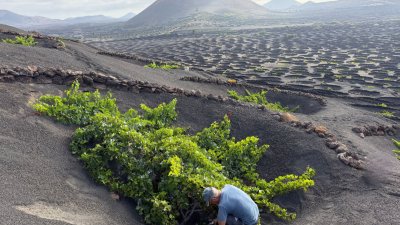
The processing of the Advance of the Special Plan for the Protected Landscape of La Geria constitutes a decisive opportunity to ensure the future of Lanzarote's most valuable cultural landscape. However, protecting La Geria cannot consist solely of imposing new prohibitions. The Plan must guarantee the continuity of the agriculture that created this territory, provide legal certainty, and fairly distribute the burdens and benefits derived from its conservation.
La Geria is a landscape built over generations. Its pits, corrals, walls, ash coverings, paths, wineries, and cellars are the result of the effort of farmers who learned to cultivate in extreme conditions. If agricultural activity disappears, the landscape that is intended to be protected will also be lost. Therefore, any planning must begin with an elementary idea: conserving La Geria requires keeping it meticulously cultivated.
The first step must be to clearly explain which territory is being planned. The designation Protected Landscape of La Geria encompasses areas with their own geographical, historical, and social identity, such as Masdache, sectors of San Bartolomé, Conil, and La Candelaria. The document must justify its boundaries, identify the affected properties and settlements, and offer accessible cartography that allows any owner or resident to understand the consequences of the Plan.
It is also essential to clarify the current legal regime. The accumulation of regulations, territorial instruments, and years of delay has generated doubts that citizens are not obliged to resolve on their own. A specific legal report must explain which provisions remain in force, what the situation is for existing uses and buildings, and how the Special Plan will be coordinated with island and municipal planning.
Furthermore, protection must be applied equitably. Those who have conserved their properties, maintained agriculture, and respected the law cannot end up bearing greater restrictions than those who acted outside the rules. It would be particularly unfair for certain irregular constructions to obtain recognition, expansion possibilities, or economic advantages while other buildings were demolished for similar infringements.
The Plan cannot convey the message that non-compliance is more profitable than respecting the law. Any treatment of irregular buildings or activities must be based on objective, transparent, and legally founded criteria. The consequences for those who suffered demolitions must also be examined, and, where legally appropriate, it must be determined whether there is patrimonial liability or a right to compensation.
The zoning must also distinguish between the landscape heart of La Geria and the peripheral areas. Not all areas present the same values, fragilities, uses, or problems. Protection must be adapted to each reality through rigorous zoning, without imposing more severe restrictions on the perimeter than on the area of greatest value, nor allowing transformations in the latter that are incompatible with its agricultural character.
Another essential issue is the role of wineries. The regulation should not consolidate dominant positions in the purchase of grapes, production, sales, or complementary activities. Expansions and uses arising from non-compliance cannot become competitive advantages. At the same time, small farmers and traditional wineries need proportionate ways to produce, process, and market their products.
Authorizations must consider the link with local production, landscape integration, the impact of facilities, agricultural employment, respect for legality, and effective contribution to conservation. It is also advisable to specify the regime for shops, tastings, restaurants, and other complementary uses to avoid arbitrary interpretations.
Agricultural land, volcanic sand, and traditional structures require effective protection. The Plan must prevent unauthorized extractions of rofe, indiscriminate digging of trenches, and alterations that degrade cultivation systems. It must also establish restoration programs for walls, pits, zocos, and sandy areas, as well as surveillance measures against incompatible or potentially invasive plant species.
Rural and agricultural settlements cannot become a way to extend urban sprawl either. Nuclei like El Islote or Masdache must preserve their historical relationship with the countryside. Isolated constructions typical of traditional farms —dwellings, warehouses, stables, wine presses, wineries, or threshing floors— must be inventoried and valued for their age, legality, state of conservation, and real connection with agriculture.
All this effort needs funding. It is unreasonable for the costs of preserving a landscape that benefits all of Lanzarote to fall exclusively on farmers and landowners. La Geria is one of the great references of the island's tourist image, so a part of the wealth generated by tourism must return stably to those who maintain their crops and traditional elements.
The Plan needs an economic report with a budget, timeline, funding sources, and multi-year commitments. It must also assess carrying capacity, prevent new accommodations and events incompatible with the space, and study tax incentives for farms that bear higher costs due to climatic conditions and landscape obligations.
Lanzarote's viticulture endures exceptional production conditions due to drought, wind, the cultivation system, farm fragmentation, and obligations arising from landscape protection. Uniform tax treatment may ignore these higher costs and environmental services. Therefore, although the determination of tax rates partially exceeds the specific content of the Special Plan, the document must acknowledge the problem and promote, before the competent administrations, the review of net yield rates applicable in objective estimation and the creation or application of corrective coefficients for farms located in protected landscapes.
Two practical measures are especially urgent. The first is to guarantee stable, affordable, and high-quality irrigation water. Any regenerated water will not suffice. Volcanic soils, local varieties, and the risk of salt accumulation require agronomic and sanitary parameters equivalent to those of drinking water in those components that may affect cultivation. This strategy must, in any case, respect the regulations of the Lanzarote Wine Regulatory Council.
The second measure corresponds to the Experimental Agricultural Farm of the Cabildo. This institution should promote an annual program for the selection and production of rooted cuttings of traditional varieties, with sanitary and varietal identity guarantees. The cuttings, prepared in bags for transplanting, could be delivered free of charge to winegrowers during November and December, coinciding with the most favorable period for their rooting, and accompanied by technical advice.
La Geria does not need a document limited to pointing out what cannot be done. It needs a true management tool that protects the territory, supports those who cultivate it, restores degraded areas, and guarantees equality before the law. It needs transparency, funding, adequate water, plant material, and opportunities for small farms.
The landscape of La Geria will not be preserved by turning it into a static picture. It will be preserved as long as there are farmers capable of working it and dignified conditions to continue doing so. The Special Plan must recognize this reality and place agricultural activity at the center of all its decisions.


Add La Voz de Lanzarote as a preferred Google source.
Stay informed with the latest current news.