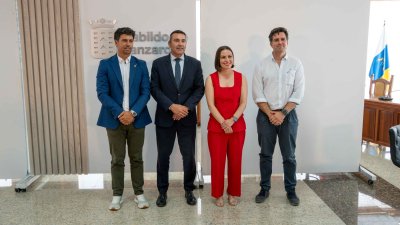
The Cabildo of Lanzarote and La Graciosa has presented this Friday the Cultural Heritage Route in Arrecife, a project promoted by the Historical Heritage Service and financed by the Directorate General of Culture and Cultural Heritage of the Government of the Canary Islands, which proposes the creation of an urban itinerary aimed at connecting some of the most relevant historical buildings in the island's capital.
The event, held in the Plenary Hall of the island institution, was attended by the president of the Cabildo and Minister of Historical Heritage, Oswaldo Betancort; the Minister of Universities, Science, Innovation and Culture of the Government of the Canary Islands, Migdalia Machín; and the architect Antonio María Zamora, author of the preliminary draft. Likewise, the councilor for Urban Planning of the Arrecife City Council, Maciot Cabrera, was present.
The initiative includes a pedestrian route of just over one kilometer that will link Casa Fajardo, Los Cabrerones, and El Mercadillo, buildings recently acquired by the Cabildo and intended to house museum centers and interpretation spaces, along with other complementary uses.
The president of the Cabildo of Lanzarote and La Graciosa, Oswaldo Betancort, highlighted that “this project allows us to understand heritage as an element that connects the history of Arrecife with its present and its future. It is about recovering historical buildings, integrating them into the life of the city, and turning them into spaces open to the public”.
For her part, the Minister of Culture of the Government of the Canary Islands, Migdalia Machín, pointed out that “Arrecife preserves in its streets, in its buildings, and in its public spaces a fundamental part of Lanzarote's identity. This project allows us to recover the essence of old Arrecife, connect enclaves that are part of the collective memory, and bring that legacy closer to new generations”.
She also highlighted that “the collaboration between the Government of the Canary Islands and the Cabildo has made it possible to promote a project that combines heritage conservation, landscape, and culture, offering a comprehensive vision of urban development”.
In the same way, the councilor for Urban Planning of the Arrecife City Council, Maciot Cabrera, insisted that “the modernization of the capital cannot be understood without the recovery of its heritage. The path towards a more attractive city also involves protecting and giving visibility to the spaces that are part of our collective memory”.
During the presentation, the Lanzarote architect Antonio María Zamora, designer of the cultural heritage route, explained that the document analyzes aspects related to urban mobility, street furniture, vegetation, lighting, pavements, and party walls, incorporating aesthetic improvement proposals for the urban environment inspired by the traditional architecture of Lanzarote and the artistic work of César Manrique.


Add La Voz de Lanzarote as a preferred Google source.
Stay informed with the latest current news.