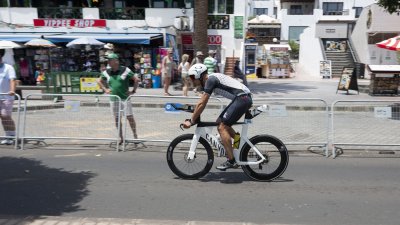
The Haría City Council expresses its "opposition to the usual route of the bicycle segment of Ironman Lanzarote and to the road closures it implies for the municipality, as they leave towns isolated for more than six hours and cause significant difficulties for the daily lives of its residents".
The institution considers that the celebration of a sporting event cannot be maintained, edition after edition, without addressing the consequences that its route generates on local mobility and economy.
This position comes after the Cabildo of Lanzarote, through its counselor, rejected the two alternatives proposed by Haría. The City Council had proposed studying a modification of the route that would allow closures to be concentrated on the LZ-10, avoiding simultaneous impact on other communication routes in the municipality. As a second alternative, it had proposed moving the swimming segment to Arrieta, accompanied by a reorganization of the race that would allow the north of the island to also participate more directly in the activity and the benefits associated with the event.
Given the refusal to consider these proposals, the City Council maintains that "it is not acceptable to maintain the usual circuit as the only option, again transferring the consequences of prolonged closures to the population of Haría without offering a solution that reduces their harm".
"Haría is not against sports or the celebration of Ironman, but against a route that leaves our towns isolated for more than six hours and which they intend to maintain without considering the alternatives we have proposed," states the mayor of Haría, Alfredo Villalba. "Defending this race cannot mean neglecting our neighbors," he emphasizes.
The institution recalls that the restrictions do not only affect those who wish to travel for leisure. They also condition arrival at work, family obligations, access to businesses, and the provision of daily services. Therefore, it maintains that informing about the closures in advance, although necessary, does not solve the underlying problem when there are no effective alternatives to enter and leave the affected areas for a large part of the day.
In the economic sphere, the City Council warns of the consequences for the municipality's shops and restaurants, which see a limitation in the arrival of customers and access for workers and suppliers. Haría questions invoking the general economic impact of the event without also considering the establishments that suffer losses in activity due to traffic restrictions, and denounces that these damages are repeated without specific compensation.
“You cannot talk about the benefits of an event for Lanzarote and ignore what happens in the towns that bear its greatest restrictions because our shops and restaurants are also part of the island's economy,” he adds. “It is not reasonable to ask them to bear the consequences every year without changes to the route or measures to compensate for this impact,” insists Villalba.
The municipal government reiterates that the safety of the participants must be guaranteed, but rejects that this requirement closes any possibility of studying another design for the circuit. Precisely for this reason, the alternatives proposed by Haría sought to open a negotiation that would allow the sporting development of the event to be compatible with the needs of the territory through which it runs.
Haría maintains its willingness to dialogue, but makes its opposition to the usual cycling route clear under the described conditions: the defense of its residents and local economic activity cannot be subordinated to the repetition of a circuit that does not respond to their needs.

Add La Voz de Lanzarote as a preferred Google source.
Stay informed with the latest current news.