
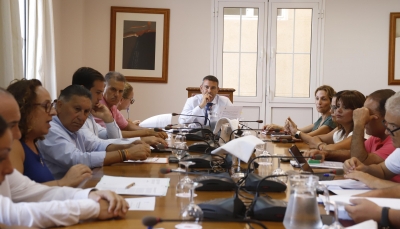
The Cabildo of Lanzarote held this Monday morning the Extraordinary Assembly of the Water Consortium of Lanzarote, a meeting where the entity participated by the Island Institution and the seven municipalities has decided to modify its Statutes to "modernize its organization and ensure a management according to the new challenges it faces".
"We will be more efficient, guaranteeing the economic sustainability of the entity," said the island's president, Oswaldo Betancort, who led the Assembly meeting, together with the municipal mayors. Another decision adopted in this forum was the designation of the new managing director of the entity, Fernando Fernández Pinazo, after dismissing his predecessor, Domingo Pérez, last September.
The final approval of the modification of the Statutes of the Water Consortium of Lanzarote is executed by virtue of the prior agreement of the General Assembly, of May of this year, without any allegation being presented during these months. As detailed by the president of the Consortium, Domingo Cejas, this modification "obeys first of all a legal requirement", included in the reform operated in the Regulatory Law of Local Regime Bases by Law 27/2013. "But", he explained, "after almost five decades of validity, given the demographic evolution of Lanzarote and La Graciosa, with the consequent increase in the number of subscribers and the need to renew the hydraulic infrastructures, the Water Consortium requires its adaptation in organizational and administrative terms, to be more effective and efficient".
In this regard, President Oswaldo Betancort has remarked that in order to satisfactorily solve the problems of the integral water cycle "it is necessary to speed up the processing of files both for drafting projects and for executing and supervising the works"; because, as he recalled, "as of today there are more than 120 actions planned to address", both in the supply networks and in purification and sanitation, as well as new network projects and supervision of works carried out by other administrations.
The statutory modification has gone ahead with the favorable votes of the Cabildo of Lanzarote and the municipalities of Arrecife, Teguise and Tinajo; and the vote against the rest.
A more dynamic Consortium
The new statutes have adapted the percentage of participation of the consortium municipalities, adapting it to the population of the same. This percentage affects the voting system since the vote is equivalent to the percentage of participation, as well as in the event that the annual budget foresees the need for the consortium entities to make financial contributions. In such case, the contribution would be distributed in accordance with the updated percentage of participation.
It should be remembered that, since the purpose of the Consortium is to improve the island service, this percentage does not affect in any way the investment and project decisions that the Water Consortium of Lanzarote decides to face in each of these municipalities.
The new Statutes foresee a regulation for the institutional relations between the Consortium and the Administrations that comprise it. And thus, the hydraulic works that require administrative cooperation or license will be applied "the urgent processing and preferential dispatch" as they are works of priority execution that are within the municipal competences.
Likewise, the Cabildo of Lanzarote assures that "to address many important future projects" that the Water Consortium has on its agenda, "the new statutes include variations in the governing bodies and in the delegation of powers, with the intention of making the monitoring of the works more agile and collaborative". Thus, the Board of Directors is eliminated given the "null virtuality that it has had during the operation of the Consortium since its origins, granting greater powers to the Assembly".
Among the decisions taken this Monday, is the creation of the vice-presidency, which will fall on the head of the Department of Water of the Island Council of Lanzarote, Domingo Cejas. "From the origins, the head of the Department of Water has assumed and led the Water Consortium of Lanzarote, although the statutes did not foresee it," they say in a press release.
On the other hand, the new regulations approved this Monday will allow that "the presidency can delegate the exercise of certain attributions to the members of the Assembly, to the Vice-presidency or to the representatives of the consortium entities". These delegations can be generic or specific, related to a specific project or issue and will be limited to the time of management or execution of the project, or until the president revokes the delegation.
This is a very useful tool because these delegations will allow, for example, the head of the Mayor's Office of a municipality in which projects are going to be executed "to assume these interventions and supervise the works, which will mean the speeding up of the execution of the same".
Extensive experience of the new managing director
In addition to updating its Statutes to improve the provision of services in the integral water cycle of Lanzarote and La Graciosa, as well as in the management of public wind farms, the Extraordinary Assembly of the Consortium has agreed to the appointment of the new managing director of the Consortium, Fernando Fernández Pinazo (1966), present today in the Assembly. There, the members of the plenary welcomed him and wished him luck in his new task, putting all of them at his entire disposal, even the four mayors who abstained today in his appointment.
Fernando Fernández Pinazo is the current head of the Purification, Distribution and Reuse Service of the Island Water Council of Gran Canaria, dependent on the Cabildo of Gran Canaria. Agricultural engineer from the University of Córdoba, he is a specialist in infrastructures, with extensive experience in the public management of desalination in the Canary Islands. During the last 28 years he has been dedicated to the world of water, in the field of public administration, from technical and management positions.
Fernando Fernández has also participated in numerous forums, seminars and congresses as a speaker. In addition, he has led the management of packaging projects such as the Adaptares Project (2014-2020) financed by the EU for adaptation to climate change and efficient water uses in Macaronesia, or the management of the Aquagran Project (2019-2023), for the implementation of ICT in the island's water system for the sensorization, monitoring and control of infrastructures (2.2M€), within the Gran Canaria Smart Island Program (Datagran), among other initiatives.
During his presence in the Assembly, Fernando Fernández has stressed his professional commitment to "provide an efficient service to the citizens, and stressed that his short-term goal will be to get water out of the chronicle of current affairs in Lanzarote, because good service should not be news, he came to say. For its part, from the Water Consortium of Lanzarote have reiterated their gratitude for the willingness he has shown to accept joining this project".
Lanzarote and its history with water
It should be remembered that the scarcity of water resources in Lanzarote led in 1964 to the commissioning of the Punta de los Vientos Desalination Plant (Arrecife), the first drinking water plant in Europe for human consumption. But the regular distribution to the inhabitants did not arrive until the spring of the following year, when the 15,000 residents of the capital of Lanzarote were the first on the island to open the tap and have a modern supply.
In the following decades, the hydraulic distribution infrastructures were created with an island-wide configuration. The difficulty of managing the island's production means based on seawater desalination plants and the complex distribution network, together with the lack of technical and economic means of the municipal corporations by themselves, led to the creation, in 1975, of the island entity called Consorcio del Agua de Lanzarote, integrated by the seven municipalities and the Cabildo of Lanzarote.
Both the island's president, Oswaldo Betancort, and the councilor Domingo Cejas, have agreed in pointing out that this agreed modification of the Statutes, together with the election of the manager, are "two important steps to continue setting the new course of this public entity and adapt it to the demands of users".
Add La Voz de Lanzarote as a preferred Google source.
Stay informed with the latest current news.


