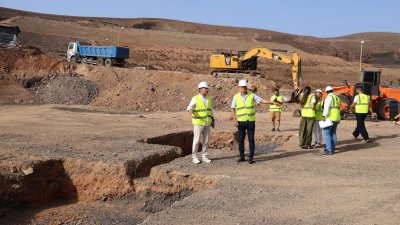
The Cabildo of Lanzarote and La Graciosa continues to advance in the modernization of the Zonzamas Environmental Complex with the construction of the new composting plant, a strategic infrastructure for the sustainable management of waste that will allow treating 4,375 tons of bio-waste annually and reinforce compliance with the objectives set by European regulations on recycling and circular economy.
The president of the Cabildo of Lanzarote, Oswaldo Betancort, together with the vice-president, María Jesús Tovar, and the Councilor for Waste, Domingo Cejas, visited the works this week to check the progress of the tasks, which are advancing according to the planned schedule since their start last June.
An investment exceeding 6.2 million euros
The works, which were awarded to the UTE formed by Elecnor Servicios y Proyectos S.A.U. and Hormigones Insulares S.L., for an amount of 6,296,768.82 euros (IGIC included) began on June 9 and have an execution period of ten months, so their completion is expected for April 2027.
The action is financed through collaboration between different public administrations. Specifically, the Government of the Canary Islands contributes a subsidy of 2,750,000 euros, another 2 million euros come from the Canary Islands Development Fund (FDCAN), while the Cabildo finances the remaining 1,546,768.82 euros with its own funds.
The vice-president and councilor for Planning and Project Coordination, María Jesús Tovar, highlighted the work done to make this investment possible, emphasizing that "collaboration between administrations and rigorous planning allow us to promote strategic infrastructures like this, which will have a direct impact on the sustainability of Lanzarote and La Graciosa. Our goal is to continue taking advantage of all available financing opportunities to execute projects that improve public services and prepare the island for future challenges."
An infrastructure adapted to new environmental requirements
As highlighted by the Councilor for Waste, Domingo Cejas, "the new plant will be a fundamental piece for consolidating the implementation of separate collection of the organic fraction that the island's town councils are developing. Having a specific facility to treat these waste materials will allow us to increase recycling rates, valorize biowaste through compost production, and significantly reduce the volume of waste destined for landfill."
The new composting plant will have the capacity to treat 4,375 tons of waste per year, of which 875 tons will correspond to biodegradable park and garden waste, which will be used as structuring material during the composting process.
The facilities will have a pre-treatment area for the reception and conditioning of the organic fraction and vegetable waste, equipped with specific systems such as bag openers, screening trommels, and pruning shredders. Subsequently, the waste will undergo a fermentation, refining, and maturation process that will allow for the production of high-quality compost for valorization.
This action is part of the priority infrastructures contemplated in the Canary Islands Integral Waste Plan (PIRCAN) and the future Insular Master Plan for Waste of Lanzarote and La Graciosa, which identify the Zonzamas Environmental Complex as the main facility for the management of waste generated on both islands.
During the visit, Oswaldo Betancort emphasized that "this plant represents a key infrastructure for the present and future of Lanzarote and La Graciosa. We are transforming the Zonzamas Environmental Complex to adapt it to current environmental challenges and equip it with modern facilities that allow for more efficient waste management, reduce landfilling, and decisively move towards a model based on the circular economy."
Betancort added that "the good pace of execution of the works demonstrates the Cabildo's commitment to rigorous planning and investments that have a direct impact on the island's sustainability. This infrastructure will allow us to comply with regulatory requirements and improve the treatment capacity of organic waste generated in Lanzarote and La Graciosa."
Add La Voz de Lanzarote as a preferred Google source.
Stay informed with the latest current news.