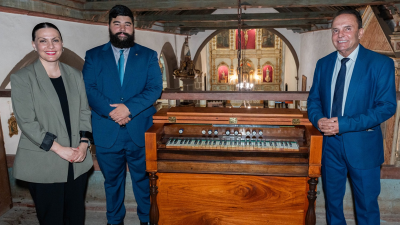
The Ministry of Universities, Science and Innovation and Culture of the Government of the Canary Islands, led by Migdalia Machín, through the Directorate General of Culture and Cultural Heritage and together with the Tinajo City Council, have joined efforts for the restoration of the organ of the church of San Roque.
This instrument dates from the decade of the 50s of the 19th century and was manufactured in Paris by the manufacturing house of Alexandre et fils, as stated in the plate that still preserves the organ in perfect condition. It is a jewel of the liturgical heritage of the hermitage that in the past fulfilled an essential function in the development of ecclesiastical life.
For the Minister, Migdalia Machín "heritage tells the story of our past, the evolution of our society and the customs of the time. It is the responsibility of the institutions to collaborate and provide the means to safeguard the memory of our people"; and adds that this intervention "is the way towards the recovery of the liturgical heritage of the island".
The restoration works have been carried out by Alejandro Jesús Rodríguez Rubio and have consisted mainly of the recovery of the coating furniture, its complements such as the lid, the lectern and the upper lid of the registers, and some reeds, preserving 99% of its original sound.
The mayor of Tinajo, Jesús Machín, thanks "the parish priest of San Roque, Francisco García, for his commitment to rescue our memory, but above all for making available to the people this instrument that opens the church to become a cultural enclave".
The model of this instrument is the Drawing Room Model by Alexandre et Fils, since this type had percussion, which is a peculiarity that only four are found in the Canary Islands, but also the one in Tinajo contains one more coupling than its equals, and it was never restored in depth, so the instrument of San Roque de Tinajo, "we could describe it as the most valuable and largest of its existing ones".


Add La Voz de Lanzarote as a preferred Google source.
Stay informed with the latest current news.