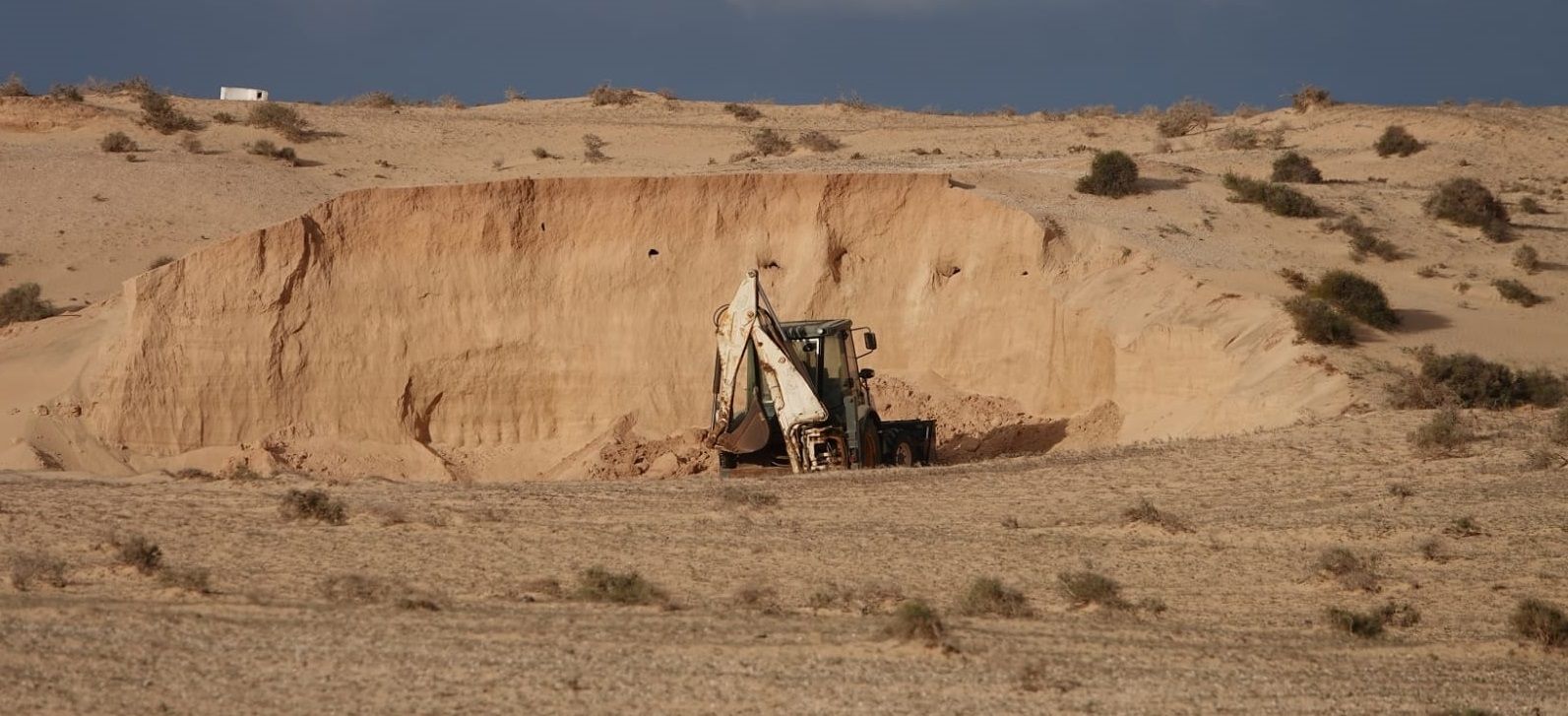
The General Directorate of Industry of the Canary Islands Government has confirmed the illegal extraction of aggregates in the Jable de Famara area, by denying an extraction authorization precisely for detecting that the activity had already started without permission. "Environmental organizations have been denouncing this activity for some time, which represents a very serious impact on biodiversity in a protected area of very high ecological value, belonging to the Natura 2000 Network," said Ecologistas en Acción, which now requests that a sanctioning procedure be opened against the company, considering that it has committed "a very serious infraction against the conservation of biodiversity".
To this end, they have announced that they will file a complaint for this procedure to be initiated, and recall that the Law foresees fines that can reach up to 2 million euros. “Environmental authorizations are not mere formalities, they are tools that allow us to anticipate the impact of a project to assess whether or not it is pertinent to carry it out. If we execute it before they authorize it, we are adulterating the entire procedure,” stressed the delegate of SEO/BirdLife in the Canary Islands, Yarci Acosta Santana. In this case, the request to exploit "Cantera Blanca" was precisely in that impact assessment phase when the Canary Islands Government confirmed that the extractive activity had begun without authorization.
"It is a space of high ecological value, recognized by different protection figures and which constitutes the most important site in the Canary Islands for the Canarian houbara, a subspecies of bird typical of sub-steppe environments that, in Spain, is only found in La Graciosa, Lanzarote and Fuerteventura and which is cataloged as Endangered," they recall in a statement. However, they point out that "this space is affected by a series of threats that put its conservation at risk." "In addition to the realization of illegal motor vehicle races and the dumping of waste or the uncontrolled transit of people and vehicles, the extractions of aggregates are among the worst affectations that are taking place," they add.
SEO/BirdLife and Ecologistas en Acción Lanzarote assure that "they are aware that aggregates have been extracted illegally for months," so in March they sent a request for environmental information to the Mining Service of the Ministry of Tourism, Industry and Commerce, in which they asked about the current status of the extraction authorizations, "given that the information on the Canary Islands Government data portal is outdated." To this day, they regret that "no response has been received from the Administration."
These environmental associations also requested in July that the authorizations that were being processed be stopped. To this end, they relied on the fact that the Plan for the Management of Natural Resources of this space was being processed and while this is happening, the Land Law and Protected Natural Spaces of the Canary Islands "prevents acts that involve a sensitive transformation of the physical and biological reality that may make it impossible or significantly hinder the achievement of the objectives of the Plan" from being carried out. However, they question that so far no response has been obtained to this request.

Add La Voz de Lanzarote as a preferred Google source.
Stay informed with the latest current news.