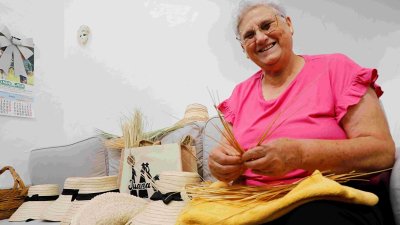
Although she ventured into the world of hats this decade, Juana María Mosegue Ortega handles her hands with the DNA of her grandmother Rafaela Ortega Sicilia, from Masdache, who made them masterfully and by commission. Juana María, connected to the land, was recognized this Wednesday by the Tías City Council as Rural Woman 2026.
The council thus celebrates the International Day of Rural Women, highlighting their essential role in society and in work related to the countryside, linking it to contact with crops and the creativity that comes from our hands. The mayor, José Juan Cruz, and the first deputy mayor and councilor for Agriculture, Nicolás Saavedra, congratulate Juana María Mosegue and share a commemorative video in which she briefly tells her life story.
“My grandmother used to cut her palm fronds from the palm trees in El Morro. She spent all afternoons making hats and rosettes. I started late with the 'empleita', as I made the first one a couple of years ago, but I work until twelve or one at night. It relaxes me a lot. The first one was this one and the second one was a 'graciosera' for my grandson, Ariday.”
Juana María Mosegue is a smiling woman with sparkling eyes who confesses her passion for the 'empleita'. She recalls that at first she just wanted to fix an old hat to wear around the house. “I removed the wheat to use it and that's how it all began,” she recalls before commenting that “the palm frond is the big struggle we have, we can't get it and it's a hassle.”
“From the moment you get the palm frond, you have to start by carefully opening it, drying it in the sun and putting it inside at night so it doesn't get damp, separating and stripping the 'pírgano', separating it leaf by leaf, removing the edge, cutting the stem and making the strips,” she explains.
Juana María was born on April 2, 1955, the fruit of the marriage of Gregorio Mosegue González, from Tías, and Victoria Ortega Ortega, from Masdache. “In my grandmother's house there was a Juana and another María, and that's why they named me Juana María,” indicates the honoree, who remembers walking from Masdache to El Islote in her early school years.
Since she was little, along with her six siblings, she helped in the fields planting chives or decapitating onions and picking grapes. “We picked the grapes, cleaned them, placed them in the 'ceretos' and my father exported them to Fuerteventura. I remember that when we were young, we hurried quite a bit because if we finished on time, we could go to San Ginés for the festivals.”
Juana María recounts that her father had an oil and vinegar shop and a bar with a high counter "and we used to jump from crate to crate to serve." "There I met my husband, Enrique de León Cabrera, whom I later married and had my two children, Pedro Baudelio and Abadesa."
Enrique comes from Soo, so Juana María also had to plant in the lands of that area of the island. "I've done everything," she summarizes, "planting everything, threshing, packing, harvesting grapes, treading in the wine press, and carrying baskets of more than 30 kilos. Nowadays we continue planting for our own consumption, some beans, corn, peppers, pumpkin, strawberries, sweet potatoes... for our own consumption."

Add La Voz de Lanzarote as a preferred Google source.
Stay informed with the latest current news.