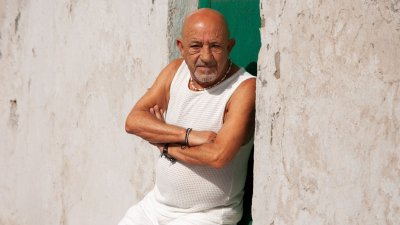
The life of José Manuel Elvira (San Bartolomé, 1955) has always been marked by one thing: being different from others at a time when what deviated from the established was viewed with hatred and contempt. Being homosexual in Francoist Spain was synonymous with hiding or repressing oneself, having to pretend to be heterosexual so that your life would not be in danger or people's gazes would not be fixed upon you. However, this man from Lanzarote chose to fight and be an example of freedom by being himself despite the insults he often received.
In an interview with La Voz, José Manuel recounts his life and how he decided to move to Arrecife to find greater freedom than he found in San Bartolomé. He does so by opening the doors of his house, inherited from his mother, one of the greatest pillars he had in his life.
Elvira says that at the age of seven he was an altar boy in San Bartolomé and admits to having had "a very beautiful childhood." "I was in church all day, on Sundays I enjoyed three masses because I went to Montaña Blanca, San Bartolomé, and so on," he reveals.
His adolescence was very similar. "It was very beautiful, like all young people from the town, I grew up a lot between the square, the church, and society, where I stepped into the first disco at 17 or 18 years old," he recalls.
"I felt different in my way of being"
José Manuel Elvira, like all men of that era, was forced to perform Spain's compulsory military service. "Perhaps I realized it during the time I was in the military because I noticed that my sexual orientation was towards men," he recalls. His time in the military brings him good memories, despite what many might think. "I would do it again, for me it was like a school. They told you that you would become a man, but in the military, you become many men if you want to," he indicates.
There he admits that he didn't learn anything because "I didn't like shooting," but he did make great friendships with whom he still maintains contact today. "There were heterosexual men who saw my sexual orientation and helped me, they protected me," he points out. At that time, having relations with a person of the same sex was prohibited and condemned, as well as frowned upon. "You imagine, they would put you directly in the dungeon, but in the end, your orientation was something you left in the air and didn't touch," explains Elvira, who highlights that the thought that always came to mind was whether "I am or am not homosexual."
However, deep down he knew he was because "I liked the touch and affection with a man, but it wasn't the same as having a sexual relationship."
This man from Lanzarote always knew, from the time he could reason, that he was not like the others. "I felt different in my way of being, dressing, walking, or gesturing, but they always respected me, which is the good thing I had at that time. Now, perhaps because I'm older, I've seen uglier things than before," he assures.
Homophobic insults in 2026
Elvira never tried to hide her sexual orientation, nor her way of being or dressing. "I was very modern at that time and I wore whatever I wanted, the biggest bell-bottoms that existed and I never hid myself because I liked to sing and do theater," he says. "I used to put on makeup, get ready, and go to work, I didn't hurt anyone. Did they look at me? Yes, because I wore ten-centimeter platform shoes, but I haven't hidden from anyone and I haven't been afraid of anyone because they haven't physically hurt me, but they have verbally attacked me, but words are carried away by the wind," he recounts.
He always received some insults for being homosexual. "They called me a faggot, but they never hurt me like the harm they do now to the youth who want to be free and be themselves," he declares. "verbally they did point fingers at me, but never mistreatment and physical violence," he continues.
Faced with these insults, the "batatero" (a nickname for someone from San Bartolomé) preferred not to respond. "Before giving the Pride speech in San Bartolomé, I was walking down the town's avenue and they insulted me, but that doesn't break me, it adds to me, it doesn't subtract because they come from ignorant people," he says.
"The important thing is to make yourself respected and to be respected, and for everyone to think as they please, as long as they don't interfere in my life because I don't bother anyone," he continues. And Elvira defines herself as "a person with my flaws and my virtues, who has made mistakes like everyone else, but I have such a big shell that I can't hurt anyone and I forgive, but I don't forget."
Regarding the increase in homophobic aggressions and hate speech in recent years, Elvira doesn't understand "why these things still happen." "Live, be happy, and let others live, let's end this now because if I want to be transgender, I am because I feel that way and I don't have to be heterosexual because you are," he defends. "When I left my house and put on some slave bracelets, I arrived at the square and they called me a faggot because they were for girls," he continues.
In this regard, he advocates for everyone to live life their own way because he emphasizes that belonging to the LGTBIQ+ community "is not an illness, a child is born with a condition that they will see as they develop and that's it, it doesn't have to be as society dictates." "I ask for respect for myself and for others, for today's youth who are coming out and have much more freedom than I had because they can go out holding hands and kissing in the square and I couldn't do that in my youth, I had to hide even if it was obvious," he claims.
Leaving San Bartolomé to find more freedom
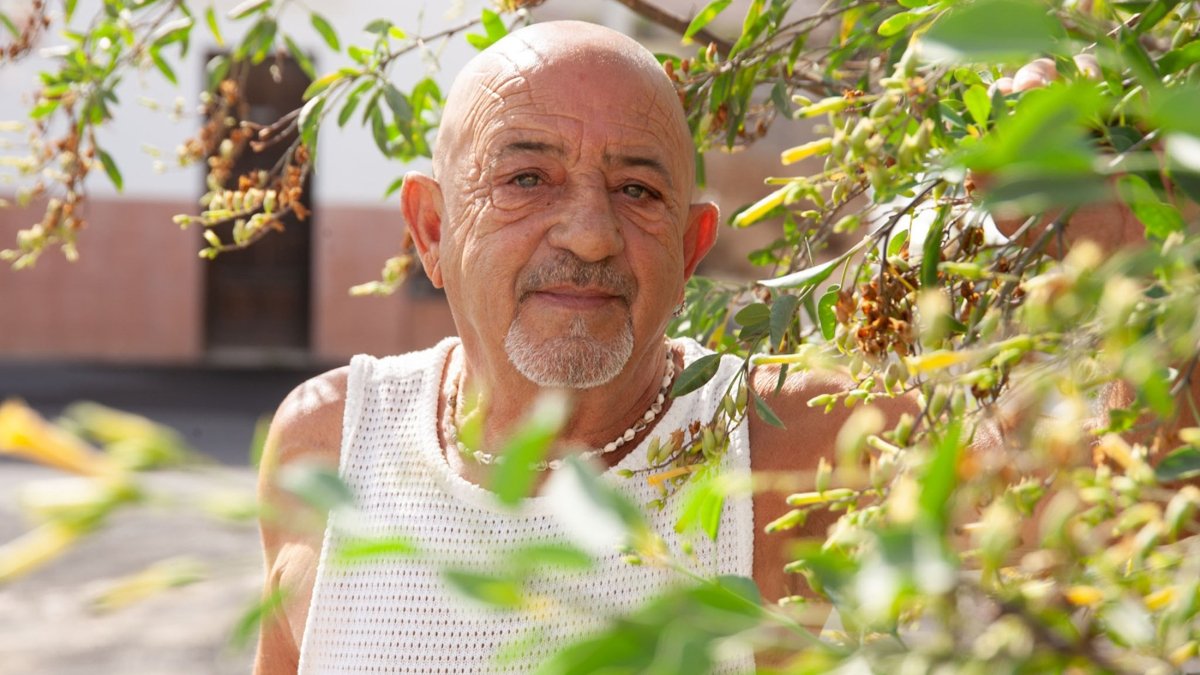
As a young man, José Manuel decided to leave San Bartolomé and move to Arrecife, where the doors to a new world opened for him. In the capital, he began working in a photography studio in Cuatro Esquinas. "That's why I say I left San Bartolomé, because once I started my photography studies and worked at the same time, I was more in Arrecife than in the town," he emphasizes.
Over time, he grew in his profession until he met a woman he fell in love with. He has spent most of his life in Arrecife, until three years ago when he decided to return due to rental prices and other personal issues.
Upon returning to the town, he settled in his mother's house, where he feels at peace and comfortable and where his neighbors are his own family. "I have felt very welcomed by my family," he confesses. His return to San Bartolomé brought joy to many of his neighbors to see him back. "I have the habit of visiting the elderly and they know me, I walk around the town and I feel like I belong, but at the same time I feel strange because I go home and I don't understand anything anymore," he comments.
Arrecife, despite not being a big city, is large enough to notice greater freedom than what might be found in a small town. "I noticed it a lot, I spent my youth in Arrecife and had my life there, I got married, I started a family, I got divorced, I continued living alone and I was also in Gran Canaria," he points out.
In the city he lived through very good times, but also very bad ones, such as one of the romantic relationships he had for four years. "I met him on the street, I picked him up from it, I gave him work, I sent him to a center (for detoxification) and we shared four years until I got tired because he wasn't getting out of where he was," he recounts. At that moment, he decided to choose his own well-being and end that relationship. "You give what you can up to a point because otherwise you sink with the person too," he indicates.
The most beautiful time that Elvira remembers from her life in San Bartolomé was when she taught photography classes in the laboratory at the City Hall. "It was for both children and adults for four years, and I felt like I was part of the town because I was doing something for it," she recalls fondly.
His family, his great support
Unlike other people who looked at him with contempt and hatred, José Manuel's family has always supported and protected him in every step he has taken throughout his life. "They have always supported me, I think my mother knew her son was different," he points out.
Of the seven siblings they were in total, Elvira assures that he was always "the most delicate and I always remember having great support because my mother always treated me with great delicacy," she recalls.
His story, an example of struggle and freedom for being oneself, led him to give the opening speech for the LGTBIQ+ Pride of San Bartolomé, promoted by the Equality Department of the City Council with the aim of fighting hate speech.
For José Manuel, this meant a lot in his life. "Of everything I have done, for me that day was a great pride to dedicate that speech to the people of San Bartolomé, and the other day I was reading it again and it still moves me because it is something that came from me and from my heart for all the youth and for the people of the town," he says emotionally.
"Just seeing my family and my friends, for me it was a very special day and it will always be in my mind's eye and in my memory," he continues.
His goal: to teach a photography workshop again
José Manuel Elvira dedicated a large part of his life to photography, and one of his best memories in San Bartolomé was teaching the rest of the neighbors this practice through laboratory workshops. Therefore, his dream now is to resume this project in the town.
"Life must be lived because it goes by very fast and I see myself at 71 years old and I think this cannot be, there must be something more and that is why I would like to offer activities like the photography workshop if they would let me," he reveals.
To recreate this space for artistic teaching "I would love to, at least for the town." "In San Bartolomé, Canary Islands Day was very beautiful because the whole school would pass by the laboratory. Having twenty children to teach them how to develop film or how to take photos, it was wonderful," he assures.
Looking back, the Lanzaroteño acknowledges being proud of how he has lived his life. "What's done is done. I have never regretted what I have done because what I did, I did with heart and love," he reflects. However, he does admit to "having done bad things and having stumbled on the same stone several times because I have been like an NGO, I have poured myself into people and I give more than I receive."
"A moment comes when you say: enough is enough, up to here and now I have to love myself and give to myself to live as best I can and with quality of life," he concludes.


Add La Voz de Lanzarote as a preferred Google source.
Stay informed with the latest current news.