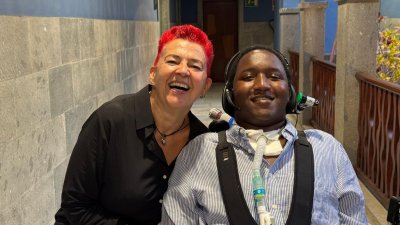
Gibbi Jallow survived a five-day journey in a pirogue from Senegal to the Canary Islands when he was 14 years old. The sea spared his life on the Atlantic Route, but weeks later a wave on a beach in Fuerteventura broke his neck against the sand and left him tetraplegic.
His story, marked by chronic pain, adaptation to a new life, and distance from his family in Gambia, is the focus of the book 'Waves like Mountains', by journalist Loreto Gutiérrez Prats, presented this Monday at Casa África, in Las Palmas de Gran Canaria.
The author explained to journalists that she began researching to write about the 30 years of the Canary migratory route, but the project changed when she met Jallow through Calixto Herrera, a psychopedagogue from the General Directorate of Child and Family Protection.
"It was clear to me that it was a story that deserved to be told and that it had to be told," explained Gutiérrez, who defined the work as "calm journalism," far from the urgency of news.
The book intertwines episodes from Jallow's life – his childhood in Gambia, his dreams, his family, the pirogue journey, and his medical recovery – with some of the main milestones of irregular migration to the Canary Islands from the arrival of the first boat in Fuerteventura in 1994 to the latest migratory crisis in 2024, when more than 43,000 people arrived in the archipelago.
"His story is not just one of personal tragedy. It is also the expression of many others: those who undertake the journey, those who survive, and those who, even reaching the shore, continue to face enormous difficulties," narrates the author of 'Waves like Mountains' in the introduction of the work.
Jallow arrived by pirogue in El Hierro and was later transferred to Fuerteventura, where he suffered the accident that changed his life while playing on the beach with other minors from the reception center.
He spent two years hospitalized at the Insular Hospital of Gran Canaria and currently resides at the comprehensive care center for people with special needs Ciudad San Juan de Dios, in Las Palmas de Gran Canaria.
Calixto Herrera, who met him during an emotional support program at the hospital, assured that the young man is now part of his family. Jallow considers him his father.
Asked about Jallow's reality, Herrera says that "it is difficult": "As he himself says: 'My life is not easy', because he has to endure neuropathic pain that is chronic and there are times when the pain wins, wins the game and despair comes, sadness comes, but we are there. And there are moments when Gibbi's bravery, generosity and strength win the game."
Under one of the photographs that the book compiles, Jallow, who due to his difficulty speaking has not addressed the press today, says: "I know I will never walk again, but sometimes I have to try hard not to think about it."
The deputy counselor of the Cabinet of the President of the Canary Islands, Octavio Caraballo, who was also one of the pieces of the puzzle for Loreto Gutiérrez to learn the teenager's story, has stated that stories like Gibbi's help to show the realities that migrants face.
"In his very dramatic case, because he becomes a quadriplegic in Fuerteventura, alone, without his family, although with a brother who lives here, and we thought it was appropriate for that story to be known," he added.
Caraballo pointed out that the book, in addition to interleaving Jallow's story with the story of the 30 years since the arrival of the first boat to the islands, also alludes to Canary Islanders' migrations to America.
"We are proud of the epic of our grandparents' journey and, on the other hand, when we refer to current migrations, we use another type of perspective, and we believe that that perspective cannot be lost," he pointed out.
Gutiérrez recounts in the introduction that the title comes from a phrase spoken by Jallow himself one afternoon from his bed at the Guttmann Institute of Neurorehabilitation, in Barcelona, "while describing the journey between sea walls that to his eyes looked like mountains."
The author assures that the book could continue to be written indefinitely "because Gibbi's life, like the course of the Atlantic migratory route, is written in the present continuous."
And it is that, he concludes, "the story told here does not end on the last page, it only stops at a bend in the road."

Add La Voz de Lanzarote as a preferred Google source.
Stay informed with the latest current news.