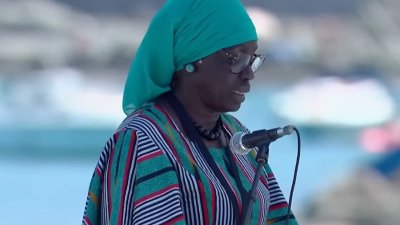
One of the African women who spoke before Pope Leo XIV in the Gran Canarian port of Arguineguín has been stuck in Senegal for almost two months waiting for a visa to return to the Canary Islands, where she has lived since 2019 and where she has two school-aged children.
The woman made the mistake of traveling to her country with the renewal of her residence permit approved, but without the document in hand yet, only with a receipt.
Known for her activism in defense of the dignity of migrants arriving on the islands in rafts and canoes and for her defense of the regularization process undertaken by the Government of Spain, Soda Niasse works as an educator in a center in Gran Canaria, to which she should have already returned.
The testimony of a young Nigerian woman, victim of sexual exploitation
In the historic meeting of Leo XIV with the migrant community and with the rescue services of the Canary Route during the first visit of a pontiff to the islands, Niasse read the testimony of her friend Blessing, a young Nigerian woman, victim of sexual exploitation networks, who for security reasons could not appear. She was the face and voice of her moving account on the Arguineguín pier.
Niasse is married to a Canarian worker whom she met in Senegal and with whom she moved to live in Las Palmas de Gran Canaria seven years ago. First with a temporary visa, but since 2021 she has had her documents regularized in Spain.
This summer, with her residence permit recently renewed, but without the physical card in her possession (only with a receipt that certified that it had been granted and was being printed), the young Senegalese woman traveled to her country. It was the first time in two years that she had returned to visit her relatives, so her children flew with her.
To leave Gran Canaria, the children's Spanish passports and her Senegalese passport were sufficient; enough to enter Dakar.
Niasse believed that with the receipt for the residence renewal she could return without a problem; but, when she wanted to return to Gran Canaria, on July 28, she was denied boarding access.
"I explained that the same Immigration Office that had given me the receipt was the one that had certified my regular administrative situation in Spain, but it was no use. I had to remain in Senegal and apply for a return visa at the Spanish Consulate in Dakar," she explains.
As the days passed, she decided to send her two children to Gran Canaria with a friend, so they wouldn't miss the start of the school year. On the island, the children are under the care of their father, who works night shifts, and they are worried because they miss their mother and think something has happened to her that they are not being told.
When she applied for the visa to be able to return, Niasse was told that the process could take up to 15 days. "However, it's almost two months since I submitted the application and I still haven't received any response or explanation," she laments.
"To this day, I am still in Senegal, waiting for a response from the Consulate, even though my administrative situation in Spain is regular and my new residence card is valid until 2031," she assures.
From the islands, the Federation of African Associations in the Canary Islands (FAAC), with which she collaborates, is also trying to help her and has brought the case to the attention of the Government Delegation.
The Equatorial Guinean sociologist Teodoro Bondyale, secretary of the FAAC, confesses that the predicament his friend has found herself in has him "talking to himself." "Soda has been the champion of the fight for the regularization of migrants in the Canary Islands and this happens to her... In the blacksmith's house, a wooden knife!", he laments.


Add La Voz de Lanzarote as a preferred Google source.
Stay informed with the latest current news.