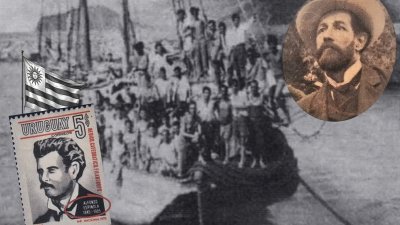
Throughout its history, Lanzarote has been an island where living, or rather surviving, became one of the toughest challenges due to its aridity and lack of resources. This situation, which caused great famines from the 17th century onwards, forced thousands of Lanzaroteans to emigrate to other parts of the world such as Cuba, Venezuela, Argentina or Uruguay in search of better living conditions. Uruguay received the former islanders with open arms, who founded cities and contributed to the country's development after fleeing, on many occasions, on clandestine ships.
In the year 1810, and before the country achieved independence, nearly 3,000 Lanzaroteans had already emigrated to Uruguay in search of new opportunities. The main reason that led the former islanders to abandon the island were the great famines that reigned on the island.
"People who had gone to Uruguay had contacted Lanzaroteans saying that life was good there and that there were opportunities to settle," explains Francisco Hernández, chronicler of Teguise, who has been investigating for years the documents in the Municipal Historical Archive that record these journeys between Lanzarote and the Latin American country. "Lanzarote is the island with the most connection to Uruguay," he assures.
One of the ships that set sail from the port of Arrecife with a stopover in Tenerife with hundreds of Lanzarotean peasants to Uruguay was La Luisa in 1810, a ship belonging to the merchant Francisco Aguilar y Leal. Another ship that also transported Lanzaroteans to the South American country was the Silveira in 1813, with nearly 370 Lanzaroteans on board.
Clandestine ships in the face of Lanzarotean desperation
Many of the Lanzaroteans who were forced to leave their land behind due to the hardships they suffered had to do so irregularly on clandestine ships.
Those who left legally for America had to do so by filling out what were known as comendaticias, official embarkation authorizations that were requested from the town councils and were used to emigrate legally from the Canary Islands to the American continent.
However, the large number of Lanzaroteans and other Canarians who were emigrating led the authorities to prohibit islanders from leaving the Canary Islands. "There was so much movement of emigrants to America that the Government said it was going to prohibit departures because the islands were going to become depopulated," says Francisco Hernández.
In the 17th century, the population of Lanzarote was around 14,000 people, but nearly 3,000 Lanzaroteans emigrated by the early 18th century. From 1790 to 1906, more than 12,000 Lanzaroteans emigrated to Uruguay.
Thanks to the work of History professor Julio Hernández, one of the most important Americanists at the University of La Laguna, 32,500 "comendaticias" from all over the Canary Islands were gathered, half of which have been published in three parts. "Cuba, Venezuela, Uruguay, and Argentina have accessed these books and they are available on their official websites as a resource for descendants of Canarian emigrants to search for their relatives," notes the chronicler.

Lanzarote, a land ravaged by hunger and misery
There were many reasons to leave Lanzarote behind, but the main ones were the hunger and misery that mercilessly plagued the island and its inhabitants. According to the chronicler, there is an account from 1778-1779 that states that "the inhabitants of Lanzarote were dying of hunger and walked along the roads to see if they could find any dead animals like horses to devour."
These hardships continued on the clandestine boats they traveled on to America because "they filled the boats with more passengers than they should have carried."
In fact, an act from the Provincial Council dated February 14, 1837, records these clandestine voyages: "The shameful traffic of negroes seems to have transferred to the Canary Islands with the continuous immigration of its inhabitants, who, hounded by hunger and misery, find themselves in the dire necessity of throwing themselves into the sea in search of sustenance and agreeing to or allowing themselves to be transported, just like those piled up to a number of 600 or 700 in a small vessel like that of Antonio Morales from the island of Lanzarote."
These journeys could last several months, and when there was bad weather, the ships would get diverted from their route and end up in another country. "One of them, loaded with Lanzaroteans, ended up in Brazil, and there the tinajero Beato Jacinto Vera was baptized, who would later become the first bishop of Montevideo and is considered the father of the Catholic Church in Uruguay.
The arrival in Uruguay
The people from Lanzarote who emigrated to Uruguay were one of the pillars that supported and helped the country grow. According to chronicler Francisco Hernández, who has researched some documents, Uruguayan authorities sent letters stating that "they preferred them to be from Lanzarote or Fuerteventura because they knew how to work the land".
For example, the reviewed documentation reveals that from 1810 to 1830, more than a thousand residents from Tinajo alone emigrated to Uruguay.
Once in the Latin American country, the odyssey began to work or pay for the trip there for those who had no money. "There were ship captains who, if emigrants didn't have money to pay for the passage, they would take them but they had to work later on the landowner's fields with an agreement until they covered the total passage with several contracts," he points out.
"Until they finished paying for the passage, they were like slaves on the estate, they had to live in warehouses, but there were also families who were established there and dedicated themselves to welcoming the migrants who arrived," he continues.
During a visit to the Uruguayan city of Canelones, Hernández confirmed that there were more than 1,100 descendants in the country of the Espínola family from Lanzarote. "In the cities of Canelones, San José, and Las Piedras is where the doctor from Villa de Teguise, Alfonso Espínola, who is considered a national hero, was located," he notes. Furthermore, his daughter, María Espínola, is considered "the first teacher who, riding a donkey, went to teach in schools in the countryside and is considered the first rural teacher of Uruguay".
Such is the union between Lanzarote and Uruguay that in the town of Villa Rodríguez, a square will be inaugurated that will bear the name Islas Canarias-Real Villa de Teguise "because of how much we have helped all the residents there".
Tala, the city founded by a Lanzaroteño
The city of Tala was founded by Ildefonso de León, born in El Mojón on March 29, 1800. With the help of a group, he founded this city and created the blocks, that is, the plots of land.
Every year, according to the chronicler, a national festival is celebrated. Furthermore, there is a commemorative plaque in Tala's main square that was promoted by the Association Seeking Roots of Canary Descendants of Tala.
"This association was led by one of the descendants of the Rodríguez family from El Mojón and organized trips from Uruguay to Lanzarote, and a twinning was established with the residents of El Mojón," he explains.
Thanks to that research work on documentation by Francisco Hernández, the Historical Archive of Teguise has managed to provide answers to many descendants of Lanzaroteans in Uruguay. "We have helped 83 families obtain Spanish citizenship and since 1996 we have received 146 Uruguayans," he concludes.



Add La Voz de Lanzarote as a preferred Google source.
Stay informed with the latest current news.