
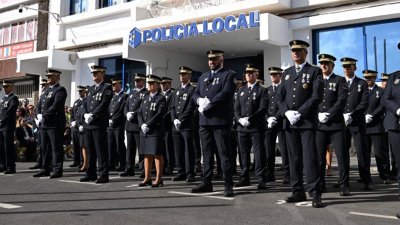
From the municipal guards who regulated traffic in the streets and worked alongside the old Recova to the current specialized units, the body's memory preserves names, photographs, and testimonies, but an essential question remains unanswered: when was it officially created.
Before surveillance cameras, specialized units, and police vehicles equipped with technology, Arrecife had a police force recognized by its officers on the street. Some walked through the city center; others regulated traffic at the busiest points, responded to incidents, notified municipal matters, or performed duties in administrative offices. Their trajectory is part of the transformation of the capital of Lanzarote, although reconstructing it requires distinguishing between what documents prove and what remains in the memory of those who knew that service.
Photographs preserved by Memoria de Lanzarote allow us to place local police officers from Arrecife during the sixties. In one of them appear Juan Domínguez, Fidel Parrilla, Santiago Palarea, and Heraclio Niz Mesa, popularly known as "el Pollo de Arrecife." The image was taken at the old Recova. Another photograph shows several officers in front of the old City Hall, now the Agustín de la Hoz House of Culture. Both are cataloged in the period between 1961 and 1970.
These images allow us to put a face to an institution whose trajectory has not always been recorded in an accessible official history. However, their dating is approximate and does not allow us to establish by itself the exact moment when the body began to function.
Heraclio Niz and a documented date: February 9, 1962
A historical reference provides a more precise date. The chronology of Memoria de Lanzarote records that on February 9, 1962, Heraclio Niz Mesa was appointed "permanent municipal guard" by the Examining Board. The record refers to the weekly newspaper Antena, issue 444, published on February 27 of that year, on page 5 of which the information appeared.
The data shows that in 1962 municipal guards were appointed in Arrecife, but it does not allow us to conclude that Heraclio Niz was the first policeman in the city or that that year corresponds to the official founding of the corps. To support either of those claims, it would be necessary to locate the municipal agreement for its creation, the first regulations, or an administrative file establishing the origin of the service.
A documented appointment date is not equivalent to a founding date. The history of an institution should not be built on assumptions when municipal archives and administrative documentation still remain to be consulted.
The memories of those who patrolled the city
Oral memory provides details that hardly appear in official announcements. The testimony of Ginés Niz Fernández, recorded in an interview published in 2017, places his incorporation into the Local Police on October 1, 1970. According to his account, he began patrolling three days later, under the command of Fidel Parrilla. Niz himself estimated that he had worked for 36 years in the corps.
His memories describe a police force with very diverse tasks. Street surveillance coexisted with services related to traffic, the market, the fish market, municipal notifications, and other departments. Police activity was not limited to intervening in crimes or disturbances of the peace: it was also part of the daily functioning of a city that was growing and expanding its administrative needs.
In that testimony, a claim transmitted within the family also appears: that his great-grandfather, Elías Niz, a native of Soo, had been the first policeman in Arrecife, when the town was not yet the island's capital. It is a lead that deserves investigation, but not a fact that can be taken as proven without independent documentation.
Oral histories are essential for reconstructing the past, especially when dealing with professions whose daily lives barely appear in archives. Their value depends on distinguishing between what was directly experienced by the interviewees, memories about other colleagues, and stories passed down from generation to generation.
The names of Fidel Parrilla, Juan Domínguez, and Heraclio Niz appear linked to the first photographs located. Recovering the careers of these and other officers, verifying their full names, and ordering their entry dates would allow for the construction of a collective memory of the force without turning a partial record into a definitive historical census.
Traffic Platforms and a Changing City
Testimonies describe an Arrecife where regulating traffic required the physical presence of officers at busy intersections and access points. The use of wooden platforms to direct traffic at points like Costa Azul and the entrance to the pier, in the vicinity of Calle Real, is recalled. Instead of current systems, traffic coordination depended on the policeman's presence and his directions.
Those watch posts are also part of the city's popular memory. The platform was not solely an element from which to direct vehicle passage: it constituted a point of contact between the municipal guard and the residents, who observed his work daily and, on occasion, shared local gastronomic products with him.
From that daily relationship, a tradition is said to have emerged which, according to the memory passed down among members of the force, has been maintained for over 25 years: the traditional "sancocho" of the Arrecife Local Police, celebrated every December 28th.
The origin of the custom is placed in the old Christmases of the capital. Residents used to offer fish, wreckfish, and sweet potato to the municipal guard who regulated traffic from a platform located in front of the Costa Azul establishment, near the pier. These gestures from the citizens ended up inspiring a gathering among the officers themselves, who began to organize a meal on that same date.
Over the years, the gathering consolidated around a "sancocho" shared also with the officers' families. The celebration evolved from a custom linked to the relationship between residents and municipal guards to a get-together for the staff, associated with the memory of those who served in that Arrecife of streets and platforms.
December 28th coincides with the Day of the Holy Innocents, but the celebration is not linked to a religious motivation. Its meaning is related to the body's own tradition and to a history that its members have kept alive through this annual gathering. The sancocho constitutes an expression of professional memory and personal bonds that have accompanied several generations of local police officers.
It is also recalled that some officers wore pith helmets and that the provision of vehicles was progressively incorporated. A Renault 18 appears in memory as one of the first police cars, while an Ossa motorcycle is associated with Heraclio Niz. These are references that can guide the search for photographs, inventories, and purchase documents, although their precise chronology still needs to be verified.
These details help to understand how the service adapted to the characteristics of a port city, with commercial activity, vehicle traffic, and movement of people. Anecdotes about fights linked to port activity, incidents with fishing crews, or interventions in robberies are also part of this universe of memories. To incorporate them with specific names, dates, and circumstances, it would be necessary to cross-reference them with files, press reports, or independent testimonies.
From municipal guards to a professional structure
The evolution of the Local Police of Arrecife must also be placed within the framework of the regulatory changes that transformed municipal police forces in Spain. Organic Law 2/1986, of March 13, on Security Forces and Corps, established the state reference framework. In the Canary Islands, Law 6/1997, of July 4, regulated the coordination of local police forces, and Decree 75/2003, of May 12, developed the framework rules for organization and operation.
These provisions help explain the progressive regulation of access, training, coordination, and professional organization. They do not mean, however, that the Local Police of Arrecife was born with any of these laws: photographs from the sixties and the reference to 1962 attest to a previous presence of municipal guards.
Official bulletins allow tracking different milestones in the selection processes for municipal staff. Among the calls identified are those of 1997, 2000, and 2001. In November 2019, the Official State Gazette published a call to fill eight Local Police positions through open competitive examination.
The recent history of the force has a direct connection with the calendar of October 20th. On that same day in 2010, the Official Gazette of the Province of Las Palmas published the bases for filling fifteen Local Police positions in Arrecife, a process that was subsequently recorded in the Official State Gazette. The call constitutes a documented milestone in the evolution of the municipal staff and offers a concrete reference to recall, on this date, the trajectory of a public service that has been adapting to the needs of the capital of Lanzarote. This is not the founding date of the force, which is still pending accreditation, but a verifiable episode of its administrative history.
The years 2005 and 2012 have also been indicated as possible dates for police calls, but these references must be contrasted with the corresponding official bases and publications before being incorporated as confirmed milestones. The existence of selection processes in other municipal areas does not allow them to be automatically attributed to the Local Police.
In 2016, the bases were published to fill seven positions through open competitive examination, another reference to the administrative evolution of the force.
This succession of procedures reflects the administrative evolution of the force, although it does not automatically determine how many officers were on duty at each moment. The positions called for may be filled on different dates, remain vacant, or not immediately translate into an increase in available personnel.
On October 16, 2019, the City Council also issued a decree related to the rectification of the bases for a selection process for three officer positions. This administrative reference does not constitute a foundational anniversary nor does it allow this date to be presented as the anniversary of the force's creation.
New functions and a police station in another time
The evolution of the Local Police is not measured solely by the number of officers or vehicles available. It is also appreciated in the expansion of their workspaces and the emergence of specialized functions.
On January 13, 2023, the new headquarters of the Local Police was inaugurated in the old courthouse building in Arrecife. According to information published by the City Council, the rehabilitation involved a municipal investment of 375,000 euros. The opening constituted a milestone in the body's facilities, although the institutional presentation itself acknowledged that there were still pending needs.
In recent years, services aimed at specific areas have also been promoted. The Minors and Family Unit, which includes the Tutor Agents, works in coordination with educational centers to prevent bullying situations and protect minors in school environments. In 2026, the City Council announced the deployment of the Prevention, Mediation, and Coexistence Unit, made up of ten agents, to intervene preventively in sporting events and other coexistence spaces.
These initiatives reflect an expansion of police functions towards prevention and mediation. To assess their results, it will be necessary to consider activity reports, interventions carried out, and data that measure their effectiveness, beyond the launch announcements.
The current challenge: distinguishing available agent positions
The current staffing situation requires distinguishing between personnel providing service and positions planned in municipal planning instruments. According to the data provided for this reconstruction, the Arrecife Local Police currently has 80 officers, including agents, officers, and two deputy commissioners. This figure should be understood as data provided on the effective staff, pending confirmation with an updated personnel list.
The personnel annex of the 2026 municipal budget reflects a broader structure of planned positions, with occupied and vacant positions in different categories. In the basic category, the document lists 61 career agent positions, one on secondment, and 31 vacancies, in addition to other police categories. These budgetary figures do not necessarily equate to the number of people actually working in the force.
The difference is fundamental for assessing the security needs of the capital. Having budgeted positions is not the same as having incorporated agents, nor does the total staff equate to the number of police officers available on each shift to attend to street services.
The City Council has announced new incorporations during 2026 and the goal of exceeding 130 officers by the end of 2027. In a municipal communication, the City Council reported the incorporation of six agents and the call for another eight positions to reinforce the corps.
The fulfillment of these objectives must be verified through appointments, taking of office, and the actual staff situation. The evolution of the Local Police cannot be measured solely by announcements of new positions, but by the human resources that are finally incorporated and their availability to provide service.
The date that is still missing
The history of the Arrecife Local Police brings together names, images, testimonies, and documents that allow for the reconstruction of different stages. Photographs from the sixties, the appointment of Heraclio Niz Mesa in February 1962, and the memories of Ginés Niz Fernández provide references on the presence and daily life of the service; subsequent calls and regulations allow us to follow its administrative evolution.
To this memory are added the customs that have survived within the staff, such as the "sancocho" on December 28th, whose tradition connects the relationship of the old guards with the neighbors with a celebration shared by the agents and their families.
But a fundamental piece is missing: locating the municipal agreement that allows us to establish when the service was officially created, how it was organized in its early years, and what people initially formed it. The Arrecife Municipal Archive, the minutes of the governing bodies, personnel files, and historical press collections are the priority avenues for finding that answer.
Until that document appears, the conclusion must be cautious. The presence of municipal guards in Arrecife is documented in the sixties, but the exact founding date of the Local Police remains pending confirmation.
The memory of those who patrolled on foot, the preserved photographs, and the traditions passed down through generations allow us to recover a part of that history. The archives must complete the other part.
Documentary sources
• Memory of Lanzarote: photographs "Local Police of Arrecife I" and "Local Police of Arrecife IV"; chronology of the appointment of Heraclio Niz Mesa, February 9, 1962.
• Interview with Ginés Niz Fernández, published in 2017, with memories of his joining the force in 1970 and the police activity of the time.
• Official State Gazette: calls and references to selection processes of the Local Police of Arrecife, including procedures published in 2011 and 2019.
• Official Gazette of the Canary Islands: bases for calls for Local Police positions in Arrecife, including that of seven positions published in 2016.
• Regulations: Organic Law 2/1986, of March 13, on Security Forces and Corps; Canary Law 6/1997, of July 4, on the Coordination of Local Police; Decree 75/2003, of May 12.
• Arrecife City Council: institutional information on the inauguration of the new police headquarters, specialized units, and staff expansion objectives.
• Personnel annex to the municipal budget of 2026: planned positions, categories, and vacancies of the Local Police.


Add La Voz de Lanzarote as a preferred Google source.
Stay informed with the latest current news.