
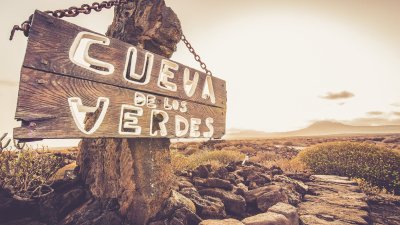
For centuries, the Cueva de los Verdes had been part of Haría's geography and the imaginary of Lanzarote's inhabitants. Its use as a refuge from pirate raids remained linked to the island's memory, and its very name referred to the family that had owned that land. However, at the beginning of the sixties, that volcanic space began to acquire a different meaning. Lanzarote was beginning to look towards tourism, and the landscape, previously considered fundamentally as territory, began to be seen also as heritage and as a possible gateway for those arriving from outside.
José Ramírez Cerdá, president of the Cabildo de Lanzarote, played a fundamental role in this process. From his institution, the transformation of certain natural enclaves was promoted with an idea that, over the years, would acquire a much greater dimension: to show Lanzarote without hiding what made it different. The Cueva de los Verdes was one of the first major trials of that strategy, and behind its transformation, there was a succession of decisions and works that allowed a volcanic cavity to be converted into a visitable space without erasing its own identity.
Jesús Soto Morales took on an essential role in the technical part of the work. The lighting posed a problem that was not simply about installing spotlights inside a cave, but about achieving lighting that would allow the cavity's shapes to be discovered without turning them into an artificial set. Soto even traveled to the Cuevas de Nerja to study other solutions and subsequently transfer that knowledge to the Lanzarote project, while Luis Morales Padrón participated in the conditioning work and the technical part of an undertaking that required very different resources from those currently available. Electricity did not reach the interior of the cave, and it was necessary to resort to a generator, the installation of which allowed the dimensions and shapes of the volcanic tube to be contemplated from a new perspective.
In that process, César Manrique's contribution was also decisive, although reducing the entire story to his figure would mean leaving out those who materially made that transformation possible. Manrique brought an artistic conception that sought to integrate the intervention with the natural space, so that the objective was not to build a stage within the cave, but to allow the visitor to walk through it and discover its forms without human intervention ending up imposing itself on them. That difference would end up being fundamental for the subsequent evolution of Lanzarote, because the project did not aim to hide the landscape under a tourist construction, but to make the landscape itself the tourist experience.
On October 5, 1963, the intervention of the Cueva de los Verdes was inaugurated. The documentation preserved by the César Manrique Foundation shows that around a thousand light points had been installed, a figure that allows us to imagine the impact that transformation must have had at a time when technical possibilities were very different from today's. But that date has a particularity that often gets left out of quick references to the history of the Cueva: the inauguration did not mean its immediate opening to the public.
We had to wait until January 15, 1964, for visits to officially begin, while during those months work continued to configure a route in which lighting, volcanic space, and atmosphere sought to build an experience different from the simple contemplation of a natural cavity. That was much more than a tourist work: it was also a declaration of intent about how Lanzarote could relate to its own territory.
The island was beginning to discover that it could turn its landscape into one of its main resources without needing to disguise it. The lava, the volcanoes, the volcanic tubes, and the arid forms that for generations had been seen as elements of a difficult land were beginning to acquire a new consideration, and the Cueva de los Verdes thus became one of the first major trials of a formula that would later spread throughout the island.
The Jameos del Agua, the Montañas del Fuego, the Monumento al Campesino, and the Mirador del Río would later arrive, among other spaces where architecture and art would seek to relate to the territory, eventually shaping one of Lanzarote's tourist hallmarks. But the origin of that way of understanding the landscape was there, underground, in an intervention that turned a volcanic cavity into a cultural and tourist experience.
On October 5, 1963, a cave became a window to the island's future.
The date becomes even more interesting when observing what was happening outside Lanzarote at the same time. The bibliography of the César Manrique Foundation records that on this same October 5, 1963, El Eco de Canarias published an article on its page 12 titled "Operation Canarias is already underway and everything necessary must be done for these islands." We cannot confirm that this piece was specifically a chronicle of the Cueva's inauguration without directly consulting the original copy, but its existence in the press of that day allows us to place Lanzarote's action within a much larger context: the Canary Islands were beginning to talk about tourism as an activity capable of transforming the islands economically.
Lanzarote was entering this new phase with a different proposal. It was not yet about large hotels or tourist developments, nor did the island that future generations would know exist. What existed was a territory that was beginning to discover the value of what it already possessed and to ask itself a question that would end up marking a good part of its future: how to showcase Lanzarote without ceasing to be Lanzarote?
The answer began to be built in places like the Cueva de los Verdes. That is why, when today this space is considered one of the most recognizable tourist sites on the island, it is easy to forget that there was a time when all of this was yet to be invented. The Cabildo of José Ramírez Cerdá made the decision to intervene, Jesús Soto sought technical solutions, Luis Morales participated in the work, and César Manrique contributed an artistic conception that would end up being decisive, while workers and inhabitants of the island made it possible to transform that space.
It was not the work of a single man, but the result of a collective idea that began to take shape underground.
On October 5, 1963, Lanzarote did not only inaugurate an illuminated cave, but a new way of looking at its territory. The island would still take years to become the tourist destination we know today, but that day the change had already begun and, perhaps for that reason, the true story of that date is not only in the lights that were turned on inside the Cueva de los Verdes, but in what those lights allowed to be seen for the first time: that Lanzarote's landscape could also become its own calling card to the world.
Documentary Sources
César Manrique Foundation. Documentation and bibliography on the Cueva de los Verdes and the development of Lanzarote's artistic and tourist intervention.
Luis Morales Padrón. Historical documentation on the conditioning and lighting works of the Cueva de los Verdes.
University of La Laguna. Academic research on César Manrique, Haría, and the configuration of Lanzarote's tourist spaces.
El Eco de Canarias, October 5, 1963, p. 12. Bibliographical reference preserved by the César Manrique Foundation: "Operation Canarias is already underway and everything necessary must be done for these islands."
Virtual Library of Historical Press and JABLE. Digital newspaper archives used for locating and contrasting historical press references.



Add La Voz de Lanzarote as a preferred Google source.
Stay informed with the latest current news.