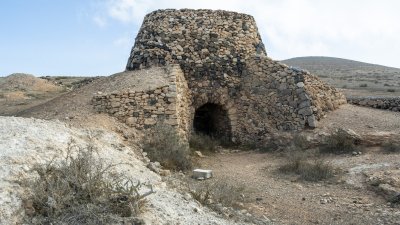
If we observe carefully as we walk through areas like Janubio, Órzola, Mala, or Teguise, we can still see some tower-shaped buildings made mostly of stone. These are the so-called lime kilns, ovens where limestone extracted from different parts of Lanzarote was burned to obtain lime, an indispensable material years ago for building houses, cisterns, or maretas.
According to research carried out in Rubicón, in the south of Lanzarote, the first signs of lime on the island were discovered in this area in one of the constructions, as explained by Paco Hernández, chronicler of Teguise. In the 15th century, ships arriving at Lanzarote later set sail from the island "loaded with lime and salt stones".
It should be remembered that one of the most important ports on the island was located next to the Janubio Salt Flats, which disappeared after being devastated by the Timanfaya eruptions. As Hernández explains, documents from the time record that ships "loaded all the stones they could," an export that continued over time well into the 20th century. "In fact, next to Cuatro Esquinas there was a warehouse where they sold the coal they brought from La Palma, and people bought lime there," he points out.
In ancient times, Lanzarote was considered the "granary of the Canary Islands" due to the quantity of legumes and cereals grown and exported to other islands and even Madeira. The island could subsist on these crops when it rained, but during the long dry months, the people of Lanzarote saw lime as a lifeline to cling to. "During these periods without rain, the only industries were lime and salt; these were the businesses people used to escape with," says Hernández.
The oldest lime kilns in Lanzarote are located in the southern part of the island, as well as in Mala, Tías, Guatiza, and Teguise, where several of them are currently preserved in good condition on Chimida Mountain. The largest lime kiln in Lanzarote belonged to Luciano Betancort, which had four mouths and was located in Chimida.
The manufacture of lime
As Paco Hernández explains, the type of lime kilns in Lanzarote were conical in shape, wider at the top and narrower at the base. These structures had a height of between three and four meters and were built with light and porous stones. The first thing that was done was to break the stone to bring them, at first, by camels, and then by trucks.
The stones were placed leaving a certain separation between them so that the flames and heat circulated and they were cooked uniformly. The stones were carefully placed and the kiln was filled to the top, an area where there was a hole through which wood was introduced to feed the fire during cooking. On many occasions, the kiln was not lit during the day, so it was done at dusk so that the heat would be less and the lime burner's work would be more bearable.
"Depending on the amount of limestone, it could take one or two days for the stone to burn, which was burned with a movement they made on the rails where the stone was falling and then water was added to finish breaking the stone," the chronicler details. Later, the stone was sifted. "From the first sifting that was done, the general lime came out, which was not sold. In the next sifting, it was done with a finer sieve and separated the white lime from the brown lime," he continues.
The brown lime was used as mortar when mixed with water, which made it a good building material for joining and fixing stones or bricks. For its part, the white lime was used to whitewash houses, that is, to paint houses white and waterproof roofs to prevent rain from leaking. The lime's capacity as a sterilizer by eliminating bacteria meant that it was also used in the interiors of cisterns or water galleries, which kept the water clean.
Types of lime kilns
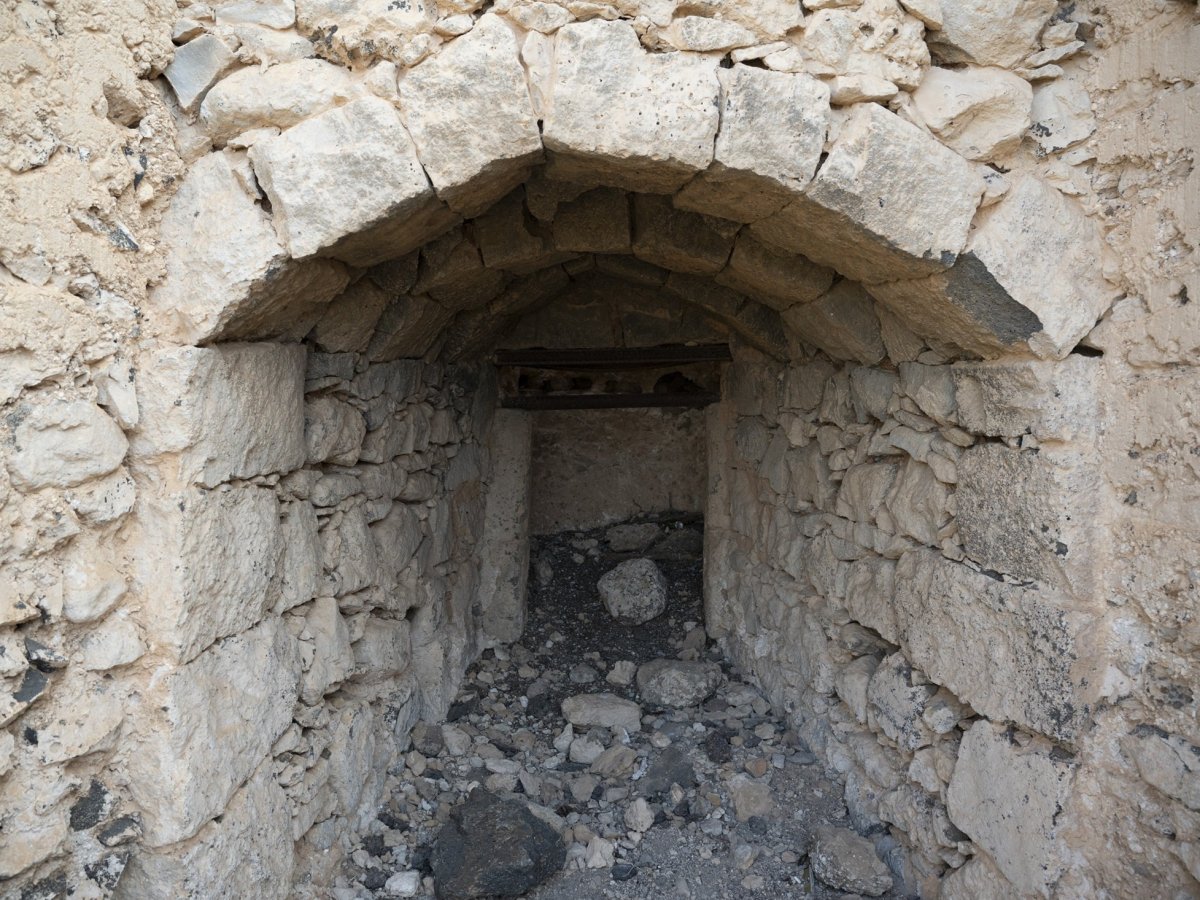
According to the document Lime and lime burners of Lanzarote collected by Memoria Digital Lanzarote, the lime kilns "were surrounded by a terrace in the shape of an embankment that reached its top, where the tube opened towards the interior and the lower part of the lime kiln. At the base there was an opening, through which the lime burner entered on foot or crouched, to place the stone inside the lime kiln."
However, not all of them were like that. On other occasions, especially in Órzola and Mala, lime kilns were built without a commercial purpose, but were created provisionally to obtain lime and manufacture houses, cisterns, or maretas. As recorded in Cal y caleros de Lanzarote and as can be observed in different areas, many of these lime kilns are today abandoned and dilapidated.
The shapes varied, as they could be cylindrical or ovoid. Furthermore, they could have a capacity of up to six cubic meters of stone.
The lime burner's work
The lime burner's work is a trade that is now part of history books. The person in charge of this work had to obtain the stone to extract the lime and the wood to burn it. Furthermore, it was hard and heavy work, as the lime burners had to withstand the intense heat of the kilns and, moreover, had to wait several days for the stone to cook and cool down.
During their shift, the lime burner was responsible for keeping the fire alive and, according to the document Cal y caleros de Lanzarote, it was characterized by being a solitary profession. Despite this, on many occasions, assistants were available to relieve the lime burner so they could rest. This work had to be meticulous and careful, as if the fire went out, days of work could be ruined.
Likewise, during breaks, the coexistence and conversations that took place helped to create cultural elements and values, which strengthened the union among the society of the time.
The threshing floors, a meeting place for the people of Lanzarote
The threshing floors are flat surfaces that were built in Lanzarote to thresh legumes and cereals, that is, to separate the grain from the straw. On most occasions, this was done with the help of animals such as camels or donkeys, which facilitated and sped up this task.
However, these threshing floors were also used as a place for celebrations for the people of Lanzarote to hold dances thanks to their completely smooth floor. "I remember that in La Caleta there was a threshing floor and they held dances there," recalls Hernández.
Likewise, the threshing floors also had other uses, such as drying figs or porretos (picones figs). "I remember seeing it at my grandfather's house and in Haría they even used dried corn stalks (millo seco) because they formed like a floor and there they would dry the porretos," he explains.
Add La Voz de Lanzarote as a preferred Google source.
Stay informed with the latest current news.