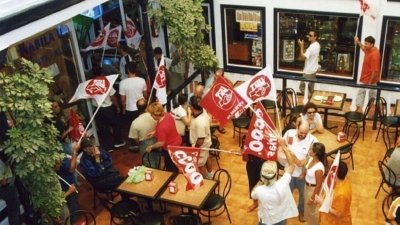
Arrecife, September 3, 1931. There were no volcanoes erupting, ships sinking, or major events that occupied the front pages of the national press. But on that day, something happened that would end up leaving a deep mark on the social history of Lanzarote: 25 workers met at the Casa del Pueblo on Miraflores street and decided to organize.
The Lanzarote Workers' Federation-UGT was born.
It was a very different Lanzarote from the one we know today. An island of day laborers, sailors, fishermen, port workers, bricklayers, bakers, carpenters, and small trades. A society in which earning a living meant, for many families, facing a daily work reality very far from the rights we consider fundamental today.
That September 3 was, in a way, the day when some of those workers understood that by uniting, they could try to change that reality.
The story had begun months earlier
To understand what happened that Thursday in September, we must go back a few months.
The workers' organization had already begun to make its way in Arrecife. At the end of 1930, the creation of a Workers' Federation was proposed, and during the first months of 1931, various trade organizations began to appear.
The drivers began to organize. Then came the shipwrights and the sailors. Day laborers, bakers, and workers from other sectors also joined.
The island was beginning to experience a social transformation.
The proclamation of the Second Republic, on April 14, 1931, also opened a new political and social scenario in Spain and also in the Canary Islands.
In Lanzarote, labor demands began to become increasingly visible. A Casa del Pueblo for a society that wanted to be heard
The Casa del Pueblo of Arrecife, located on Miraflores street, played a fundamental role in that process.
It had been inaugurated on June 5, 1931.
That building became a meeting, debate, and organization place for workers.
There, people from different trades who had previously faced their problems separately met.
The idea was simple, but at the time it had enormous significance: unity could turn individual demands into collective strength.
It was not solely a matter of politics. It was a matter of work, wages, rest, and living conditions.
The sailors' conflict
When September arrived, labor tension was especially visible among seafarers.
On August 14, 1931, the sailors of Arrecife had started a strike.
The protest came to involve about 600 workers and brought to the table demands that allow us to understand what life on board was like then.
Salary improvements, Sunday rest, and better food conditions were demanded.
It may seem surprising today, but among the demands was also the need to improve the food for workers during their days at sea.
The conflict demonstrated that the labor movement already had the capacity to mobilize a considerable number of workers.
And just a few weeks later, the organization would acquire an island dimension. Twenty-five men on Miraflores street
September 3 finally arrived.
The constituent assembly of the Lanzarote Workers' Federation was held at the Casa del Pueblo.
Twenty-five people participated in that meeting.
It wasn't hundreds. There was no crowd gathered in the streets. It was 25 men gathered in a venue in Arrecife.
But that small assembly shaped an organization that would begin to grow in the following months.
The first leadership was headed by:
Benito Méndez Tarajano, president.
Domingo Ortega Rodríguez, secretary.
Miguel Saavedra Medina, treasurer.
Three names were thus linked to a foundational moment in the social history of Lanzarote. An island that was beginning to discover the power of organizing
The Federation began to gain members.
Historical records show 114 new affiliations during 1931 and another 96 during 1932.
Among its members, we find sailors, day laborers, masons, bakers, drivers, carpenters, and workers from different sectors.
Those names and those trades allow us to reconstruct a part of that Lanzarote that often remains hidden behind the grand narratives of island history.
It was the Lanzarote of labor. That of those who went to sea. That of those who worked the land. That of those who built the houses. That of those who drove, baked bread, or worked in the workshops.
They are also part of the island's history.
And the struggle continued
The birth of the Federation did not end labor conflicts.
The sailors' strike continued for weeks.
Finally, on November 7, 1931, the protest came to an end with improvements for the workers on issues related to wages, food, and rest.
The celebration took place, once again, at the Casa del Pueblo.
A demonstration of workers went to that place to celebrate the outcome. Barely two months had passed since that meeting of 25 people.
The small organization born on September 3 began to demonstrate its mobilization capacity.
95 years later
Today, 95 years later, it is difficult to imagine that Lanzarote.
Arrecife was still a small city. The port was one of the great engines of its activity. Agriculture had an enormous weight in the island's economy, and thousands of people depended directly or indirectly on work in the fields and the sea.
The hotels that would transform the coast decades later did not exist. Tourist Lanzarote did not exist. A large part of the island we know did not exist.
But there were people who aspired to work and live in better conditions. September 3, 1931, did not change the history of Lanzarote on its own.
But that day symbolizes something important: the moment when different workers began to understand that their problems could also be faced together.
A date that deserves to be remembered
History usually preserves the names of those who held high office, led battles, or were protagonists of extraordinary events.
But there is also another history.
The one that was written in workshops, ports, fields, and humble homes.
The one that was led by people whose names have barely reached us. On September 3, 1931, 25 workers met in a Casa del Pueblo in Arrecife. Perhaps none of them imagined that this meeting would be remembered 95 years later. However, a small page of Lanzarote's history was written there. A page that speaks of work. Of organization. Of demands.
And, above all, of a word that those men knew well: Union.
Add La Voz de Lanzarote as a preferred Google source.
Stay informed with the latest current news.