
Arrecife lived then very far from the tourist image that Lanzarote would end up projecting decades later. The port was, above all, a space for work, fishing, merchandise, and communication with the outside world, and any vessel of extraordinary dimensions could become news. But on September 30, 1959, something more happened. While a vessel that seemed to belong to another world appeared at sea, in the sky of the island capital an unknown light also caught the attention of those on the coast. Two distinct events, united by the same date and preserved in the pages of the Lanzarote press.
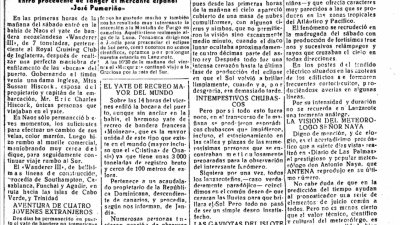
The maritime protagonist was the Moineau, a French-flagged yacht that Antena presented as the largest pleasure yacht in the world. The vessel measured 100 meters in length and displaced about 3,000 tons, extraordinary dimensions for the time and, even more so, for a port like Arrecife. The historical reference preserved by Memoria de Lanzarote comes directly from issue number 327 of Antena, published on October 6, 1959.
The news also had a social component that explained a good part of the fascination. The owner was described as a wealthy businessman from the Dominican Republic of Canarian descent. The chronicle also pointed out that the Moineau even surpassed the famous Christina, the yacht associated with the Greek shipowner Aristotle Onassis.
Historical research links the ship to Félix Benítez Rexach and his wife Lucienne Dhotelle, internationally known as Môme Moineau, a former French singer who became a high society figure. The yacht's name was not coincidental, and the couple's story was also linked to the famous Hotel Normandie in San Juan. That ship that appeared in Arrecife was not simply a large yacht: it was the floating expression of a world of international fortunes, grand voyages, and private luxury that powerfully contrasted with the daily reality of Lanzarote in the late fifties.
And then there was the sky
On September 30, 1959, according to the historical chronology of Memoria de Lanzarote, several dockworkers and some vacationers who were at the Caseta del Cable, in Arrecife, observed a luminous object of a spheroidal shape that slowly crossed the sky. The phenomenon would have lasted approximately 13 seconds. The news also appeared in Antena, number 327, of October 6, page 2.
The description is especially interesting because it comes from a journalistic source of the time and not from a later reconstruction. It does not originally speak of an extraterrestrial ship nor is there a definitive identification of the object in the located documentation. What is recorded is something much more precise and, at the same time, more mysterious: a light of spherical appearance, observed by several people, which moved slowly over Arrecife for a few seconds.
The choice of words matters. The source speaks of a luminous object and a spheroidal shape. It does not allow us to determine with certainty whether it was an astronomical phenomenon, an artificial artifact, an atmospheric effect, or any other explanation. Nor does it allow us to reconstruct today with sufficient precision the exact trajectory, altitude, or direction. Therefore, the most rigorous approach is to preserve the mystery where the documentation itself from 1959 left it.
Furthermore, it was not the first time that the people of Lanzarote had observed something strange over Arrecife. Three years earlier, on May 2, 1956, Antena had reported five bodies of spheroidal configuration and intense color that crossed the sky of the capital. According to that news, they were observed by several people around eight in the morning and the phenomenon lasted for more than two minutes.
And it would not be the last either. On April 11, 1962, the same weekly reported another episode: a large luminous object, with a white glow, was observed for approximately half an hour from Generalísimo Avenue. On that occasion, the chronicle itself suggested that it could be an American or Soviet artificial satellite.
That context is fundamental because it shows that the observations of strange lights were part of Arrecife's journalistic culture during those years, precisely when the arrival of artificial satellites had turned the sky into a new territory for public observation. The space phenomenon no longer belonged exclusively to observatories and scientists: it was also beginning to be part of everyday conversations.
But the September 30th episode has something special
In just a few hours, Arrecife became a stage where two seemingly impossible-to-relate worlds coincided. On the water, a hundred-meter giant, a symbol of international wealth that seemed alien to island life. Above the city, a luminous sphere that crossed the sky for thirteen seconds and that no one managed to identify.
The Moineau belonged to a perfectly real, though extraordinary, world: that of great international fortunes who used the Atlantic and Mediterranean routes as settings for their private journeys. The light, on the other hand, remained suspended in that much more difficult-to-explain area where observation exists, witnesses exist, and the news exists, but the definitive answer does not appear.
Perhaps that is why the coincidence is so powerful. On that September 30, 1959, Arrecife had two ways of looking outward before its eyes. One was moored to the sea and measured one hundred meters. The other appeared in the sky and disappeared thirteen seconds later.
Sixty-seven years later, the first can be reconstructed with names, dimensions, and documentation. The second continues to be exactly what the newspaper recorded: a strange spheroidal light that slowly crossed the sky of Arrecife and that several people saw before it disappeared.
And perhaps that is the true story of September 30, 1959: the day Arrecife simultaneously looked towards the sea and towards the stars.
Documentary Sources
• Memoria de Lanzarote, historical chronology of the Cabildo de Lanzarote, records corresponding to September 30, 1959.
• Antena, nº 327, October 6, 1959, page 2, news about the luminous object. • Antena, nº 327, October 6, 1959, page 5, news about the visit of the Moineau. • Historical sources on Félix Benítez Rexach and Lucienne Dhotelle (Môme Moineau) and their yacht.


Add La Voz de Lanzarote as a preferred Google source.
Stay informed with the latest current news.