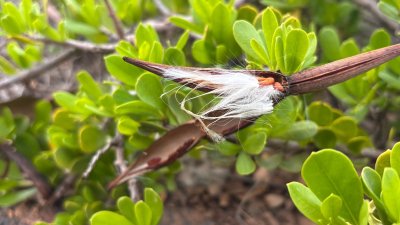
There are different native plants in Lanzarote and the rest of the Canary Islands that have had different uses and whose characteristics make them a lifeline for humans and also for the biodiversity of the islands. This is the case of the cornical (Periploca laevigata), a climbing shrub that grows throughout the island geography and whose seeds act as a barrier that prevents other invasive species such as cat's tail from germinating.
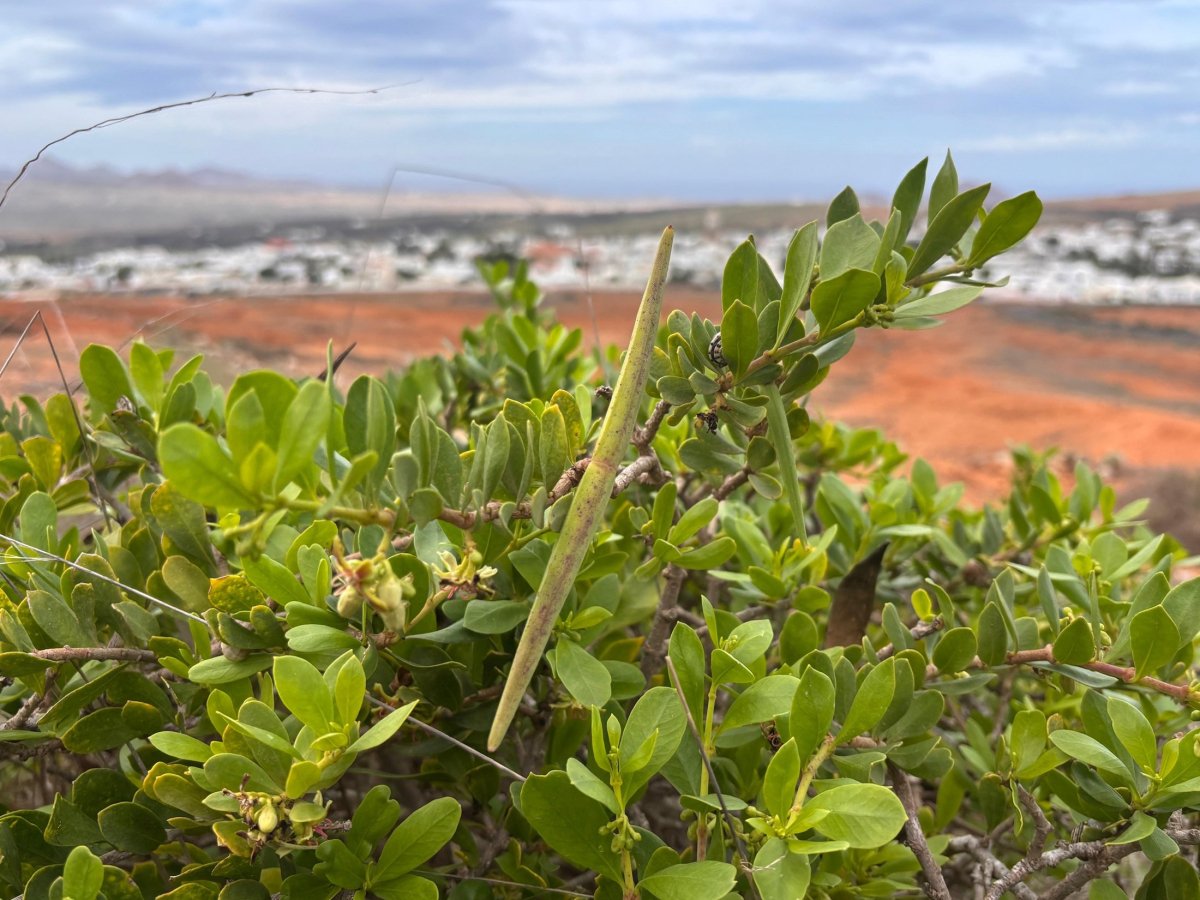
It is a plant that entwines itself with other shrubs and its branches can reach three meters in length. According to the Canary Islands Government's CanariWiki website, its leaves and stems contain a white and sticky latex and its flowers are star-shaped and green and purple. Like many other species adapted to the dry climate that characterizes Lanzarote, the cornical ends up losing its leaves in the hottest months, regrowing with an intense green with the first rains.
One of the striking curiosities is its fruit, which appear in the shape of horns that end up opening when ripe and release a large number of seeds with silky hairs that can often be mistaken for animal fur. This causes the wind to disperse the seeds very easily, allowing them to colonize a large part of the territory.
As explained by biologist and scientific communicator Víctor de León in an explanatory video on Instagram, the cornical seeds "are a defense barrier because they grow even on bare or disturbed soils due to human activity." "This allows that soil to be gradually covered with native vegetation, making it difficult for new exotic species to establish themselves," he continues.
Medicinal use
In addition to being a natural barrier against invasive species, the cornical was also used by past generations as a medicinal remedy for its multiple properties, according to CanariWiki.
Therefore, it was used in traditional Canarian medicine as a treatment for skin inflammations, irritations, and burns. Furthermore, it was also used as a natural purgative. For this purpose, the water from the infusion of its roots and barks was consumed.
Regarding burns, the cornical became a great antidote when medicines for this type of injury were not available or simply did not exist. For example, the juice from the stem was applied to burns caused by cardón latex. Growing on this species, it was quickly applied to prevent the lesion from appearing.
On the other hand, the infusion of its stems and leaves was used to clean wounds, which aided in their healing. Likewise, the seeds were used to fill pillows or cots, while the tender leaves and stems were used as fodder for livestock. In contrast, the dry branches became ideal fuel for fire.
It should be remembered that the cornical is part of the archipelago's biodiversity, so its collection is totally prohibited. Furthermore, its medicinal use is purely informative and should never be replaced by any medical treatment.



Add La Voz de Lanzarote as a preferred Google source.
Stay informed with the latest current news.