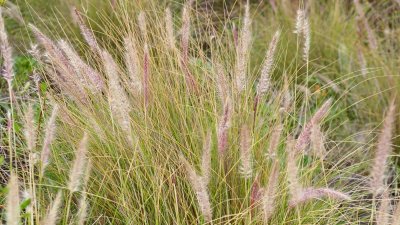
Canary Islands has about 2,500 species of flora, of which at least 700 are endemic to the archipelago. Some of these species are being affected, to a greater or lesser extent depending on each island, by the constant growth of fountain grass (Cenchrus setaceus), a species native to North Africa introduced in the fifties to the islands for its use as an ornamental plant. Its great adaptability to the environment and its easy reproduction have made it a major problem for biodiversity in the Canary Islands.
This situation, which particularly affects islands such as Gran Canaria, Tenerife, and La Palma, also harms Lanzarote although it is on early alert due to constant monitoring. On the island of volcanoes, its size and the constant work to eliminate it have kept fountain grass at bay.
This grass has been spreading at a dizzying rate for decades through different areas, as in addition to adapting very easily to almost any climate and soil, its seeds have a great capacity for dispersal, which also gives it great power to recolonize all those areas where it has already been eliminated previously. To be able to fight against it, it was included in the Spanish Catalogue of Invasive Alien Species.
Globalization puts the biodiversity of the Canary Islands in serious danger regarding the entry of flora and fauna species that can become very difficult-to-control pests. According to biologist Beatriz Fariña, "through early alert, RedEXOS tries to intercept this invasion before it becomes uncontrollable and economically impossible to eliminate." "Being islands, we are very delicate places and our habitats are not prepared for that type of species," she continues.
Seeds, its strong point
One of the characteristics that makes fountain grass so resistant and difficult to eliminate are its seeds. According to Beatriz Fariña, what makes it spread so easily is "the great production of seeds and their persistence in the soil." After falling to the ground, the seeds can remain there for more than six years with their germination capacity intact.
Furthermore, fountain grass also stands out for its resistance to lack of water. This can seriously affect the native and endemic species of the islands, as while they are suffering from drought, fountain grass continues to grow.
"It is also very tolerant of different types of soils, both rich and poor, and in the case of Tenerife and La Palma, it is already entering the undergrowth of the pine forest," Fariña points out.
Such is its resistance that it can germinate almost anywhere, from cracks in the asphalt to tiny spaces between roads and curbs. "It is a species very associated with habitat alteration, as it is more difficult for 'rabo de gato' to enter a very pure environment, but there are few pure places left in the Canary Islands because we have goats or rabbits everywhere related to humans and construction, roads, or pathways, which are one of the most dangerous ways of dispersal," he notes.
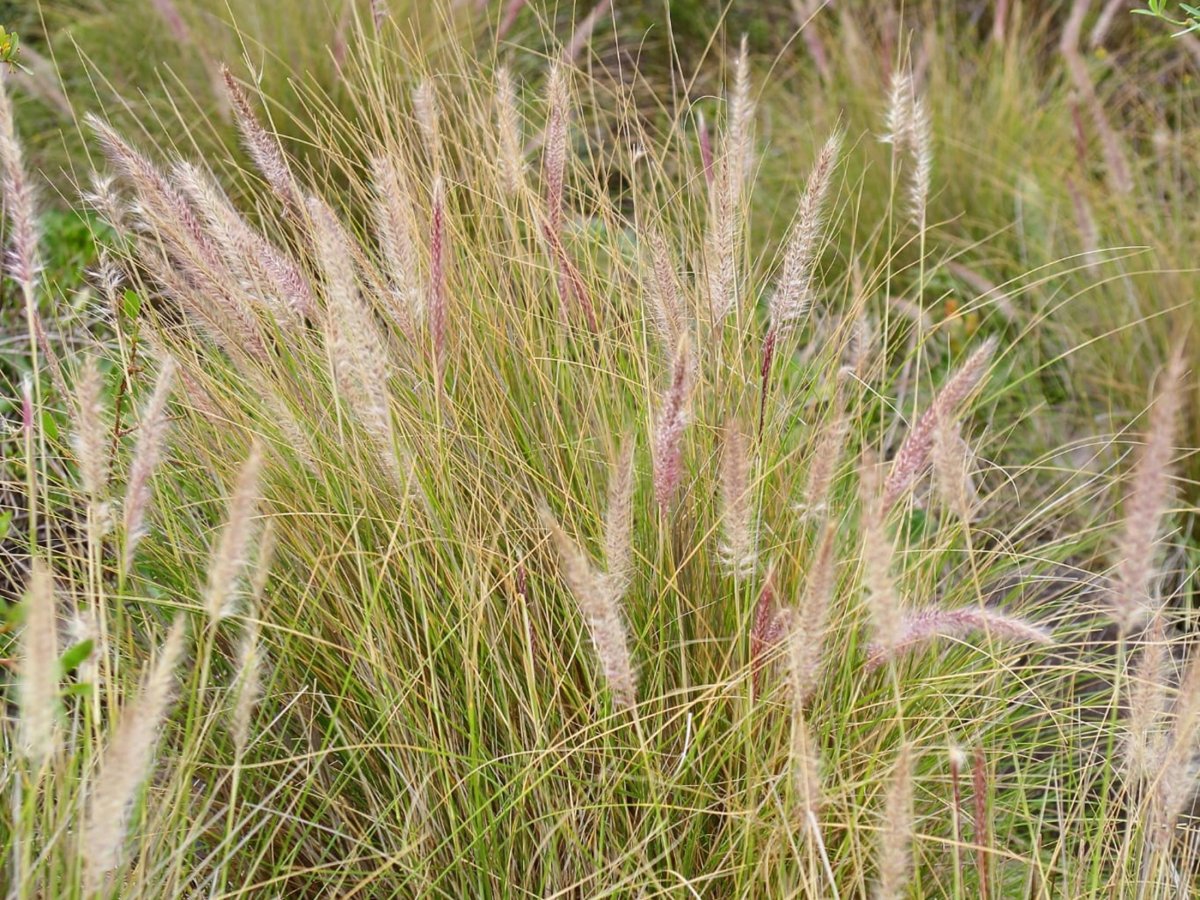
Impact on Canarian biodiversity and elimination of 'rabo de gato'
The main visible impact caused by 'rabo de gato' is the alteration of the landscape. "By competing for water, land, and sun with native species, especially flora, it smothers them by surpassing them in size because the native plants do not receive enough light," explains the expert.
On the other hand, it is a plant that generates allelopathic chemical elements, that is, a substance that inhibits the growth of other nearby plants.
Given this danger to Canarian species, the Canary Network for Early Warning of Invasive Exotic Species (RedEXOS), of the Government of the Canary Islands, has been working for several years to eliminate this grass from the islands. RedEXOS's mission is to detect and act quickly upon the appearance of new foci or populations of invasive exotic species that may pose a threat to the biodiversity of the Canary Islands.
Regarding the work to control this species, consistency is the main tool. On islands such as Tenerife, Gran Canaria, and La Palma, where 'rabo de gato' has spread at an enormous speed, the work of volunteers and experts supported by the regional government, municipalities, and island councils is paramount.
When eliminating it, the first step is to carefully remove the flowers (spikes) and put them in bags to prevent seeds from falling off and dispersing again. After removing all the flowers, the plant must be completely uprooted and the soil dug to remove as many roots as possible. "When it's a very large crew in a vast area, it's difficult work because it's very slow," he assures.
Once the plant is uprooted, it is left in the soil itself and the seeds are moved to another place to rot in a tank with water for eight to ten weeks. "We leave the plant in the soil because it provides organic matter and prevents soil erosion," Fariña details.
The situation in Lanzarote
Despite the very complicated situation that other islands are going through, in the case of Lanzarote, the cat's tail is quite controlled. However, initially its dispersion was much greater than at present, but the work to eliminate it, along with the size of the island, has led to its control being carried out successfully. This work is carried out by RedEXOS, made up of two people in the case of Lanzarote, which began to operate with a permanent team on the island since 2020, but previously, a team from Gran Canaria traveled to Lanzarote regularly to carry out specific actions.
Lanzarote, like El Hierro and Fuerteventura, are on early alert regarding the presence of cat's tail, as its appearance is well controlled. As Manuel Miranda, a RedEXOS technician, explains, this grass has been identified in the seven municipalities on the island. "Where we have acted the most is in the municipalities of Tías, followed by Yaiza, San Bartolomé, and Teguise," he specifies.
The growth points in Lanzarote have been concentrated on roads, abandoned agricultural land, and altered areas where waste such as rubble is deposited. One of the factors that further enhances dispersion on the island is the prevailing wind, which causes seeds to travel long distances and their growth to spread.
Before RedEXOS interventions in Lanzarote, Miranda highlights that there was an "important population" of this species on the island. However, the different actions over the years have allowed its presence to be considerably reduced. "Our most important mission, apart from identifying these foci and acting quickly, is to monitor them because you return to the place and find that it is no longer there, and if it is, you extract it again," he indicates.
Until September 14, 2026, RedEXOS has carried out 1,205 actions, with 1,060 follow-ups, of which 137 have been extractions.
RedEXOS has different ways to communicate citizen alerts about these species. Alerts can be sent via the RedEXOS mobile application, available for Android and iOS, through the RedEXOS website, by email, via WhatsApp, and by phone at 646 601 457.


Add La Voz de Lanzarote as a preferred Google source.
Stay informed with the latest current news.