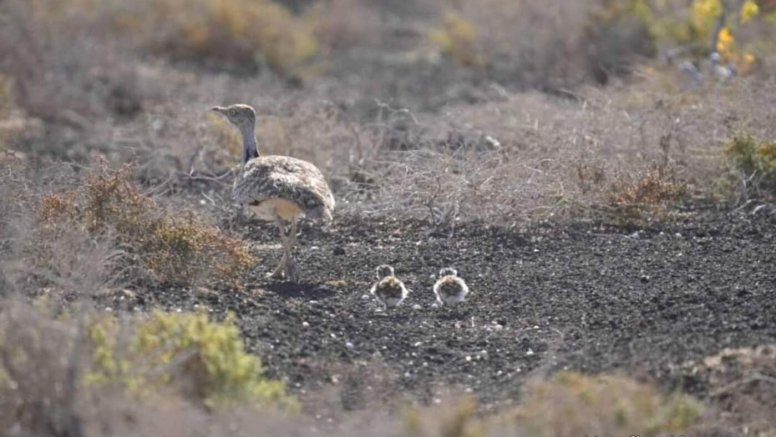
A layer of sand runs through Lanzarote from east to west, in a kilometer-long strip of semi-desert, crossing the island from Caleta de Famara to Playa Honda and Los Pocillos. This space, known as El Jable, is protected as a Place of Geological Interest, in addition to being part of the Natura 2000 Network as a Special Protection Area for Birds (SPA), with more than 15 types of species of community interest. The sand with which it is formed is of marine origin, originated by the shells and algae that the sea turns into small grains and that are then transported by the wind. Its environmental value is incalculable and has made experts from all over the world study it.
However, a mining extraction project seeks to extract sand from this enclave for construction, in a space already affected by decades of extractions where quarries and the landscape have not been recovered.
Last November, the request from the company Hermanos Ramirez Barreto SL was made public, seeking to obtain an extraction license for 15 years in the Hoya de la Plata area, in Muñique. Already then, Ecologistas en Acción warned of the "serious irregularities" contained in the environmental impact study presented by the company and which is mandatory to obtain this license.
The extension of El Jable is home to unique species on the planet and with different degrees of protection, such as the Canary hubara (Chlamydotis undulata fuertaventura), endemic to Lanzarote and Fuerteventura and listed as "endangered" by the Canary Islands Catalog of Protected Species and the Spanish Catalog of Threatened Species. This space is "by far, the most important place for this species in the Canary Islands and possibly the most important place in the world", adds Ecologistas en Acción in the allegations presented against this project.
In contrast, the company states in its environmental study that the birds, despite being the most important fauna group in the area and many of them being listed as vulnerable and endangered species, "will be able to move to adjacent areas where they have ample spaces with conditions similar to those existing". At the same time, it argues that "a good part of the species present" in the special protection area are "of nocturnal habits" and that as "the works will only be carried out during the day", it makes "the impact on them not significant".
In the allegations presented by Ecologistas en Acción and to which La Voz has had access, the group highlights that interpreting that their habits are only nocturnal "does not mean, in any case, that during the day they disappear from the area", but indicates that the activity "will produce interaction" and that it "will affect the rest period or lower activity of the species".
The group states that the environmental impact study presented by the company is "biased and lacking in technical and scientific rigor". In addition, it denounces that it "does not comply with the minimum requirements", that it presents "poor description and assessment", that it "obviates" relevant species and also the effects of the exploitation on them and on the environment. It also points out that both the inventory and the environmental and fauna description "lack all rigor or any reference to scientific studies".
The group recalls that this space was classified as a SPA due to the presence of species such as the Balearic shearwater, the European storm petrel, the osprey, Bulwer's petrel, the little shearwater or Eleonora's falcon, as well as the Berthelot's pipit, the Canary raven, the Canary Islands grey shrike or the yellow-legged gull. It also highlights that this quarry may affect steppe species more, which nest on the ground, such as the aforementioned Canary hubara, the stone curlew (Burhinus oedicnemus insularum), the cream-colored courser (Cursorius cursor), the Barbary partridge (Alectoris barbara) and the lesser short-toed lark (Calandrella rufescens polatzeki).
Ecologistas en Acción insists that the avifauna collected in the environmental study "lacks scientific support" and that if the analysis of the Canary hubara "had been carried out adequately" it would be "a more than sufficient argument to prevent any alteration of the environment", including, "any mining extraction".
The environmental association recalls that if a Special Protection Area for Birds does not have its own management plan, the island councils must be in charge of "ensuring the conservation and protection that is necessary".
"Lack of rigor" in the classifications of invertebrates and mammals
On the other hand, it points out "the lack of information provided" on invertebrate animals, where it does not include a list of species, "nor its descriptive sheet, nor the methodology used for the census" and states that it is "a sample, again, of the lack of scientific rigor of the study".
In this section, in El Jable there are different species of invertebrates that are part of the diet of the Canary hubara such as lizards, beetles, the cochineal of the sands, endemic to Lanzarote and Fuerteventura, which is part of the diet of the cream-colored courser. In addition to other Canarian endemisms such as grasshoppers and crickets (the Arminda lancerottensis, Calliptamus plebeius), ants (Camponotus brullei) or spiders (Cerbalus verneaui). In this space, the group highlights the rough marbled grasshopper which is in danger of extinction and on the red list of threatened species of the International Union for Conservation of Nature.
Likewise, Ecologistas en Acción denounces that the environmental study states that "the presence of mammals has not been verified" and that it assumes, "once again, that the non-finding constitutes sufficient evidence of their absence in the territory", even if this is contrary to "scientific studies that contradict it". The same occurs with plant species and communities, where sand plays a fundamental role as it is "a reservoir of seeds" for species that sprout after rains.
Thus, in El Jable live vulnerable species such as the Canary shrew (Crocidura canariensis) and "the extraction of sand would be a further aggravating factor for the conservation of the only endemic soricomorph" of the Canary Islands. Regarding the presence of species such as the Lanzarote lizard (Gallotia atlantica atlantic) or the Fuerteventura gecko (Tarentola angustimentalis), the group warns of the risk that this activity poses for both species.
To conclude, among its allegations, Ecologistas en Acción defends that "the extractive activity is incompatible for the conservation of the star onion (Androcymbium psammophilum), destroying its habitat and the seed bank available to the sandy substrate".
The value of the PORN
Meanwhile, the promoter of the extraction project stated in the environmental study that throughout the island only this space is included in the Lanzarote Island Planning Plan (PIOL), from 1991, as a potentially productive mining rustic space. However, Ecologistas en Acción points out that the PIOL, which "is not adapted to current legislation" does not order the natural resources of this space, because they are within the Natural Resources Management Plan (PORN), which is really in charge of ensuring the environmental and cultural presentation of ecosystems.
For environmentalists, the PORN "displaces the determinations of the PIOL in everything that contradicts them", although it contemplates mining extraction if it is supported by "studies or data that allow adjusting the rate of extraction of resource renewal and establishing a limit".
Likewise, the group points out that "environmental determinations will prevail over strictly territorial and urban ones", according to the Canary Islands Natural Spaces Law.
Some of the arguments that the company outlines in this environmental impact document argue that the areas of jable extraction in Lanzarote are "very limited" and that if extractions in these spaces are rejected, it could generate "an adverse effect" with "illegal extractions, both outside said mining areas and within them", for "convenience and proximity" and "failing to comply with any type of measures".
In addition, it highlights that Lanzarote "maintains very important unmet needs" demanded by "the tourism sector and the population". Finally, the company rules out filling the gap in the quarry created by this extractive activity in the jable and offers in exchange to create "a surface of gentle slopes".
Ecologistas en Acción has requested the General Directorate of Industry of the Ministry of Economy, Industry, Commerce and Self-Employed to issue a negative environmental impact statement because the effects of this project "will be significant on the fauna, flora, biodiversity, geology, landscape and cultural heritage", that it denies the concession of the exploitation "for being incompatible" with the PORN and that it suspends "this and all existing mining concessions in the area" until "all" abandoned extractions are "restored".
Add La Voz de Lanzarote as a preferred Google source.
Stay informed with the latest current news.