
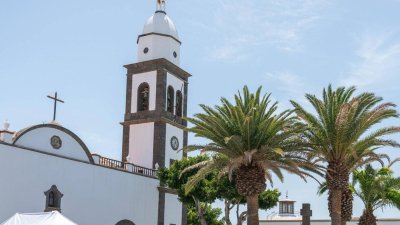
Installed on November 23, 1859, in the bell tower of the main church of the Lanzarote capital, the old mechanism accompanied the daily life of Arrecife for generations. In 2008 it was replaced by a modern one, but neither the historical machinery nor its face were preserved as heritage pieces. Its whereabouts remain unknown.
For almost a century and a half, the hours of Arrecife had a visible and audible reference at the top of the tower of the church of San Ginés. From there, the mechanical clock set the pace of daily life for several generations of residents. Its chimes accompanied religious celebrations and became integrated into the soundscape of a city that grew around its temple.
That mechanism was part of the collective memory of the Lanzarote capital until, in 2008, it was replaced during the bell tower renovation work. The intervention restored an operational timekeeping system to the temple, but it also led to the disappearance of a historical instrument whose trajectory had extended since the mid-19th century. The machinery and its face were not incorporated into any known heritage collection.
A church built with the effort of the neighbors
The history of the clock is linked to the construction and consolidation of the church of San Ginés, one of the fundamental buildings in the historical development of Arrecife. The town had achieved its parochial independence in 1798, a decisive step for a population that was beginning to gain greater prominence on the island.
The construction of the temple was a prolonged process, conditioned by economic difficulties and the need to gather resources in a still small community. The initial projects envisioned a church with two towers, but budgetary limitations forced modifications to that proposal. The final design became linked to the parish priest Francisco Acosta Espinosa, who promoted the works and sought the collaboration of the neighbors.
The work carried out between 1842 and 1843 included popular contributions and personal initiatives to secure funding. The priest himself even requested a loan of one hundred pesos, mortgaging his home to contribute to the execution of the project. The tower that years later would house the clock became one of the most recognizable elements of the temple and the urban physiognomy of Arrecife.
On November 23, 1859, it began to mark the hours
November 23, 1859, was marked as the date of the installation of the mechanical clock in the San Ginés tower. Its arrival represented an advance for public life in a town that found a common reference in church clocks to organize daily activities.
The manufacturer and origin of the original mechanism are not known with certainty. Researcher Gustavo Alejo Trujillo Yánez records the installation date and points out that it has not been possible to identify its maker or the place where it was built. The machinery remained in the bell tower for generations and could still be seen at the beginning of the 21st century.
Its operation required periodic care, adjustments, and repairs. Historical documentation identifies Francisco Acosta Guillén among those who performed tasks related to the clock from at least 1861. Decades later, in 1889, Adán Miranda Naranjo appears linked to that responsibility. Maintenance was essential for the hours to continue to be heard from the tower.
The bells that accompanied the life of Arrecife
The clock was part of an architectural and sound ensemble in which the bells played an essential role. The first bronzes of the temple were inaugurated on June 9, 1843. Over the years, the needs of the church and the deterioration of the original elements made their renewal necessary.
In 1882, two new bells were added, costing 5,200 reales and 82 cents. Part of this amount was obtained from the sale of the old bells and a small bell, which brought in 2,075 reales and 60 cents. The rest came from donations and private contributions.
The main bell, weighing 197 kilograms, was dedicated to San Ginés and had Vicente García Talavera and María Candelaria Curbelo de Páez as godparents. The smaller one, weighing 137 kilograms, was named Jesús María and had Guillermo Topham Martinón and Filomena Martinón de Coll as godparents.
The acquisition of the new bronzes also left an anecdote passed down through local memory. María Luisa de Páez Curbelo, upon hearing the sound of the bells, is said to have exclaimed: "Mr. Priest, how well my money sounds." An expression that reflects the involvement of the neighbors in the conservation and improvement of their church.
A repair to restore the clock in 1956
The passage of time forced interventions on the mechanism on several occasions. One of the documented actions took place in April 1956, when the clock was repaired, its exterior was painted, and a luminous dial was installed to improve its visibility.
The intervention allowed for its continued operation and adapted the system to the needs of a city that had undergone significant transformations during the 20th century. From the tower, its chimes continued to mark a daily reference for those who passed through the center, worked in its shops, or lived in the vicinity of the temple.
August 2008: the last testimonies of the old clock
Information published by La Voz de Lanzarote on August 14, 2008, allows us to know the state of the bell tower shortly before its renovation. The report included the explanations of the parish priest Miguel Hernández, who had promoted an intervention to restore the operation of the bells and the timekeeping system.
The clock had been stopped for months. According to the priest, when he arrived at the parish, he found the mechanism stopped at half-past nine. Rust had deteriorated the machinery to the point of making it unusable, so it was decided to install a new system.
The description of the interior of the tower is particularly revealing. Among old newspapers, dirt, and other debris, the machinery and the rusted dial were still found. Cleaning had made it possible to remove 83 bags of waste, mostly remains and carcasses of pigeons. The condition of the bell fastenings, deteriorated by the passage of time, was also a concern.
The report included an image of the old dial, broken and deposited on the bell tower's roof. This photograph constitutes one of the most significant graphic testimonies of the last days of the historic clock in its original location.
The bells traveled to Burgos
The renovation of the bell tower affected different components, whose destination should be differentiated. The information published in August 2008 indicated that, of the six bells in the tower, four had been transferred to Burgos for repair by the company A. Cano Campanas. The other two remained in Arrecife.
That transfer corresponded to the bronzes, not to the timekeeping mechanism installed in 1859. The consulted documentation does not confirm that the old clock traveled to Burgos along with the bells.
The intervention was carried out by specialist Antonio Cano, who installed a new clock with Spanish machinery and technology from Belgium. Two new bells were also incorporated, while work was done on the old ones. The restoration culminated in August 2008, coinciding with the patron saint celebrations, and allowed the functioning of the entire set to be recovered.
A heritage that was not preserved
Researcher Gustavo Alejo Trujillo Yánez, in his work dedicated to the inventory of historical bells and clocks of Fuerteventura and Lanzarote, confirms the replacement of the San Ginés mechanism in 2008. His study expressly states that neither the original machinery nor the dial were preserved.
The loss is significant from a heritage point of view. The restoration of the historical mechanism or its removal for later exhibition would have allowed a testimony of the functioning of old public clocks and their importance in the daily life of the capital to be maintained.
These instruments were not merely technical pieces. They represented the economic effort of the communities that acquired them, the work of those who maintained them, and a way of organizing collective life before the widespread use of personal watches.
In San Ginés, the installation date, the documented repairs, and the photographs taken in August 2008 allow a large part of the clock's trajectory to be reconstructed. However, published sources do not identify the place to which the mechanism was moved nor explain what was done with its components after its dismantling.
The memory of a disappeared clock
The clock installed in 1859 was much more than machinery intended to tell the time. For almost a century and a half, it was a daily reference for the population and accompanied the transformation of Arrecife from a small port town into the island capital.
Its history is linked to the effort of those who built the church, to the neighborhood contributions that allowed its bells to be acquired and maintained, and to the work of the people who cared for the mechanism over generations.
Today, the San Ginés tower still marks the hours, but the clock that accompanied Arrecife for almost 150 years has disappeared without a known heritage trace. Its history is documented; its end, is not. Who removed the 1859 machinery, where was it deposited, and why was a piece that was part of the historical memory of the Lanzarote capital not preserved?
DOCUMENTARY SOURCES
1. Perera Betancor, Francisco and Olivero Díaz, José (1997). "The parish factory of the church of San Ginés, bishop of Clermont, patron saint of Arrecife". Proceedings of the VII Conference on Studies on Lanzarote and Fuerteventura, volume II, pp. 375-399.
2. Trujillo Yánez, Gustavo Alejo. To the sound of the bell ringing. Inventory of bells of Fuerteventura and Lanzarote. Heritage research and inventory. Includes documentation on the historic San Ginés clock and its replacement in 2008.
3. La Voz de Lanzarote (August 14, 2008). "San Ginés makes a splash". Contemporary information on the state of the bell tower, the old machinery, the dial, and the planned actions for its renovation.


Add La Voz de Lanzarote as a preferred Google source.
Stay informed with the latest current news.