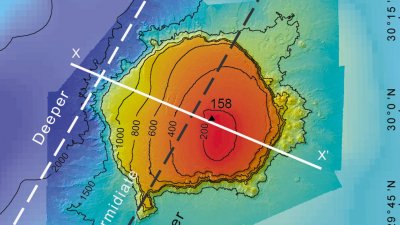
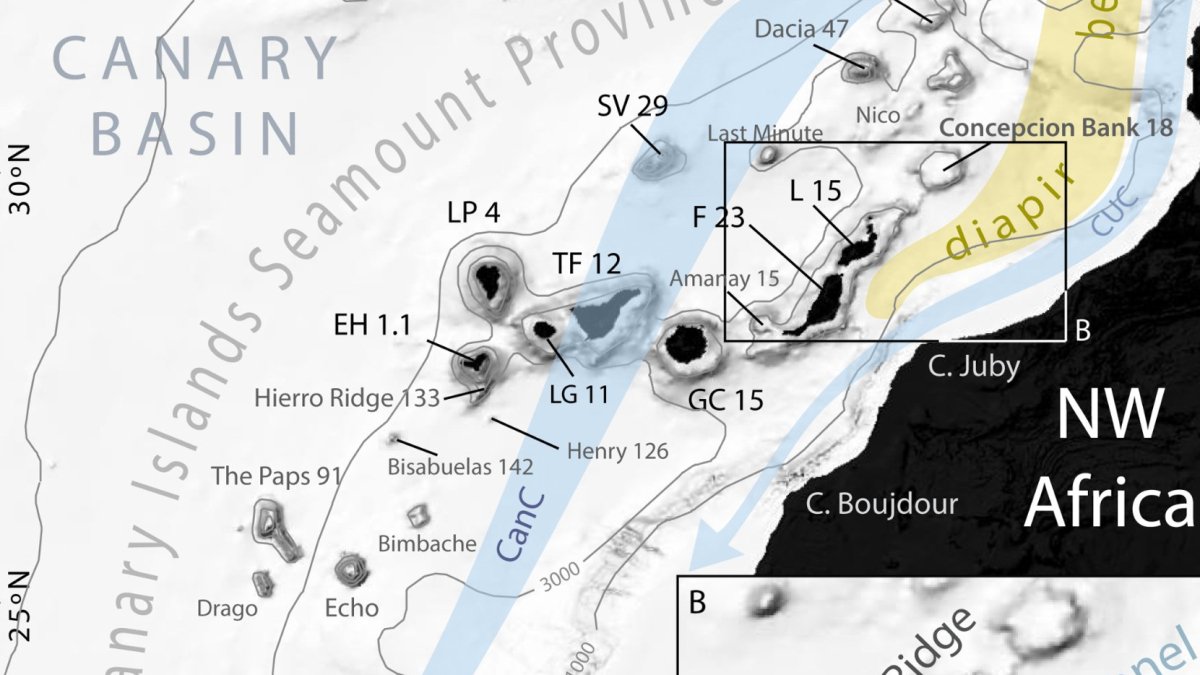
Just 75 kilometers north of Lanzarote is the Concepción Bank, a Canarian seamount that plunges to 2,700 meters deep and rises to 158 meters. In 2010, this seamount was one of the least scientifically explored marine areas in Spain and its environmental richness was practically unknown.
Research carried out by the project Inventory and Designation of the Natura 2000 Network in Marine Areas of the Spanish State (INDEMARES) shed light on this underwater space: it is of volcanic origin, has a circular shape, and forms part of the axis that keeps Fuerteventura and Lanzarote connected underwater. Furthermore, it was once emerged above the sea during its volcanic formation process.
With an area of over 610,000 hectares, this seamount has recent protection, as it was not until 2014 that it was declared a Site of Community Importance within the protected areas of the Natura 2000 Network.
"It's an oasis in the middle of the desert," defines field technician Aitor Gil in an interview with La Voz. The expert, also a nature photographer, explains that this seamount is elevated on an abyssal plain. "When currents hit its walls, upwellings are generated that enrich the entire food chain," he continues.
Gil describes it as "a concentration point for life." In this space, corals, sponges, seabirds (such as Macaronesian shearwaters, the black-winged stilt, or the white-faced storm petrel, among others), loggerhead turtles, and different cetaceans (bottlenose dolphin, spotted dolphin, bottlenose dolphin, or common dolphin, as well as the tropical pilot whale) coexist. Fish, tuna, and sharks can also be found.
According to a study by Indemares, dependent on the Ministry of Science and Innovation, most of the detected birds are species that reproduce in the Canary Islands, but migratory species that reproduce in northern Europe or the Southern Hemisphere are also found.
Gil explains that in addition to the bird species that arrive at the Concepción Bank from the islands and islets of the Canary Islands, species from the Arctic and the East Atlantic can also be found in the area, as the seamount is located in the middle of the East Atlantic migratory corridor.
The field technician organized this September, together with the scientific catamaran Gara Itsasoa, an expedition on the Concepción Bank, where, in addition to local species, they also hope to spot the post-nuptial passage of species bred in the Arctic and northern Europe that stop in the area to feed, such as the long-tailed skua, the parasitic jaeger, or the pomarine skua.
The Concepción Bank also serves as an oasis for the Cory's shearwater, which nests very close by, in the Chinijo Archipelago. On the inhabited islands, the chicks of this seabird species face the dazzling lights generated by light pollution on the archipelago's coast each year, while this seamount is not yet anthropized.
Add La Voz de Lanzarote as a preferred Google source.
Stay informed with the latest current news.