
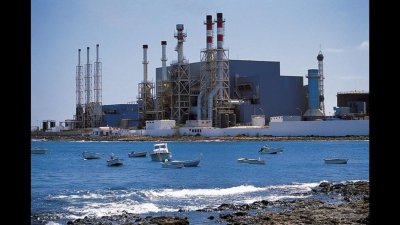
In the early sixties, Lanzarote was burdened by a historical problem that conditioned its development: the scarcity of drinking water. The population depended on rainfall, cisterns, and underground reservoirs, while the authorities resorted to maritime transport from other islands to guarantee supply. The Famara gallery had represented an advance, but its production was insufficient given the growth of Arrecife, fishing activity, and the needs of the canning industry.
Added to this situation were the limitations of the electricity supply. Outside the capital, a large part of the population continued to use kerosene lamps, and the existing facilities could barely meet the needs of households and productive activities. Lanzarote needed an infrastructure capable of simultaneously addressing both deficiencies.
The solution began to take shape in 1960, following a conversation in Madrid between the Lanzarote naval engineer Manuel Díaz Rijo and the then mayor of Arrecife, Ginés de la Hoz. During that meeting, the engineer learned about the efforts the island authorities were making to obtain ships to transport drinking water from Gran Canaria and Tenerife. Faced with this dependence, he proposed an alternative that could change the island's future: producing fresh water directly from the ocean.
Manuel Díaz Rijo, the engineer who looked to the Atlantic
Born in La Vegueta in 1927, Manuel Díaz Rijo began studying the feasibility of a desalination plant that would use residual steam from an electrical installation to obtain drinking water. His proposal integrated two industrial processes into a single infrastructure, allowing for the simultaneous production of electricity and water by harnessing thermal energy.
To develop the initiative, he contacted specialized organizations in the United States and obtained documentation on the research being carried out in that country. However, the proposal encountered difficulties in obtaining financing and institutional support. Due to the lack of public commitment, Díaz Rijo decided to promote the project through a private company, bringing in his brother José, a lawyer, and naval engineer Javier Pinacho Bolaños.
The initiative aimed to resolve a structural need in Lanzarote and provide a supply base that would allow it to face the demographic, industrial, and tourist growth that was beginning to be glimpsed.
From the first steps to the incorporation of Termolansa
The business process had begun before the date commemorated by this anniversary. On June 1, 1961, the announcement of the foundational program of Termoeléctrica de Lanzarote, S. A., with a provisional capital of thirty million pesetas, was published in the Official State Gazette. The promoters acquired the Arrecife power plant and participated in the municipal tender to manage the supply of drinking water.
On August 9, 1961, the Cabildo agreed to grant an exemption from the tax levied on the import of machinery intended for the future plant. One year later, on August 10, 1962, the Council of Ministers authorized the installation of a dual plant to produce water and electricity, also allowing foreign capital participation.
On November 29, 1962, the public deed of incorporation of Termoeléctrica de Lanzarote, S. A. was granted before the Madrid notary Lamberto García Atance. The share capital was set at five million pesetas, fully paid up, with an agreement to increase it to fifty million.
The presidency of the board of directors fell to Rudy Meyer Asensio; Gerardo Barrios García assumed the secretaryship, and Javier Pinacho Bolaños, the vice-presidency. Manuel and José Díaz Rijo were part of the board, with executive responsibilities. The company was registered in the Mercantile Registry of Madrid on February 21, 1963.
The distinction between the 1961 foundational program and the 1962 public deed allows for a precise chronology: the business initiative was born earlier, but its formal incorporation corresponds to November 29.
Westinghouse and Burns and Roe: American technology for Lanzarote
The international dimension of the project was materialized through contacts with Westinghouse Electric Company and the engineering firm Burns and Roe. Manuel Díaz Rijo had studied an experimental installation near San Diego, California, which used a multistage distillation system, based on successive stages of evaporation and condensation.
Following meetings held in the United States, it was agreed to acquire and install a plant adapted to the needs of Lanzarote. The project included two steam generators, two 750-kilowatt turbo-generators, and an evaporator with an approximate capacity of 2,300 cubic meters of water per day.
The innovation consisted of using the exhaust steam from the turbo-generators to feed the desalination process. Thus, the same facility could generate electricity and produce drinking water through the recovery of thermal energy.
The agreement with Burns and Roe amounted to $2,079,000, with a ten-year financing period. The operation allowed the incorporation of American industrial technology to an island that until then depended on very limited water resources and low-capacity electrical installations.
Punta Grande, the place where the transformation began
In 1963, construction work on the dual plant began in Punta Grande, in Arrecife. Proximity to the sea facilitated the intake of saltwater, and the location allowed for the organization of fuel supply and industrial facilities.
The arrival of machinery from the United States and its subsequent assembly required a complex logistical operation. Specialized technicians from Burns and Roe traveled to Lanzarote to direct the work, which also involved island professionals with experience in mechanics and naval machinery.
In parallel, Termolansa undertook the construction of Arrecife's drinking water distribution network. Streets had to be opened to install the main pipelines, and sidewalks were lifted to lay the secondary networks. Regulating tanks and new electrical infrastructure were also planned.
The construction of the plant was only one part of the project: it was essential to develop a network that would allow water and electricity to be delivered to homes and industrial establishments.
1964: the first tests and the population's doubts
In September 1964, the first tests of the plant began, with the arrival of an American engineer who had participated in the commissioning of a similar facility at the Guantanamo base, Cuba. In December, new tests were carried out with positive results.
The initiative had aroused some distrust among a part of the population, unaccustomed to the idea of drinking water obtained directly from the sea. However, the results made it possible to verify that the technology worked and that the produced water met the necessary conditions for consumption.
The transformation also affected traditional activities linked to supply. Water carriers, known as "carreros," saw their livelihood threatened, an activity that for generations had been part of Arrecife's daily economy. The arrival of running water modified domestic habits and altered a deeply rooted distribution system.
1965: the Atlantic begins to supply Arrecife's homes
The spring of 1965 marked a before and after. Desalinated water began to circulate through Arrecife's distribution network. The plant could produce approximately 2,300 cubic meters daily and generate 1,500 kilowatts of electricity.
The change transcended the strictly technical. The availability of water had conditioned domestic life, agriculture, industry, and Lanzarote's growth possibilities for generations. The new infrastructure made it possible to reduce dependence on rainfall and maritime transport from other islands.
The network also began to extend to other areas. The connection with Puerto del Carmen, where the Hotel Los Fariones was inaugurated in 1966, highlighted the relationship between supply and the tourism development that was beginning to transform the island's economy.
On May 28, 1965, the Official State Gazette published the authorization of the Termolansa facilities, including the thermoelectric power plant, the water treatment plant, the transformation substations, and the complementary power lines. The Lanzarote experience also contributed to boosting institutional interest in desalination and its application possibilities in other territories.
The price of progress: millions in losses and financial difficulties
The launch of an infrastructure of such a dimension was not without problems. Fuel, maintenance, financing, and distribution costs began to compromise Termolansa's economic viability.
In December 1967, Manuel and José Díaz Rijo met with a commission presided over by Mayor Ginés de la Hoz to analyze the company's situation. The 1966 accounts had registered losses exceeding eleven million pesetas, so the company needed to revise its rates to cover operating expenses and financial obligations.
The documentation from that meeting also indicated that approximately a quarter of the water produced was lost in the distribution network. Added to this were the commitments arising from international financing and the increase in the cost of foreign currency.
The capital increase to fifty million pesetas also did not proceed according to the initially planned conditions. The committed disbursements did not resolve the company's financial needs.
The situation worsened during the early years of the following decade. The international oil crisis of 1973 increased operating costs and added pressure on a company that had to guarantee two essential services.
Electricity reaches the towns of Lanzarote
Despite the economic difficulties, Termolansa participated in the expansion of the island's electrical grid. In 1969, agreements were reached to advance the electrification of the municipalities and reduce the inequalities between Arrecife and the inland towns.
On January 28, 1970, Tías joined the new electricity supply plan. The connection allowed the service to be extended to homes and improve public lighting.
The electrification of the towns represented a significant change for daily life, commerce, and productive activities. The company, which had been created to produce water and electricity, was also contributing to modifying the territorial organization of Lanzarote.
1974-1975: the end of Termolansa's integrated model
Economic difficulties and the need to guarantee essential services led to the reorganization of infrastructures. In December 1974, the Cabildo agreed to acquire Termolansa's hydraulic assets, valued at 200 million pesetas by the Ministry of Public Works.
Financing was distributed between the Cabildo, which assumed 60%, and the seven town councils, which were to contribute the remaining 40%. The management of the supply was organized through a joint structure that gave rise to the Water Consortium.
The electrical activity followed another path. The corresponding assets were acquired by UNELCO, whose incorporation into the island service materialized in 1975. Transmission allowed the reorganization of electricity production and distribution, while hydraulic supply passed to the insular public sphere.
The company that had been born to integrate both services ended up seeing its two main activities separated. Its workers were also incorporated into the new management structures.
The legacy of a company that changed the history of Lanzarote
The significance of Termolansa cannot be measured solely by its business results or the trajectory of the first plant in Punta Grande. Its importance lies in having contributed to addressing two problems that conditioned Lanzarote's future for decades: the scarcity of drinking water and the limitations of the electricity supply.
Desalination expanded the possibilities for urban growth, improved domestic conditions, and accompanied the expansion of industry and tourism. The electrification of the towns opened new opportunities for thousands of inhabitants who had previously lived with significant energy limitations.
At the center of that transformation was Manuel Díaz Rijo, who turned an idea that arose during a conversation in Madrid into an industrial project of international scope. His initiative linked Lanzarote with American technology companies and contributed to introducing a supply model that would eventually become essential for the island's development.
The original Punta Grande plant gave way to new facilities and technologies, but its experience ushered in an era that forever changed Lanzarote's relationship with water.
On November 29, 1962, not only a commercial company was born. An initiative was formalized that allowed the island to look at the ocean in a different way: not as an extension of saltwater surrounding it while suffering from drought, but as a source capable of guaranteeing one of the most necessary resources for its future.
DOCUMENTARY SOURCES
• Díaz Rijo, Manuel. Drinking water in Lanzarote. Academy of Sciences and Engineering of Lanzarote, 2007. • Water Memories. Cabildo de Lanzarote, chapter "Termolansa, turning our eyes to the sea again". • Official State Gazette, June 1, 1961: foundational program of Termoeléctrica de Lanzarote, S. A.
• Official State Gazette, May 28, 1965, number 127, pages 7657-7658: authorization of industrial facilities.
• Lanzarote Report: historical chronology of island desalination and electrification.
• González Morales, Alejandro. "The water culture on the island of Lanzarote. 16th-20th centuries", XII Conference on Studies on Lanzarote and Fuerteventura, 2008


Add La Voz de Lanzarote as a preferred Google source.
Stay informed with the latest current news.