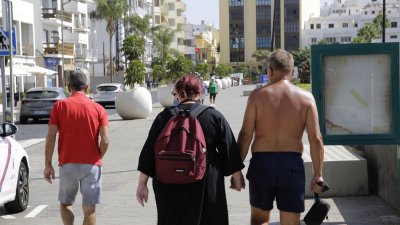
A part of the population of Lanzarote and La Graciosa cannot cool their homes during the summer months nor maintain their homes at an adequate temperature in winter. The climate emergency that is hitting the planet means that heatwaves are increasingly intense and long-lasting, but after more than thirty years of warnings about the climate crisis, there are still not enough public spaces in the Canary Islands to take refuge in.
The archipelago will suffer the first heatwave of the summer starting this Wednesday, following two previous episodes of high temperatures. In a special warning, the State Meteorological Agency (Aemet) has warned that from this Wednesday onwards, a significant, even "extraordinary" level of danger is expected during the central hours of the day and warns of the risk to vulnerable people.
Faced with an episode where outdoor activities will pose a risk to the population, 24.8% of Canary Islanders cannot take refuge at home because their homes are not adapted to high temperatures, according to a survey by the National Statistics Institute (INE) from 2023. Although adequate housing temperature is one of the sustainable development goals committed to by States in Agenda 2030, many people still live for months with temperatures above what is recommended for their health. A situation that is also repeated in reverse during the winter.
With the rise in high temperatures, it is sometimes very difficult to find a place to shelter without having to pay for it. Faced with this reality and the forecast that the climate will become increasingly extreme if the decarbonization of the planet is not achieved, climate refuges have emerged, public and accessible spaces designed for the population to protect themselves during extreme weather phenomena.
Just in the same week that Lanzarote is facing its first heatwave of the summer, with maximum temperatures that could reach 39 degrees, the Government of Spain has made public its State Network of Climate Refuges.
A single climate refuge registered in Lanzarote
Throughout the country, the Ministry for the Ecological Transition has created a network of 180 public and accessible spaces owned by the General State Administration that will be available free of charge this summer and between May 15 and September 30 of subsequent years. In total, 1,100 climate shelters have been identified throughout the country, most of them in Catalonia and the Basque Country.
In the case of Lanzarote, for the moment there is only one space available: the Registry Office of the Insular Directorate of the State in Lanzarote. This space can be used only in the morning, between 9:00 AM and 2:00 PM. According to information released by the Ministry, it is located at Blas Cabrera Felipe street, 6, in the sub-delegation of the Government building on the island. In the Canary Islands, there are eight other climate shelters.
The Spanish Executive has also launched a guide aimed at administrations, companies, associations, and organizations that wish to implement a climate shelter.
Teleclubs as climate shelters
A few months ago, the San Bartolomé City Council, led by the socialist Isidro Pérez, announced that it was working on identifying municipal spaces that could serve as climate shelters. To do this, these places must meet the requirements of accessibility, safety, and services.
The council announced that some of the spaces evaluated were the sociocultural centers of Güime, El Islote, and Lomo de Tesa (Montaña Blanca), the Civic Center of Playa Honda, the Sports Center of Playa Honda, or the day centers for the elderly in Playa Honda and San Bartolomé, among others.
Meanwhile, this Tuesday the Local Committee of Nueva Canarias-Bloque Canarista (NC-BC) in Arrecife has proposed creating a Municipal Network of Climate Oases, using the Sociocultural Centers in the neighborhoods. The initiative aims to reconvert them into conditioned public places so that the population can protect themselves from heatwaves.
The party proposed implementing adequate conditions of thermal comfort, ventilation, air conditioning, as well as access to drinking water, accessible bathrooms, and extended hours during alerts for high temperatures.
“Arrecife has an advantage that other cities do not have. It has a network of Sociocultural Centers spread across practically all neighborhoods. Instead of keeping them underutilized for a good part of the day, we must turn them into authentic climate oases open to the public when temperatures reach dangerous levels,” concluded the spokesperson for Nueva Canarias, Sheila Guillén.



Add La Voz de Lanzarote as a preferred Google source.
Stay informed with the latest current news.