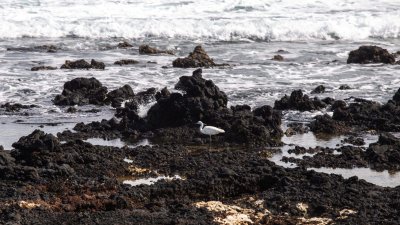
Shellfishing is one of the oldest activities that humans still practice and represents one of the most deeply rooted traditions in the Canary Islands. However, it is highly regulated in the archipelago due to the decline of many species due to human pressure, according to the Biodiversity Service of the Government of the Canary Islands.
These regulations particularly affect species such as the majorera limpet, which is extinct on almost all islands except Fuerteventura. This is due to human pressure, which causes specimens to become smaller and smaller. Furthermore, the Canary mussel is also severely threatened on the majorera island.
Therefore, the law establishes minimum sizes for catching different species. Limpets (white, black, or curvina) must be 45 mm in size, and a maximum of three kilos can be caught. Regarding winkles, of the common winkle, only a maximum of 1.5 kilograms can be harvested, but specimens must be at least 15 mm in size. As for the male winkle, it must also be 15 mm in size, and a maximum of 0.5 kilos can be caught.
For its part, the Canary mussel, present on all islands except Fuerteventura, must be at least 70 mm in size to be consumed.
Crabs and octopuses also have minimum size requirements. The Moorish/black crab must be 60 mm in size, and only a maximum of 3.5 kilos can be collected, while the white crab must be 50 mm and a maximum of 2.5 kilos can be harvested. Octopuses must weigh at least one kilo each, and only a maximum of five kilos can be caught.
The months for catching are also regulated to protect the breeding season and aid in the recovery of these species. In the case of crabs, they can be collected between April and November, while it is completely prohibited the rest of the year. The months for harvesting limpets and winkles are between May and November, while for mussels, it is only permitted in the months of January, February, March, July, August, and December.
Prohibited species and fragile zones
There are several species whose capture is completely prohibited. These include the majorera limpet (Patella candei candei); bucios (Charonia lampas, Charonia variegata, and Semicassis granulata); Canary clam (Haliotis tuberculata coccinea); Canary mussel (Perna perna, only in Fuerteventura); Herreña lobster, antenna lobster, and Canary lobster (in the SCI); Barrel shell (Tonna galea), among others.
Furthermore, on all the islands there are coastal areas that are especially fragile and sensitive. In the case of Lanzarote, one of these areas is the one that comprises the coast between the Pechiguera Lighthouse and Los Charcones, in the south of the island. Thus, also the coast in the surroundings of La Santa towards the coast of Timanfaya National Park, as well as the coast of Mala.
Add La Voz de Lanzarote as a preferred Google source.
Stay informed with the latest current news.