
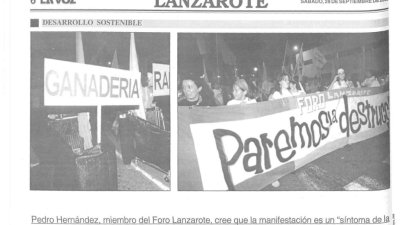
The calendar wanted to add symbolism, because that day was World Tourism Day, precisely the activity that had transformed Lanzarote's economy and was also at the center of the debate. The Island was growing, new residents were arriving, tourist accommodations were increasing, and urban development projects were multiplying, but doubts were also growing, how far could Lanzarote go?, how many beds could it support?, how many roads?, how many ports?, how many golf courses?, how much construction? The discussion was no longer exclusively environmental, it had fully entered daily life.
Lanzarote then had around 110,000 inhabitants and the population had increased rapidly in the previous years, while tourism advanced and construction also advanced, subjecting the territory to increasing pressure. The concern extended to water, infrastructure, traffic, healthcare, education, the primary sector, and the coastline, but also to the economic model that was taking shape on the Island.
The conflict had concrete names. Berrugo was one of them, port works had begun in 2000 and the project became one of the symbols of citizen opposition. Playa Quemada was another, where the possibility of new constructions had provoked a strong neighborhood mobilization. Maciot appeared in the debate with a project for six golf courses and a tourist-residential complex, while Montaña Blanca was related to the project for an air approach radar. New developments in Playa Blanca, Órzola, La Santa, Tahíche, Guatiza, and other points on the Island were also on the table.
The problem was not only what was already being built, but also what could be built. Thousands of new tourist accommodations appeared in different projects, and Montaña Roja concentrated a significant part of the controversy. The possibility of developing thousands of beds in the south fueled the fear that growth would escape the control of institutions, while a word began to gain prominence in public debate: limit.
Water was another of the big issues, because Lanzarote depended on desalination and tourist expansion demanded more resources. The management of desalination plants and the future of Inalsa were part of the discussion, as was the extraction of aggregates, waste disposal, coastal deterioration, the future of the agricultural and livestock sector, soil loss, and landscape transformation.
And then Foro Lanzarote appeared, a platform that managed to bring together different sensibilities, environmentalists, neighborhood associations, unions, businessmen, social groups, organizations, and private individuals. Not everyone shared the same ideas or had the same priorities, but they decided to walk together around a common concern: the future of the Island.
The call was prepared for months, posters were printed, brochures were distributed, banners were made, and vehicles toured Lanzarote announcing the protest, trying to ensure the message reached all municipalities. There was a question that summarized that campaign and appeared on numerous posters: “And what are you going to do?”.
The response came on September 27. The gathering began near the Arrecife Sports City and then the march began, which advanced towards Cuatro Esquinas, continued along Calle Real, and ended at the fairgrounds. Images from that night show a crowd occupying the streets of the capital. Figures differ depending on the source, although the press at the time spoke of around 10,000 people and other reconstructions place participation above 8,000, a difference in estimation that does not change the scale of that mobilization, considered one of the largest citizen protests in Lanzarote's recent history.
The banners spoke of the conflicts that had led to the call, Berrugo, Playa Quemada, Montaña Blanca, Las Coloradas, the coast, oil exploration, and the tourism model, but there was also room for irony, humor, and satire, because that demonstration was not only a protest, it was also a cultural expression of a society that felt its territory was changing too quickly.
Among the protesters walked José Saramago, the Portuguese writer who had been living in Lanzarote for nine years and had made the Island his place of residence and a fundamental part of his life. That night he went out into the street accompanied by Pilar del Río, José Juan Ramírez and Fernando Gómez Aguilera, while Miguel Ríos also participated. The presence of both artists gave a special dimension to the protest and allowed the defense of Lanzarote to acquire a repercussion that went beyond the island's scope.
Saramago spoke about the future of the Island, about the need for citizens to become aware, and about the importance of preventing growth from ending up transforming what made Lanzarote unique. Miguel Ríos also showed his support, and the night ended with music and performances by Arístides Moreno, Kardomillo, Salvador Leal, and Losotroh, in addition to Miguel Ríos himself, who performed “Todo a pulmón”.
But the central moment was the manifesto, whose reading was led by six people. The message called for citizen participation, asked for responsibility, and questioned a growth model considered excessive by the organizers, arguing that the future of Lanzarote could not be decided solely from offices.
Island society seemed to share a large part of those concerns. A survey by the Data Center conducted in 2002 showed that 83.3% of respondents were aware of the demonstration and that 77.2% agreed with it, while the defense of the primary sector received a rating of 8.98 out of 10. The closure of illegal tourist establishments, the regulation of discharges into the sea, the opposition to oil exploration, and the reduction of tourism growth also received high support.
Those data help to better understand what happened that night, because 27-S was not just a mobilization of activists; there was a much broader social concern behind it. A significant part of the population was beginning to wonder if economic growth could be maintained indefinitely without consequences for the territory and for daily life.
The demonstration had political consequences. In January 2003, a revision of the Insular Plan was presented that proposed eliminating about 25,000 tourist beds and reducing millions of square meters of undeveloped tourist land, a proposal that affected, among other areas, lands in Playa Quemada, Playa Blanca, and Charco del Palo. The author of the document, Fernando Prats, linked that possibility to the support of a significant part of Lanzarote society.
Some of the projects that had fueled the protest would end up being rejected, others would continue for years, some would end up in court, and others would disappear from the public agenda. The lives of some of the protagonists also changed, because some of those activists ended up making the leap into institutional politics, while others argued that social movements should maintain their independence. The relationship between environmentalism and politics thus became one of the debates arising from that mobilization.
The 27-S had managed to place the territory at the center of public conversation, but it had also shown that a citizen platform could modify the political debate of an Island. That mobilization was not born solely out of environmental concern; it was also related to the loss of quality of life, pressure on infrastructure, education, healthcare, traffic, and the accelerated transformation of Lanzarote society.
Twenty-four years later, the photograph from that night retains extraordinary power, a crowd walking through Arrecife, banners raised, entire families, young people, old people, workers, businessmen, environmentalists, neighbors, and people who perhaps had never participated in a demonstration before, with José Saramago among the people and Miguel Ríos on a stage. All accompanied by a phrase that summarized that concern: "In defense of Lanzarote and its future, no to the destruction of the Island".
Today that demonstration is part of Lanzarote's contemporary memory, but it also poses a question that still has journalistic relevance, what remains of that September 27, 2002? Some battles were won, others were lost, some projects disappeared and others changed form, while tourism continued to grow, as did the population, and the debate about limits returned again and again, with the territory once again becoming one of the main issues of island politics and life.
The 27-S was a photograph of its time, but it was also something more, it was a warning and a wake-up call, a society saying that growth had a price and that the territory was not infinite. That night thousands of people walked through the streets of Arrecife to defend a certain idea of Lanzarote, they did not know what the Island would be like 24 years later nor could they imagine all the debates that would come, but they did have one certainty: Lanzarote had a limit and that night they decided to take to the streets to remember it.
Documentary sources
La Voz de Lanzarote, September 28, 2002 edition, Jable Archive of the University of Las Palmas de Gran Canaria.
El País, "Mass demonstration to preserve Lanzarote," September 29, 2002. Lanzarote Memory, recording of the demonstration "Stop the destruction," September 27, 2002. Lanzarote Data Center, 2002 Island Topics Survey.
Lanzarote Biosphere Reserve, documentation on the September 27 mobilization. WWF/Adena, Panda magazine, autumn 2002.

Add La Voz de Lanzarote as a preferred Google source.
Stay informed with the latest current news.