
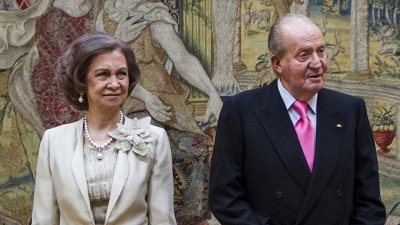
A century separated two events that became linked in the contemporary history of Lanzarote. On April 5, 1906, Alfonso XIII disembarked in Arrecife during the first trip of a Spanish monarch to the Canary Archipelago. One hundred years later, on Saturday, November 25, 2006, his grandson, Juan Carlos I, accompanied by Queen Sofía, returned to the island as part of an official tour of the Canary Islands organized to commemorate that historic visit.
The coincidence allowed for a comparison between two profoundly different eras: a Lanzarote that at the beginning of the 20th century demanded better port infrastructure, water, and means to overcome its isolation, and another that, in 2006, had undergone an extraordinary economic and social transformation, driven mainly by tourism development and a growing international profile.
The visit of the King and Queen was part of an institutional program developed between November 22 and 26. Over five days, Juan Carlos I and Sofía toured the seven islands of the Archipelago, symbolically retracing the itinerary followed by Alfonso XIII a century earlier.
A tour of the seven islands to remember Alfonso XIII
The commemoration had special significance for the Canary Islands. The 1906 visit marked the first presence of a Spanish monarch in the Archipelago and was an exceptional event for a society then characterized by geographical distance and communication difficulties with the mainland territory.
The return of the Crown aimed to renew that institutional link and recognize the evolution experienced by Canarian society during the 20th century.
The tour began on Wednesday, November 22, in Tenerife and continued through the different islands, reaching Lanzarote on the fourth day. On Sunday, the 26th, the monarchs concluded their stay in the Canary Islands in Gran Canaria.
In each territory, meetings were organized with institutional and civil society representatives, as well as visits to places of special historical, cultural, and social significance. The commemoration allowed for the recovery of photographs, documents, and testimonies from Alfonso XIII's expedition.
In Lanzarote, the day of November 25 acquired a particularly symbolic dimension due to the relationship between that first royal visit and the transformations that had marked the island's development.
Costa Teguise, the setting for the meeting with Lanzarote society
The monarchs arrived from Fuerteventura, where they had carried out the planned activities during the morning. They landed in Lanzarote minutes before 2:30 PM and traveled from the airport to the Meliá Salinas Hotel, in Costa Teguise.
The establishment hosted an institutional lunch with representatives of Lanzarote society. Civil and military authorities, businessmen, representatives of social groups, and journalists attended the meeting.
The choice of Meliá Salinas also had an architectural and cultural dimension. The establishment, designed by Fernando Higueras with the artistic participation of César Manrique, was one of the most representative examples of the integration between architecture, art, and landscape that had contributed to defining Lanzarote's tourist personality.
During the lunch, Juan Carlos I expressed, also on behalf of the Queen, the affection they both felt for the Canary Islands and for Lanzarote. The monarch recalled that his grandfather had concluded his tour of the Archipelago precisely on the island and highlighted the effort made by its inhabitants to overcome the difficulties arising from remoteness, insularity, and scarcity of resources.
His speech constituted a recognition of the economic and social transformation capacity of the Canary Islands and the role played by Lanzarote society in building its own identity.
César Manrique and Lanzarote's international projection
One of the most notable aspects of the speech was dedicated to Lanzarote's personality and César Manrique's contribution to its international recognition.
Juan Carlos I highlighted the island's ability to develop a differentiated image, linked to its natural characteristics, its architecture, and respect for the landscape. The reference to the Lanzarote artist was particularly relevant: his influence had transcended the cultural sphere to become one of the keys to the territory's tourist transformation.
The defense of the integration of constructions into the environment, the recovery of natural spaces, and the creation of centers of artistic interest contributed to consolidating a unique identity against other holiday development models.
The King also recalled the declaration of Lanzarote as a Biosphere Reserve by UNESCO in 1993, an international recognition that reinforced the importance of reconciling economic growth with the conservation of environmental values.
When the monarchs visited the island, it had already managed to project an external image associated with its volcanoes, its cultural heritage, and a particular way of understanding tourism. In that process, the figure of César Manrique had been decisive.
The inauguration of the Titerroy Health Center, in the old Santa Coloma neighborhood
The afternoon agenda took the King and Queen to Arrecife, where they inaugurated the new Titerroy Health Center, located in an area historically linked to the old Santa Coloma neighborhood, the initial name of this nucleus of the Lanzarote capital, which later became known as Titerroy.
The health infrastructure responded to population growth and the need to improve primary care in different neighborhoods of Arrecife.
The project had involved an investment of 2,708,000 euros by the Ministry of Health of the Government of the Canary Islands and had approximately 1,800 square meters built, distributed over two floors.
The building incorporated different care areas, including general medicine, nursing, pediatrics, women's health, maternal education, dentistry, and spaces for blood draws, wound care, and complementary health care.
The new facility was designed to serve a reference population of 34,773 users, of whom 8,110 were under fourteen years of age, according to data released by the Ministry of Health in August 2006.
Its commissioning represented a significant improvement for thousands of residents of the capital, by expanding healthcare capacity and offering facilities adapted to the needs of an expanding urban population.
The event was attended by the president of the Government of the Canary Islands, Adán Martín; the president of the Cabildo of Lanzarote, Inés Rojas, and the mayor of Arrecife, María Isabel Déniz, in addition to other institutional representatives.
Juan Carlos I unveiled the commemorative plaque and toured the facilities accompanied by the authorities.
One of the most remembered elements of that afternoon was the citizen response. Hundreds of neighbors gathered around the building to greet the monarchs, who were received with applause, flags, and expressions of affection. The photographs of the day bore witness to a popular welcome that also became part of the memory of that visit.
Once the events in Lanzarote concluded, the King and Queen returned to the airport to continue their official tour. The following day, Sunday, November 26, they concluded their visit to the Canary Islands in Gran Canaria.
On April 5, 1906: Alfonso XIII disembarked at the Muelle de las Cebollas
The historical precedent for that commemoration dated back to April 5, 1906, when Alfonso XIII arrived in Lanzarote aboard the ship Alfonso XII.
The monarch was accompanied by the ministers of the Interior, War, and the Navy, six secretaries of State, and eight journalists from Madrid. The expedition was of extraordinary importance for the time, both due to the presence of the King and the political and journalistic representation accompanying the trip.
The disembarkation took place at approximately 1:30 PM, and the stay lasted until five in the afternoon, when the ship departed for Cádiz.
During those hours, Alfonso XIII visited the church of San Ginés, inspected the State Maretas works, and held a reception with local authorities at the Casino de Arrecife society.
One of the best-known images from that trip shows the monarch disembarking at the Muelle de las Cebollas. Another photograph places him touring the capital on the back of a camel, a scene that reflects the particularities of an island where travel and communication were still conditioned by transportation difficulties.
The visit had repercussions for the development of Lanzarote. Historical studies by José Manuel Clar Fernández, as well as the works of Antonio J. Montelongo Franquiz and Marcial A. Falero Lemes on the port of Arrecife, link that stay with the impetus for two fundamental actions: the improvement of port facilities and the Maretas del Estado works.
A port conditioned by reefs and communication difficulties
At the beginning of the 20th century, the port of Arrecife was one of the main concerns of Lanzarote society.
The natural characteristics of the coast and the reef barrier made it difficult for larger ships to enter. Vessels had to anchor outside the bar, while passengers and goods were transferred in smaller boats to the main pier, known as Muelle de las Cebollas.
These limitations were an obstacle to trade, transport, and the supply of the population. Economic activity depended largely on maritime connections, so having adequate port facilities was essential to facilitate commercial relations with other islands and abroad.
Historical studies of the port of Arrecife allow us to understand the significance of these demands. The improvement of facilities and the promotion of a new commercial pier were essential actions to modernize Lanzarote's maritime communications.
The port transformation represented much more than a public work: it meant opening new possibilities for trade, facilitating the movement of goods, and reducing some of the difficulties that had historically conditioned the island's economy.
The State's Maretas: water as a fundamental necessity
The second major concern linked to Alfonso XIII's visit was the water supply.
Lanzarote suffered from a historical scarcity of water resources. Irregular rainfall, the absence of permanent streams, and the characteristics of the territory had forced the population to develop systems for utilization and storage.
The State's Maretas constituted one of the most important actions to respond to this need. Their purpose was to collect and store rainwater to have reserves on an island where this resource conditioned both agricultural activity and daily life.
The monarch's presence at the works made it possible to visualize one of the fundamental demands of Lanzarote society at the beginning of the 20th century.
Water was not a secondary issue. It directly affected the possibilities for the growth of towns, agricultural production, and the living conditions of its inhabitants. Therefore, the relationship between the royal visit and the hydraulic works allows for a better understanding of the significance of that trip.
Alfonso XIII had arrived on an island that needed basic infrastructure to overcome its geographical and economic limitations.
From an agricultural and commercial economy to an international tourist destination
The comparison between 1906 and 2006 allows us to observe the magnitude of the changes experienced by Lanzarote during the 20th century.
In the early years of that century, the island's economy depended mainly on agriculture, fishing, and trade. Maritime communications, water supply, and transportation difficulties conditioned the possibilities for growth.
Lanzarote society had developed different strategies to adapt to a territory with limited resources, taking advantage of its geographical and climatic characteristics.
During the following decades, the island underwent profound transformations. The improvement of infrastructure, changes in productive activities, and especially tourism development progressively modified its economic and social structure.
The expansion of tourism turned Lanzarote into one of the most recognized destinations in the Atlantic, while architecture, natural heritage, and cultural projection acquired growing importance.
The figure of César Manrique was decisive in this process. His defense of the landscape and his commitment to integrating human interventions into the environment helped establish a unique identity compared to other tourism development models.
The declaration of Biosphere Reserve in 1993 represented another milestone in this external recognition.
When Juan Carlos I and Sofía returned to Lanzarote in November 2006, they found a very different reality from the one Alfonso XIII had known a century earlier. The island had new infrastructure, a profoundly transformed economy, and an international image associated with its volcanic landscapes, cultural heritage, and tourism model.
However, some of the historical concerns remained valid: the need to properly manage natural resources, guarantee public services, and reconcile economic growth with territorial protection.
Two royal visits and a century of transformation
The visit of Juan Carlos I and Sofía on November 25, 2006, allowed for the recovery of one of the most significant episodes in Lanzarote's contemporary history.
A century earlier, Alfonso XIII had landed in Arrecife on an island that claimed essential infrastructure to guarantee its development. In 2006, his grandson returned to a territory that had managed to overcome a good part of those limitations and project its identity internationally.
The day brought together two dimensions that explain the island's evolution: the memory of its historical needs and the recognition of the progress achieved by several generations.
The institutional lunch in Costa Teguise, the monarch's words about César Manrique, and the inauguration of the Titerroy Health Center were the main settings for a visit that combined history, institutional recognition, and citizen participation.
On November 25, 2006, Lanzarote once again received the Spanish monarchy. The commemoration allowed for a contemplation, through a hundred years of distance, of the collective effort of a society that had profoundly transformed its economic and social conditions without renouncing the natural and cultural elements that defined its uniqueness.
Between the photographs of both trips, the same relationship with the territory was reflected: Lanzarote's landscape continued to be its great protagonist, although the society that inhabited it had changed profoundly.
Documentary sources and historical references
-
House of His Majesty the King. Visit to the Autonomous Community of the Canary Islands. Centenary of the visit made by H. M. King Don Alfonso XIII in 1906, November 22-26, 2006.
-
House of His Majesty the King. Words of His Majesty the King at the lunch held in Lanzarote, Costa Teguise, November 25, 2006.
-
Clar Fernández, José Manuel. The visit of Alfonso XIII to Lanzarote. VIII Conference on Studies on Lanzarote and Fuerteventura, 1999.
-
Montelongo Franquiz, Antonio J. and Falero Lemes, Marcial A. El Puerto del Arrecife. Cabildo de Lanzarote and Ayuntamiento de Arrecife, 2000.
-
Government of the Canary Islands, Ministry of Health. Institutional information on the construction and inauguration of the Santa Coloma-Titerroy Health Center, 2006.
-
Memoria de Lanzarote. Historical chronology of April 5, 1906.
Add La Voz de Lanzarote as a preferred Google source.
Stay informed with the latest current news.