
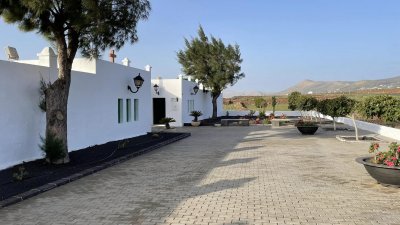
Every November 1st, Lanzarote families go to the cemeteries to visit the graves of their loved ones, lay flowers, and keep alive the memory of those who preceded them. The All Saints' Day celebration is a day of religious tradition, but also an opportunity to revive the customs and stories of generations who left their mark on the island.
Lanzarote's relationship with burials dates back to a time when churches and convents were also burial sites. For centuries, temples housed the remains of the deceased, and the place designated for each burial was largely determined by the social standing and economic means of the families. While some had privileged graves, a large part of the population was buried in common areas.
In Teguise, the former island capital, interments were carried out in the main church of Nuestra Señora de Guadalupe and in the temples of the Franciscan and Dominican convents. This custom began to change with the regulations that promoted the construction of cemeteries separate from religious buildings. The Royal Decree of 1787, promulgated during the reign of Charles III, established the need to move burials outside churches for health reasons. However, its implementation in the Canary Islands was progressive and conditioned by the circumstances of each locality.
The island's first cemeteries
The construction of the first Lanzarote cemeteries took place between the late 18th and early 19th centuries. The old cemetery of Tías, dated 1799, is the oldest preserved on the island. It was followed by Arrecife in 1809; San Bartolomé, whose first burials are recorded in 1810; Teguise in 1814; and Femés in 1818.
In the case of San Bartolomé, historical documentation allows for precise chronology. On August 20, 1809, Mayor Francisco de la Cruz Guerra Ferrer summoned the residents due to the lack of space to continue burying in the parish church. A week later, on August 27, it was agreed to build the cemetery next to the temple. The first burials began in 1810. The date 1813 appears, on the other hand, in later studies on the funerary architecture of Lanzarote and Fuerteventura, but it should not be confused with the start of interments.
The implementation of these enclosures was not uniform. In some places, churches continued to be used for decades, as happened in Yaiza, where burials in the church were maintained until approximately 1860. The first cemeteries were also built, in many cases, next to the parishes and within inhabited areas, maintaining a close relationship with religious and community life.
The old cemetery of Tías, located next to the church of Nuestra Señora de la Candelaria, is a testament to that early stage. Its construction in 1799 reflects Lanzarote's early incorporation into the transformation of funerary practices that spread throughout the Spanish territory.
Teguise: the cemetery that preserves two centuries of history
One of the burial grounds of greatest historical and heritage interest is located in Teguise. The Old Cemetery of La Villa, built in 1814, is one of the most representative testimonies of the evolution of burials in Lanzarote during the 19th and 20th centuries.
The enclosure remained in operation until 1979, when the municipal cemetery Nuestra Señora de Las Nieves was opened. For more than a century and a half, it housed the remains of residents of Teguise and other towns on the island, including members of families who played a prominent role in the economic and social life of Lanzarote.
Its architecture preserves elements of special interest, such as the funerary chapel, founded in 1822; the priests' crypt; various family pantheons; and a unique pyramidal tomb located opposite the main entrance. The complex reflects the different ways of representing the memory of the deceased, from the simplest graves to more elaborate funerary monuments.
In April 1945, a significant expansion of the enclosure was undertaken, with the incorporation of approximately 900 square meters of land. The project was promoted by Francisco García Escámez, head of the Economic Command of the Canary Islands, and the works were directed by Miguel Llivina Bonete. In the same month, the keys to the cemetery were handed over to the parish of Teguise, recognized as the legal owner of the facility. During 1944, resources had also been allocated to the expansion works of the cemetery.
Among the characters linked to the cemetery, Luis Ramírez González (1884-1950) stands out, recognized for his work as a patron and for his initiatives in favor of the heritage and culture of Lanzarote. Born in El Islote, in the municipality of San Bartolomé, he died in Barcelona on May 20, 1950, as a result of peritonitis, while on a pilgrimage to Rome for the Holy Year. He died at the El Carmen boarding house, located at number 12 Carmen Street in the Catalan capital.
Ramírez González had expressed in his will the desire to rest in the Catholic cemetery of Teguise, in a pyramid-shaped pantheon shared with his family. His remains were transferred from Barcelona in 1954 or 1955. The tomb is one of the most unique elements of the old cemetery and recalls the trajectory of a man whose activity left an important mark on the island's history.
After decades of abandonment and deterioration, the enclosure underwent a restoration intervention that made it possible to recover the doors, walls, chapels, stonework, tombstones, and crosses, in addition to conditioning the priestly crypt. On October 28, 2016, it reopened its doors to the public. The recovery returned to the citizens a space of great heritage value, with more than two centuries of history and numerous testimonies of Lanzarote society.
Los finaos: the night when families remembered their deceased
The relationship of the people of Lanzarote with their ancestors has not only been preserved in cemeteries. It has also endured through family customs, stories passed down from generation to generation, and popular manifestations linked to the days dedicated to the deceased.
One of the most deeply rooted traditions in the Canary Islands was the celebration of Los Finaos or Finados, during the night of October 31 to November 1. Families gathered in their homes, and the elders evoked their deceased relatives, sharing anecdotes and episodes from the lives of those who were no longer there.
Those gatherings had a marked family and community character. Seasonal products, dried fruits, dried figs, and other foods were shared, while conversations recalled names and events that were part of each household's history. The tradition allowed the younger generations to get to know their ancestors and maintain the bond with previous generations.
In Lanzarote, these practices were also related to the ancient "ranchos de ánimas" (choirs of souls), groups that performed songs and couplets linked to the memory of the deceased and prayers for souls. Their tours through the towns and visits to homes were part of an expression of popular religiosity in which music, neighborly solidarity, and religious beliefs intertwined.
The historian and official chronicler of Teguise, Francisco Hernández Delgado, has studied these manifestations and their relationship with the tradition of the "ranchos." On the island, the Easter "ranchos" preserve part of that musical and cultural heritage, although they have evolved into expressions specific to Christmas celebrations.
It is important to distinguish the dates of this cycle: "Finaos" were traditionally celebrated on the eve of All Saints' Day, October 31; November 1 corresponds to the feast of All Saints' Day, and November 2, to the Commemoration of All the Faithful Departed. Three different days united by religious and family practices dedicated to those who have passed away.
Photographs that return faces to memory
Photographs preserved in island archives allow us to reconstruct how these celebrations were experienced and recover scenes of daily life that, otherwise, might have been relegated to family memory.
Among the documents of special interest is the "Memoria de Lanzarote" collection, which preserves images taken by José Pérez Duque in the old cemetery of Teguise between 1961 and 1970. They show children and family members portrayed next to the graves of their loved ones during the days dedicated to remembering the deceased.
Those photographs show a custom that may seem unusual today: going to the cemetery as a family, cleaning and decorating the graves, and keeping a photograph next to the tomb. The visit was not only a religious act but also a way to transmit family history and the memory of those who had come before to the younger generations.
Cemeteries, a heritage that tells the history of towns
The cemeteries of Lanzarote are much more than burial places. Their tombstones, chapels, crosses, and mausoleums offer a glimpse into the evolution of island society, the economic differences of past eras, religious beliefs, and the families who contributed to building the identity of each municipality.
Funerary architecture also reflects changes in taste, economic possibilities, and artistic expression of each period. From simple crosses to family mausoleums, these spaces showcase different ways of representing the bond between those who remain and those who have passed away.
Each grave can lead to a personal story, a profession, a family, a migration, or an event that deserves to be documented. In many cases, inscriptions and associated archives help reconstruct episodes of local history that do not always appear in grand political, economic, or social narratives.
To this material heritage is added the documentary heritage. Historical research, photographs, and family testimonies allow for the recovery of customs that have changed over time and an understanding of how different generations have maintained their relationship with the deceased.
Two centuries after the construction of the first cemeteries, Lanzarote preserves a fundamental part of its history in its burial grounds. November 1st is once again a day to visit graves, place flowers, and remember the absent, but also an opportunity to recognize the value of a heritage that speaks of the lives of those who inhabited the island.
Because behind every cemetery there is a town, behind every grave a story, and behind every name engraved on a tombstone a part of Lanzarote's collective history.
Documentary and bibliographic sources
Municipal Historical Archive of Teguise. María Dolores Rodríguez Armas, D. Luís Ramírez González (1884-1950). Biography on his death, pilgrimage to Rome, and transfer of his remains.
José Ferrer Perdomo, The old Cemetery of San Bartolomé. Documentary reconstruction of municipal agreements from August 1809 and the first burials in 1810.
Edilia Rosa Pérez Peñate, The space of death: notes for a study of funerary architecture in Lanzarote and Fuerteventura, V Conference on Studies on Fuerteventura and Lanzarote, 1993.
Teguise City Council. Documentation on the reopening of the Old Cemetery, October 28, 2016, and background of the 1945 expansion.
Lanzarote Memory. Photographic collection of José Pérez Duque and graphic documentation of the expansion works of the Teguise cemetery.


Add La Voz de Lanzarote as a preferred Google source.
Stay informed with the latest current news.