
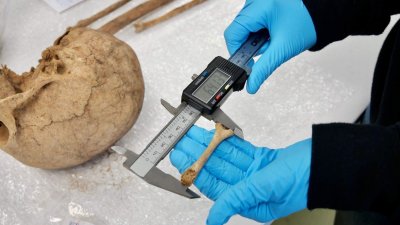
This October 19, the gaze on the history of Lanzarote focuses on the traces that remain underground and on the files that still pose questions. From two violent deaths about 1,800 years ago, reconstructed by archaeology, to several cases collected in the island's newspaper archive, this journey distinguishes documented facts from hypotheses and judicial outcomes that have not yet been confirmed.
A territory that still holds questions
Finding a corpse, identifying a lesion on bones, or knowing about an arrest does not mean a story has been clarified. Science can reconstruct part of what happened; in other cases, data remain scattered among news published at different times and documents whose subsequent trajectory is difficult to follow. Therefore, investigating requires separating evidence from hypotheses and from what the press may have reported at each moment. An arrest does not prove guilt, a suspicion does not prove homicide, and the absence of subsequent news does not allow us to affirm that a case is still open.
Two violent deaths 18 centuries ago
Long before Lanzarote became a tourist destination, two people died violently and their remains were left in volcanic tubes on the island. Decades after their discovery, a scientific investigation published in 2024 revisited both cases and provided new clues to interpret the injuries and the circumstances of those deaths. The study, published in the journal Quaternary Science Reviews with the title In the Bowels of the Volcano. Lethal violence in the dissemination of AMAZIGH groups to the Canary Islands, was authored by Verónica Alberto-Barroso, Teresa Delgado-Darias, Marco Moreno-Benítez, Ibán Suárez-Medina, Félix Mendoza-Medina, and Javier Velasco-Vázquez. The researchers analyzed injuries on the remains of two individuals from La Chifletera and Jameos del Agua, and provided new evidence about violence in the early Amazigh communities of the Canary Islands.
La Chifletera: the traces of a bladed weapon attack
In 1968, a group of speleologists discovered human remains in La Chifletera, a volcanic tube near El Golfo, in Yaiza. The following year, an intervention was carried out to recover part of the skeleton. A braid of hair about fifty centimeters long was found next to the bones; the skull, however, was not preserved among the recovered remains.
Anthropological analyses estimate that the individual was a man between 25 and 35 years old, of robust build and an approximate height of between 1.75 and 1.81 meters. Radiocarbon dating places his death between the years 207 and 338 of our era.
The observed injuries, especially the traumas in the thoracic region, point to several wounds produced by a sharp instrument. Their distribution and characteristics are compatible with a violent death in which the victim would have received multiple stab wounds. The weapon used is one of the most relevant aspects of the study. Its characteristics do not seem compatible with a manufacture from the mineral resources available on the islands, an indication that raises questions about its origin and the contacts between island communities and other territories.
By itself, however, it does not allow identifying the aggressor or reconstructing the attack. Nor has it been possible to establish why the body ended up in that volcanic tube. Science approaches the cause of death, but cannot recover all the details of a story that occurred about eighteen centuries ago.
Jameos del Agua: four injuries to the skull
The second case corresponds to a woman whose remains were discovered in 1977, during the tourist development work of the Jameos del Agua volcanic tube. Her skull remained for decades among the archaeological materials of Lanzarote, without the circumstances of her death being precisely known. Modern analysis identified four blunt force injuries to the head. Due to their distribution and characteristics, the traumas point to a violent death.
Researchers raise the possibility of an execution, although this interpretation does not equate to certainty about the context in which it occurred. The identity of the woman remains unknown. Nor has the motive for the aggression or who may have caused it been determined. Both findings demonstrate the value of reviewing archaeological materials with current techniques and, at the same time, recall their limits: bones can reveal injuries and provide clues about death, but they do not always explain the victim's life or the reasons for what happened.
When the archives do not tell the end
In contemporary events, the method of investigation changes, but not the need for caution. Newspapers record findings, preliminary autopsy results, arrests, and judicial decisions; each news item, however, reflects what was known on the date it was published and does not in itself certify the current status of a case.
The island's crime reporting chronicles deaths that raised questions during the initial investigations. In some cases, there were police and judicial actions whose subsequent evolution still needs to be verified.
In others, the hypotheses disseminated at the time are not enough to prove that it was a homicide. Revisiting those reports allows for the reconstruction of events without turning initial suspicions into conclusions. The decisive question is whether the doubts raised then received an answer. To answer it, it is not enough to reproduce old news: one must locate resolutions, consult official sources, and verify if there were subsequent actions.
Expedita Santana: arrests and an outcome to be confirmed
On December 7, 2008, two amateur fishermen found the body of Expedita Santana Guerra, 35, on the coast of Mala, in the municipality of Haría. The information published in those days described signs of violence and indicated that the victim's hands and feet were tied.
According to the news of the time, the autopsy pointed to asphyxiation as the cause of death. In February 2009, the investigation led to the arrest of two men allegedly linked to the case. Both appeared before Investigating Court number 7 of Arrecife and were released on provisional bail, subject to precautionary measures that included a ban on leaving the island and the confiscation of their passports. The available information allows for the reconstruction of part of the proceedings, but not for establishing how the procedure concluded.
To clarify it, it would be necessary to locate a subsequent judicial resolution or obtain official confirmation. Provisional release does not equate to a declaration of guilt, nor does it allow for the opposite conclusion; and not having found subsequent news does not prove that the case remains open. The judicial outcome, therefore, remains unconfirmed.
Cathaysa Rodríguez: the provisional dismissal does not close all questions
The disappearance of Cathaysa Rodríguez began on November 9, 2006. In April 2007, her body was found in the trunk of an abandoned vehicle in Arrecife. The discovery was made by her mother, who had been trying for months to find out her daughter's whereabouts. On January 28, 2011, La Voz de Lanzarote reported that the Court of Instruction number 5 of Arrecife had provisionally shelved the case without anyone having been arrested or charged for the death.
According to that information, the proceedings could be reopened if new leads or evidence emerged. The news allows us to establish the situation known in January 2011, but it does not clarify whether new actions were taken afterwards. To clear up that uncertainty, it would be necessary to check if the proceedings registered any developments or if evidence appeared that modified its situation. The story is not exhausted by the dates of the disappearance and discovery, nor by the provisional shelving. The search undertaken by her mother is part of the human dimension of the case, which deserves respect and rigor: the family's suffering should not be confused with what can be judicially proven.
Alfonso Fernández Ramos: the Tahíche case
In February 2007, Alfonso Fernández Ramos, 49 years old, was found dead inside a wardrobe in a house in Tahíche. The body was bound and wrapped in plastic. Information published after the autopsy indicated that he had died of asphyxiation. The police investigation attempted to locate two sisters of Polish nationality, surnamed Jurkszak, who lived with the victim. The officers were trying to reconstruct their movements and clarify what had happened in the house.
The press also reported the existence of a grave dug in the garden, although the body was never buried there. In 2009, La Voz de Lanzarote published information about Alfonso's family and collected the testimony of his ex-wife, who was demanding answers. The available news indicated that the two women under investigation had remained in prison for about eight months before being released due to lack of evidence.
The information allows for the reconstruction of part of the investigation and its consequences for the victim's circle. It does not authorize attributing criminal responsibility to the investigated persons, nor does it clarify the definitive outcome. This gap can only be closed with a judicial resolution or an institutional confirmation; until then, the result must be considered unverified.
The woman found near the San Román cemetery
On September 20, 2003, the body of a 38-year-old woman, identified in journalistic reports by the initials P. G. R., was found in Arrecife. News at the time described numerous stab wounds and indicated that the victim had been beheaded. In June 2007, a journalistic compilation of unsolved homicides included the case among those for which no public solution had been announced.
The reference describes what was known then, but does not allow us to establish what happened next. Among the consulted documentation, no judicial resolution has been found to clarify whether the case was archived, reopened, or concluded with the identification and conviction of a responsible person. Before closing the reconstruction, it is advisable to compare the victim's identity, the date, and the exact location of the discovery with the original news and official sources. The temporal coincidence of different events requires avoiding any confusion between cases.
José Jiménez Ramos, "El Sevilla": a suspicion does not prove a homicide
The body of José Jiménez Ramos, known as "El Sevilla," a parking attendant from Seville, was found floating near El Reducto beach in Arrecife on May 26, 2007. In July of that year, it was reported that he had filed a complaint for assault and threats a few days before his death. The same information indicated that the forensic doctor had found no signs of violence on the body and that the hypothesis known at the time pointed to death by drowning.
His family was waiting to know the results of the toxicological tests. The previous report justified the interest in clarifying the circumstances of the death, but it did not prove that the threats were related to the death. With the located data, it is not possible to present the case as a proven homicide. The episode shows one of the risks of the crime news: that a suspicion, repeated over time, ends up becoming a certainty. Journalistic work must distinguish between accredited facts, considered hypotheses, and questions that may have remained open for family members.
The disappearances of Francoist repression: memory and investigation
Not all unanswered stories belong to contemporary crime news. Lanzarote is also part of the history of disappearances linked to Francoist repression, which left families without information about the fate of their loved ones. The registry of repressed and disappeared persons of the Government of the Canary Islands includes Domingo Abreu Arocha, a day laborer from Arrecife, arrested twice in Gran Canaria and disappeared after the second arrest.
The file points to the Arucas wells as a possible burial site and indicates that he has not been identified or exhumed. Francisco Acuña Peraza, a native of Haría, is also listed. His file records a governmental arrest and states that his burial place is unknown. The files are a starting point, not the end of the investigation. Their content must be cross-referenced with arrest records, civil and military registries, archival documentation, family testimonies, and historical studies.
A possible burial site does not mean that the remains have been located there; similarly, documenting a disappearance does not in itself allow for the exact circumstances of the death to be established. These cases should not be presented as criminal enigmas in the usual sense. They are part of a history of political repression that demands historical investigation, identification of the victims, and, when possible, the location and recovery of their remains. The lack of information does not turn a disappearance into a legend: it compels continued investigation in archives, testimonies, and public policies of democratic memory.
What was left to know
The review reveals different levels of knowledge. In archaeological cases, science has provided evidence about the injuries and circumstances of two violent deaths. In contemporary events, the press archive reconstructs the initial police and judicial actions, although not always their outcome. In disappearances linked to Francoist repression, official records allow for the tracking of personal trajectories, but unknowns remain about the fate of some victims.
To complete the work, it would be necessary to locate, when the law permits, judicial documentation on the proceedings related to Expedita Santana Guerra, Alfonso Fernández Ramos, and the woman found next to the San Román cemetery. It is also necessary to check if there were any developments after the provisional archiving of Cathaysa Rodríguez's case, communicated in January 2011. The identity of each victim, the chronology, and the place of the events must be cross-referenced with original news and official sources.
In terms of democratic memory, it will be necessary to expand the documentation on disappeared persons and contrast institutional records with other historical sources. The purpose is not to gather all these episodes under the label of "unsolved deaths," but to specify what is known about each one and what evidence would allow for progress. That is the difference between a compilation of events and journalistic investigation.
Investigating also means recognizing what we don't know
Lanzarote holds stories of violence and disappearance belonging to very different eras. Some have found new explanations thanks to science; others require the reconstruction of judicial actions or deeper exploration of historical archives. The woman from Jameos del Agua and the man from La Chifletera are no longer solely archaeological remains recovered decades ago. Their bones have provided evidence of two violent deaths and have expanded the knowledge of the first Amazigh communities that inhabited the Canary Islands.
In contemporary cases, the families who demanded answers and the news that documented the investigations are part of a memory that deserves rigorous review. For disappearances linked to Francoist repression, official records offer traces that still require investigation and, when possible, identification and recovery of remains. Investigating does not consist of multiplying mysteries, but of reducing them: returning to documents, verifying data, and separating what has been proven from what was only known through contemporary reports or remains unconfirmed. An unanswered question does not authorize inventing one. But it should not be a reason to stop searching for it either.
Documentary and newspaper sources
Alberto-Barroso, Verónica; Delgado-Darias, Teresa; Moreno-Benítez, Marco; Suárez-Medina, Ibán; Mendoza-Medina, Félix; Velasco-Vázquez, Javier. «In the Bowels of the Volcano. Lethal violence in the dissemination of AMAZIGH groups to the Canary Islands». Quaternary Science Reviews, volume 343, article 108895, 2024. https://www.sciencedirect.com/science/article/abs/pii/S0277379124003962
La Voz de Lanzarote. «One of the first lime kilns in Lanzarote found at the San Marcial de Rubicón site». Updated October 19, 2024. https://www.lavozdelanzarote.com/actualidad/cultura/hallado-primeros-hornos-cal-lanzarote-en-yacimiento-san-marcial-rubicon_230049_102.html
Agencia EFE. «Lanzarote, 3rd century: archaeological evidence of a knife murder and an execution emerges». September 5, 2024. https://efe.com/canarias/2024-09-05/lanzarote-siglo-iii-afloran-las-pruebas-arqueologicas-de-un-asesinato-a-cuchillo-y-una-ejecucion/
La Voz de Lanzarote. «Deaths without culprits». 2009. https://www.lavozdelanzarote.com/actualidad/sucesos/muertes-sin-culpables_54357_102_amp.html
La Voz de Lanzarote. «Justice dismisses the case of Cathaysa, who was found dead in the trunk of a car». January 28, 2011. https://www.lavozdelanzarote.com/actualidad/sucesos/la-justicia-archiva-el-caso-de-cathaysa-que-aparecio-muerta-en-el-maletero-de-un-coche_64000_102.html
The Voice of Lanzarote. Information about the families of Alfonso Fernández Ramos and Cathaysa Rodríguez and their claims for information. https://www.lavozdelanzarote.com/actualidad/sucesos/las-familias-de-alfonso-fernandez-y-cathaysa-rodriguez-colocan-carteles-con-sus-fotografias-para-encontrar-pistas-sobre-sus-crimenes_76338_102_amp.html
Government of the Canary Islands. Searcher for repressed and disappeared persons. Files of Domingo Abreu Arocha and Francisco Acuña Peraza. Archival expansion and verification of individual files must be completed before final closure.
Editorial note: newspaper sources allow the reconstruction of facts known at the time of their publication, but do not by themselves accredit the current judicial situation of cases whose subsequent outcome could not be verified.

Add La Voz de Lanzarote as a preferred Google source.
Stay informed with the latest current news.