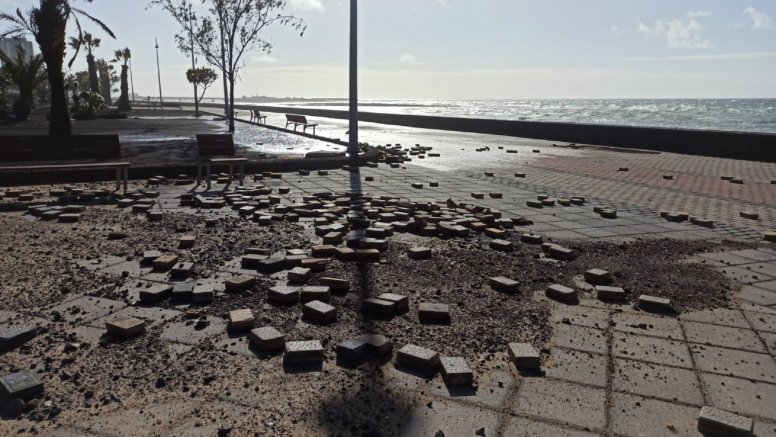
The environmental organization Greenpeace has taken note of the Canary Islands' fight against cement and warns of the "crisis of vulnerability" in which the islands find themselves due to the rising sea level caused by the warming of the waters. This is highlighted in its report on the situation of the Spanish coast, Destrucción a Toda Costa, published last July.
The document, which dedicates a section to each Spanish autonomous community and highlights the environmental struggle in the Canary Islands, warns that two realities converge on the islands: the climate emergency, which will affect Macaronesian territories like the Canary Islands more; and human pressure on the coast.
This environmental organization highlights that "violent storm surges" and the warming of the sea in the cold season reveal the vulnerability of the archipelago. Furthermore, it cites the destruction of part of Arrecife's coastline during severe weather episodes last year, which were repeated again this March, as an example.
Throughout the country, a total of 246 million euros were invested in 2026 to rebuild the coastline. However, it has pointed out that not all destruction is related to storms, but that the "precarious situation of the coast," which has been "mistreated for decades with constructions on the beachfront," also plays a role.
Regarding the consequences of the climate emergency, the non-governmental organization points out that in Macaronesian territories (Azores, Madeira, Savage Islands, Canary Islands, and Cape Verde), the rise in sea level will be more pressing than the global average. In total, the ocean is projected to rise by nearly one meter by the end of the century in these archipelagos.
Meanwhile, regarding human impact, Greenpeace relies on the report SOS Costas Canarias, commissioned by the Fundación Canaria, which indicates that in the Canary Islands, four kilometers of natural coastline are lost each year due to human pressure, especially for activities related to tourism. The NGO emphasizes that the archipelago is in "an unprecedented state of fragility."
Furthermore, it points to the records of the Canary Agency for the Protection of the Natural Environment, which opened 1,419 sanctioning proceedings for illegal constructions and unauthorized earth movements. Of these, 115 were registered in Lanzarote, mainly in Haría and Teguise, as reported by La Voz at the beginning of the year.
Finally, he also highlighted that Spain's largest marine reserve, in the north of Lanzarote, suffers "a systematic collapse of its fishing biomass" due to the climate crisis and "inadequate management" of fishing.
Add La Voz de Lanzarote as a preferred Google source.
Stay informed with the latest current news.