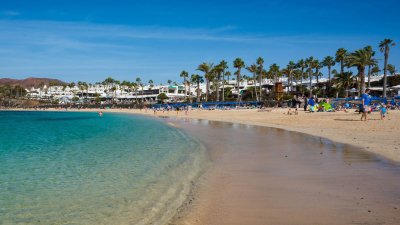
Greenpeace warns in its report 'Destruction at All Costs 2026' of the "serious crisis" suffering the Canary Islands' coastline, which loses four kilometers of natural coast per year due to human pressure and climate change.
The Canary Islands' coast has 18 critical points, 150 kilometers of coastline in danger, and almost 1,500 open files, with factors such as "the suffocation of cement" or "illegal constructions in public areas and regulatory deregulation" that "threaten the integrity of the islands' coast," warns this study, which ING announced this Thursday in a statement.
It assures that "artificial breakwaters or the repair of promenades after storms are just a very expensive and increasingly less durable patch compared to nature-based solutions."
Furthermore, the environmental organization warns that scientific projections predict "an ocean rise close to one meter by the end of the century," so "about 150 kilometers of the Canary Islands' coast are at imminent risk."
Climate change "has already arrived and is lethal," emphasizes the NGO, which denounces that while "there is talk of heritage defense to maintain constructions in risk areas, physical reality is ignored" because "neither the sea nor climate change will respect administrative exceptions."
Human activity, Greenpeace points out, destroys four kilometers of natural coast each year due to artificialization, highlighting conflicts such as the one caused by the Cuna del Alma macro-project in Adeje, judicially investigated for invading the protection easement, protests against the La Tejita hotel for destroying protected dunes, or the demolition order for the Oliva Beach hotel in Fuerteventura.
"The lack of control over land is evident in the 1,419 sanction files opened by the Canary Agency for Nature Protection in just one year," it states.
Furthermore, this report emphasizes that the onslaught of storms, such as storm 'Therese', which caused eight million euros in damages and destroyed the natural pools of La Laguna, "has exposed the fragility of this artificialized coastline."
Among the problems at sea, whose biodiversity "suffers alarming biological alterations," it mentions the case of Punta Blanca (Tenerife), with the Underwater Gardens company project which, "in a flagrant exercise of greenwashing, hides a private theme park over the Teno-Rasca Special Conservation Zone," so the latest news about the possible annulment of the Declaration of Insular Interest is "good news" for Greenpeace.
In parallel, the study detects that the marine reserve in northern Lanzarote "suffers the collapse of its fish biomass due to climate change and the alteration of currents," which favors the expansion of tropical species such as the old woman (Sparisoma cretense) to the detriment of mackerel, while the University of La Laguna confirms that the "thermal rise damages three essential species of macroalgae."
Greenpeace celebrates, however, that the Cabildo of Gran Canaria has halted a sea bass macro-farm in La Aldea de San Nicolás to protect the environment and sustainable fishing.
The NGO also refers in its report to the aggression that "massive earth movements by a subsidiary of the Lopesan group" have represented for Veneguera beach (Gran Canaria), which it claims "is awaiting sanction from Costas."
Faced with obsolete infrastructure, such as the Fonsalía macro-port, which has not yet disappeared from the Canary Islands' port plan, Greenpeace highlights "nature-based solutions and strategic withdrawal plans," such as the demolition of the abandoned Añaza hotel to renaturalize the Santa Cruz de Tenerife waterfront or the investment of 1.2 million in Las Caletillas beach (Candelaria, Tenerife) to enable integrated access without breakwaters.
To these, it adds the management in La Cícer (Las Palmas de Gran Canaria), where the City Council "avoided dumping artificial sand by scientifically demonstrating that the sea's own hydrodynamics recover sediments in spring."
“The Canary Islands' coast is facing a climate crisis that is increasingly leaving more visible and violent impacts. The Administration must face this reality to guarantee the survival of its coastal wealth,” stressed the head of Greenpeace's Coastal Adaptation campaign, María José Caballero.
Therefore, the NGO calls for natural solutions that prioritize the restoration of nature over groynes and breakwaters, in order to "stop construction in flood-prone areas and in the last free stretches of the coast."
And it proposes "planning the removal of exposed infrastructure, assuming that artificial sand is economically unviable, managing rivers and reservoirs so that natural sand reaches the beaches again, and designing the future of the coast under scientific criteria, moving away from political short-termism."


Add La Voz de Lanzarote as a preferred Google source.
Stay informed with the latest current news.