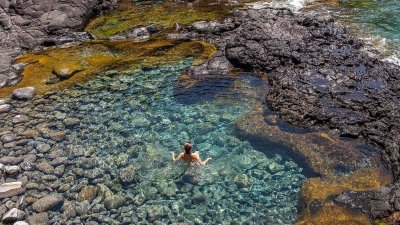
The typical paper tourist guides of yesteryear have given way to social networks like TikTok or Instagram, which many use to organize their trips and see what places to visit. Through videos of certain natural areas of Lanzarote recorded by tourists themselves, and even locals, visitors arrive without really knowing their characteristics or the danger of them. This is the case of Los Charcones, a place presented as "paradisiacal" in hundreds of videos, but which has claimed several lives in recent years.
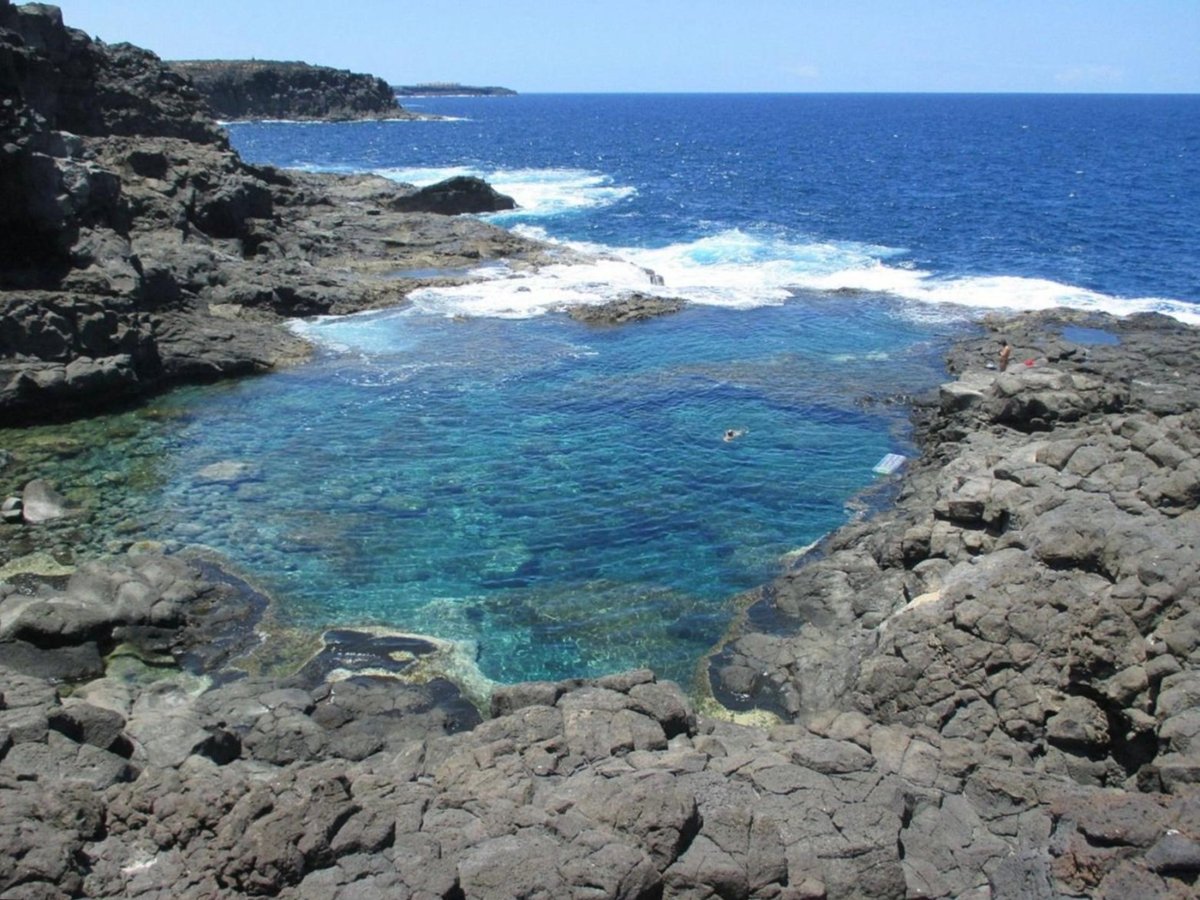
This area of Los Charcones, located in the southwest of Lanzarote, is characterized by having "a silhouette of a rocky formation with a very pronounced platform where there is no shore to access by walking and, in addition, it is very exposed because it has no shelter to mitigate the force and power of the waves," explains Chano Quintana, an aquatic safety expert and president of the Canarias, 1500 Km de Costa Association.
This part of the island's coastline is known for the force of the waves and the depth, which causes different coastal phenomena to form, such as undertow waves and whirlpools. "For a swimmer with few swimming skills to enter the water here is a significant danger," assures Quintana.
Los Charcones has claimed several lives over the years, five in the last year. The latest victims died in January of this same year when four young Americans approached this area despite the orange alert for strong waves that was in effect on that tragic January 25 and the fence that prohibited passage. Three of them drowned. In August of last year, the 30-year-old young man Pablo Brieba died after drowning in these natural pools, and last December, a young Italian fisherman who was rescued in cardiorespiratory arrest died in the same area.
What these undertow currents do is suck a person out to sea, making them a deadly trap. "The undertow current normally forms on sandy beaches, but in Los Charcones we are talking about a rocky area where the series of waves arrives and impacts with all its force and speed against the rocks, and all that mass of water, upon rebounding, returns from land to the sea," explains the expert. As the water returns from land towards the sea, this current impacts with the wave coming from the sea, causing a collision "that raises the water level."
Promoted as a "paradise" on social media
Social networks play a very important role in the promotion of natural areas that until a few years ago were totally unknown to tourists, such as Las Grietas or, in this case, Los Charcones. Apart from the environmental impact, the overcrowding and degradation that these spaces suffer due to the enormous number of tourists who visit them, they also pose a great danger to those who go to them without knowing their characteristics, which can turn them into deadly places.
A quick look at TikTok is enough to find thousands of videos of tourists showing the beauty of Los Charcones with phrases like "spectacular place in Lanzarote" or "we couldn't leave Lanzarote without coming to Los Charcones". However, the vast majority of videos do not mention the danger of this area and the different rescues and deaths that have occurred.
Many of these videos exceed thousands of views and, even, one of them reaches 1.2 million views and more than 16,000 shares.
Furthermore, one of the videos we can find on this social network shows how a couple is bathing in one of the pools with calm water, but suddenly a large wave surprises them and they are forced to get out of the water quickly. "Never underestimate the power of nature, luckily we got out fine, but minutes later another very strong wave arrived and knocked a couple with backpacks, clothes and cameras into the water," says the description of the video, which has accumulated 16.7 million views.
This massive promotion by the tourists themselves becomes a vicious circle that feeds itself continuously, but not only by visitors. There are tourist websites that recommend visiting Los Charcones without even alerting tourists to its dangers and simply highlighting its beauty, spectacularity, and uniqueness.
Thus, social networks and the use of mobile phones have become one of the causes of drownings in the Canary Islands. "A one-year-old child can drown in 27 seconds and a four or five-year-old child can do so in two minutes," he details, warning that the carelessness that causes the deaths of minors is often due to distraction with screens.
Recklessness, the bather's worst enemy
Between 15 and 20% of people who have drowned so far in the Canary Islands did so in natural pools, rock pools or small ponds. "The bather thinks that, even seeing waves out at sea, they are safe within the perimeter of that rock pool, but as soon as the wave comes, it will raise the water level and cause the bather to lose their footing and be at the mercy of the sea," he points out.
This false sense of security often occurs in these types of rock pools or natural pools. However, this belief is mistaken, as a wave can breach any existing barrier without warning and drag the bather away.
After this happens, the person ends up being thrown out of the rock pool and finds themselves in an area of lava rocks that "are like sharp knives." "This violent expulsion from that environment can often cause a blow to the head, and that traumatic brain injury will cause the bather to lose consciousness or become disoriented and drown," points out Chano Quintana.
From the Canarias, 1500 Km de Costa Association, they have analyzed the behavior of bathers in the Canary Islands, and there is a difference between a local person and a tourist. Recklessness, without a doubt, becomes the bather's greatest enemy, but two types are distinguished: the conscious reckless person and the unconscious reckless person.
The conscious reckless person, as the expert explains, is usually the Canarian bather. This is someone who thinks they have everything under control by knowing the bathing area and believes nothing will happen to them. "It is this overconfidence that causes the fatal outcome," he says. On the other hand, the unconscious reckless bather is usually a tourist who is normally unaware of possible warnings about rough seas. Furthermore, to this is added the lack of swimming skills, which, in a scenario with minimal risk, ends up leading to a dangerous situation. Out of every ten deaths in Canarian waters, seven are foreign tourists, according to the president of the association.
Lack of surveillance
Despite their danger, Los Charcones and other areas such as Papagayo beach do not have a lifeguard service; instead, there are only lifebuoys to be used by the bathers themselves in case of emergency.
In the case of Los Charcones, the Security and Emergencies Consortium has carried out surveillance and deterrence work in this area on occasions when there have been alerts for rough seas. However, being an area of difficult access by sea and land makes it even more complicated to act in case of emergency.
The aquatic safety expert recommends that, whenever you want to go to a beach, it should always be one with lifeguard services. "A person who is drowning and goes into cardiorespiratory arrest, every second that passes and they are not attended to counts, as the chances of survival are reduced exponentially," he warns.
Once the wave drags a swimmer in a rocky area like Los Charcones, Quintana insists that "there are few possibilities of survival no matter how much you do." "Either you hold onto a rock as best you can or to some railing, but the force of the tide itself means that, no matter how hard you try, you won't be able to," he continues. This is why the chances of survival are very low.


Add La Voz de Lanzarote as a preferred Google source.
Stay informed with the latest current news.