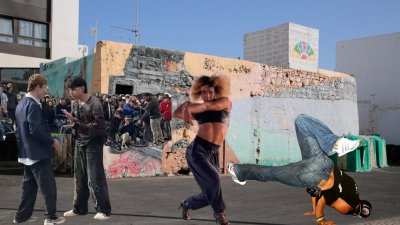
In recent weeks, the expression farming aura has spread like wildfire across social media and word of mouth. This term, which is now part of Generation Z slang, is a colloquial expression that means something like acquiring a great reputation through confidence and presence to "score points." In many parks in Spain, many young people gather to carry out these battles, in which two people face each other and the audience forms a circle around them.
To understand it better, farming aura is doing any type of move that makes you more "iconic" or have more presence than your opponent. As for the meaning of aura, it means how 'cool' someone is. Having aura is being a person with presence and magnetism, a term widely used by young people that has emerged from social media.
However, this new practice, widespread among many young people and boosted on social media like TikTok, is one of many that also captivated past generations, such as breakdancing, rap battles, or voguing, which, at the time, were also considered by many as frowned-upon activities.
And indeed, for a part of society, farming aura is a phenomenon that many describe as "ridiculous" or "second-hand embarrassment," even though many defend that it is just a trendy pastime for young people who are simply having fun outdoors without causing problems.
Breakdancing, a dance style that triumphed among Lanzaroteans in the eighties
One of the examples of these phenomena in previous generations is breakdancing, an urban dance style originating from hip hop that emerged from African American communities in the Bronx and Brooklyn and became popular worldwide in the seventies and eighties. Breakdancing also reached Lanzarote in the eighties, and the island's youth practiced it in the streets.
According to some of these Lanzaroteans, films like Beat Street (1984) marked the entry of this dance style into their lives. "All the guys on the island started and we created small crews," he recalls. "We painted some small graffiti and, above all, what we did was dance and have battles, which back then we called 'piques'," he continues.
These battles were held in schools because they could put cardboard on the floor and dance on it. "We would challenge each other, for example, on a Saturday at the School of Arts and Crafts or at the Antonio Zerolo school, and besides, those of us who danced better would go to Puerto del Carmen, put out a cap, and the tourists would give us money," he recounts. With this money, they would go to the movies or have a drink with friends.
"It was very fun and we would challenge people both in schools and in the old Islas Canarias park because there was a skating area next to the Puente de las Bolas where we would bring cardboard and a huge double cassette deck boombox (with two cassettes at the same time)," he explains. In these breakdance battles, they would take turns, first one opponent would dance, then the other. "One danced better on the floor and another up, I was good at spinning with my head on the floor," he reveals. According to him, "the ones who won back then were the ones who did the screw and the windmill."
Although the audience would gather around to enjoy the spectacle, he says that "there were no judges" and the winner was decided by obviousness. "When we were very good, there was no contest," he assures. "When we were very young, the older ones got competitive and there was some pushing, but there were never fights, and I remember we ran to the School of Arts and Crafts to see that competition, it was impressive," he admits.
Such was the success of some of these young people that sometimes, the old Wilson nightclub contacted them to go and dance. "They would have us dance so people could see us and they paid us 1,000 pesetas back then," he recalls.
Although it was a very healthy and normal pastime among young people, many saw it as a danger. "They told us that breakdance was bad for the bones because they saw us hitting the floor with movements like the caterpillar, where you had to throw yourself on the floor and jump on it," he indicates.
Rap battles, an example of camaraderie and respect
Another of the pastimes that gathered (and still gather) the youngest people in the street were rap battles. Its origin dates back to the seventies in New York and it is a type of confrontation that comes from freestyle, which in turn arises from Mcing (rap), an element of hip hop. One of its most important characteristics is that it was born to "claim the rights of minority ethnic groups in the United States." In the case of Spanish-speaking countries, it was in the nineties and 2000s when it reached the squares and parks as a youth pastime.
As the artist and freestyler Antonio Miguel González, also known artistically as Nase, explains, freestylers usually meet every week and have street battles to which anyone can join. "Sometimes new kids arrive who like improvising and rhyming, and from there, they usually become part of this group and then, generally, over time they improve that mental process," he indicates.
Nase began rapping, writing songs, and improvising in 2007, but "back then there were no applications like WhatsApp, so the way to create these groups of freestylers was through groups of friends. In my case, studying at the institute with other classmates from other courses, we formed our group of rappers and we met that way not only during recess, but also on weekends."
In the mechanics of rap battles, two participants usually face each other and compete by rhyming over an instrumental. What is valued in these competitions is the *flow* (adaptation to the rhythm), the message, the style, and the staging, among other aspects. A jury of three to five judges decides the winner and conveys their feelings. When the judges' decision is a majority, that is the definitive result.
"One of the aspects that I think is most important is that freedom of expression that grants the possibility of rhyming about whatever you want over an instrumental. Let's say that freestyle is the crudest representation of freedom of expression in *hip hop* culture," the artist points out.
Furthermore, he emphasizes that "it also contributes a series of values such as companionship, collectivity, tolerance, and respect, although many may think that a rap battle is two freestylers insulting each other, the reality is that they always start by shaking hands and in most cases end with a hug and a greeting".
Farming aura with influences from voguing
During the encounters to *farm aura*, different movements are used, all that the participant can think of, to show that presence that is sought and to overcome the opponent. Within these movements, there are influences from other dances such as voguing, an urban dance style characterized by imitating the poses of models in fashion magazines. In fact, the well-known magazine *Vogue* took its name from this dance.
Specifically, voguing consists of freezing movement in dramatic and angular poses to the rhythm of house music. This dance style emerged in the seventies and eighties in Harlem, New York, at the hands of the African American and Latino LGTBIQ+ community.
It was usually danced in the *Ballrooms*, a type of ballroom where through voguing they managed to express themselves and found refuge. In these ballrooms, dance competitions were held between "houses," that is, those chosen families in which people from the community felt understood and free.
The fame of voguing spread significantly worldwide thanks to the 1990 documentary *Paris is Burning* and the popular music video for *Vogue* by artist Madonna.
Add La Voz de Lanzarote as a preferred Google source.
Stay informed with the latest current news.