
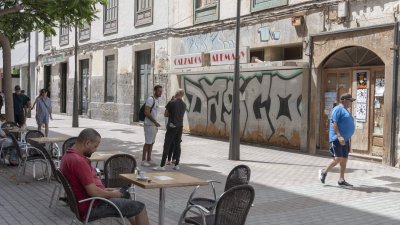
León y Castillo street, popularly known as Calle Real, preserves the memory of a city that grew under the shelter of the port and ended up becoming the main urban and commercial center of Lanzarote. Its layout was part of the old Royal Road that connected Arrecife with Teguise, then the political and administrative center of the island.
The development of the town was closely linked to maritime activity, the exchange of goods, and the island's economic transformation. The Timanfaya eruptions, between 1730 and 1736, profoundly modified the landscape and economy of Lanzarote, while Arrecife gained prominence as a port and commercial enclave.
The island's capital status, assumed by Arrecife in 1847 in place of Teguise, consolidated this process. The city began to concentrate institutions, services, and businesses, attracting residents from different municipalities. Calle Real progressively became one of the most representative spaces of that transformation.
Its importance was not limited to economic activity. It was the place where purchases were made, errands were run, shops were visited, and everyday encounters took place. A street that built a shared identity for generations of Lanzaroteans.
Shops, homes, and families: the identity of the street
For a large part of its history, Calle Real maintained a close relationship between commercial activity and domestic life. Many buildings combined the family business and the home in the same property: on the ground floors, customers were served or goods were stored, while the upper floors housed their inhabitants.
This model favored a direct relationship between merchants and customers. The owners knew the families, their needs, and their economic possibilities. Trust, personal interaction, and, at times, credit sales were essential elements of that activity.
The establishments had proper names and were linked to people and families who ended up becoming part of Arrecife's memory. Commerce was also a form of coexistence: neighbors went to buy, but they took advantage of the walk to chat, meet, and participate in the life of the center.
The architecture preserves testimonies of that past. Interior courtyards, staircases, corridors, and traditional facades allow us to recognize the different stages of the city's growth and the way its inhabitants organized their homes and businesses.
La Casa Amarilla, the Hotel Orienta, and the heritage of León y Castillo
Among the most representative buildings is La Casa Amarilla, at number 6, the former headquarters of the Cabildo de Lanzarote, an institution created in 1913. Its presence recalls Arrecife's role as the island's administrative center. The building is protected as a Site of Cultural Interest.
At numbers 23 and 25 is the Segarra building, whose facade is also protected. Its history is linked to the island's industrial and commercial activity: around 1932, the La Defensa tobacco factory, considered the first and only one in Lanzarote, was established there. Later, the building became associated with the Segarra shoe store.
At number 35 is Tamaragua, a house from the early 19th century that represents the affluent traditional architecture of Arrecife. Its interior courtyard and corridors preserve characteristic elements of the old manor houses of the capital. It was declared a Site of Cultural Interest in 2024.
Very close by, at number 37, stands the Hotel Oriental, founded by Claudio Toledo Cabrera at the beginning of the 20th century and considered one of the first hotels of a certain category in Lanzarote. Its facilities hosted merchants, visitors, professionals, and prominent families who arrived on the island.
The hotel was also linked to intellectual and educational life. Among its guests was the writer and professor Juan Millares, who came from Gran Canaria to teach with his family. There he met Agustín Espinosa, a fundamental figure in Canarian literature and one of the most prominent names in Lanzarote's cultural life during that era.
These buildings show that Calle Real was not solely a commercial space. Its buildings are part of the institutional, residential, and cultural history of Arrecife.
Prat, Arencibia, El Barato, and Ferrer: the commerce that marked an era
For decades, Calle Real was the main commercial showcase of Lanzarote. Neighbors from Arrecife and other municipalities would go to its establishments to buy clothing, footwear, fabrics, and household items. The capital concentrated an offering that made shopping a regular activity for a large part of the island's population.
Family businesses predominated, many of them specialized, where the owner knew their customers and maintained an ongoing relationship with them. Personalized attention and trust were part of a model that transcended the simple commercial transaction.
The history of the street is linked to names that remain in the memory of numerous families: Prat, linked to Juan Prat; Arencibia, associated with Antonio Becerra; El Barato, related to Pepe Arencibia, and Almacenes Ferrer. Each establishment had its own clientele and a recognizable identity.
Other businesses, such as Confecciones Tito and Medina, are also part of the commercial memory of the street. The disappearance of many of those establishments progressively modified the urban landscape and eliminated a part of the activity that had given personality to the center.
It was not just about losing shops. With each closure, shop windows, counters, jobs, and personal relationships built over years disappeared.
1977: the photograph that preserves commercial memory
Old photographs allow us to reconstruct a Calle Real that has changed profoundly. Among the graphic documents, a 1977 image taken by Ambrosio Robayna Fernández and preserved in the collection of José Manuel Montero Barreto stands out.
The photographic collection allows us to identify facades and establishments such as the Matallana pharmacy, the Cabrera Panasco house, Rogelio Tenorio's pharmacy, Las Cuatro Esquinas, and various premises in the León y Castillo area. References linked to Almacenes Ferrer, the Atlántida Cinema Theater, Pensión Alespa, and Casa Alfa also appear.
Beyond their architectural value, these images show the signs, shop windows, vehicles, and the occupation of public space. They are testimonies of a city in which commerce constituted one of the main engines of urban life.
The preservation and dissemination of these collections in the island's digital archives allow for the recovery of a part of collective memory and the documentation of the transformation of Arrecife's main commercial artery.
The decline: a crisis that predated the pandemic
The loss of prominence of Calle Real did not begin with the closure of its large establishments nor can it be attributed to a single event. It was the result of a progressive transformation of the commercial model, urban mobility, and consumption habits.
The increased use of automobiles, the expansion of residential areas, and the emergence of new commercial areas modified consumers' relationship with the center of Arrecife. Large establishments offered parking, a concentration of shops and services, while traditional commerce had to face greater difficulties in competing.
Deiland, in Playa Honda, and Biosfera Plaza, in Puerto del Carmen, became alternatives for a portion of consumers who previously went to the capital. Arrecife's loss of commercial attraction was accompanied by problems related to parking, the variety of offerings, and the state of the urban environment.
These difficulties were already documented in April 2004, when the Lanzarote Island Council's Data Center published a study on the Arrecife Zona Centro commercial area. The research, based on 428 interviews conducted at the end of 2003, warned of competition from other commercial areas and problems affecting the shopping experience.
17.7% of the people surveyed pointed to the lack of parking as a negative aspect and 14.2% mentioned the insufficient commercial variety. Furthermore, 35% considered the offerings of the Zona Centro to be scarce and 71% missed other establishments or facilities.
These are figures corresponding to a survey from more than two decades ago, not indicators of the current situation. Their value lies in demonstrating that the competitive deterioration of the center was already an institutional concern long before the most recent closures.
The study also emphasized that commerce plays an urban function that goes beyond sales: it generates movement, promotes coexistence, and maintains activity in the streets. A warning that remains relevant for understanding the future of Calle Real.
From the pandemic to the closure of Zara and the opening of the Open Mall
The 2020 health crisis worsened the problems that traditional commerce had been dragging. Restrictions, the interruption of activity, and reduced mobility particularly affected businesses that depended on in-person customers.
In May 2021, Zara closed its establishment on Calle Real as part of the reorganization of its commercial presence and its move to the new Open Mall space. The departure of a highly visible brand was one of the most significant episodes in the transformation of the center's offerings, although it does not solely explain the area's decline.
On November 11, 2022, Open Mall Lanzarote opened, located at number 156 León y Castillo. The new center incorporated a commercial model based on the concentration of establishments, services, and leisure, with an approximate gross leasable area of 35,100 square meters and 1,075 parking spaces, 980 underground and 95 outdoor.
Its opening introduced a new commercial centrality on the same street that had historically represented Arrecife's traditional commerce. However, it would be simplistic to attribute the center's situation to Open Mall: the loss of competitiveness had been documented for years prior and was due to structural factors.
The coexistence of both models presents a challenge for the city. The activity of the new commercial spaces should not translate into the emptying of the historic center. Arrecife needs to connect its different areas and recover reasons for residents and visitors to continue walking down Calle Real.
Almacenes Ferrer: the end of an era in May 2024
If there is an establishment that symbolizes the trajectory of family businesses in Arrecife, it is Almacenes Ferrer. It opened its doors on December 12, 1958, at number 32 Calle Real and for more than six decades was a benchmark for generations of Lanzaroteños.
Driven by Emilio Ferrer, the business grew especially during the 1960s and 1970s. Its expansion was linked to commercial contacts with suppliers from Barcelona and Bilbao and the introduction of credit sales, a formula that facilitated purchases for agricultural and fishing families.
At its peak activity, it employed around 80 workers. It also participated in social and commercial initiatives organized by entities such as Sociedad Democracia and Círculo Mercantil, including fashion shows.
The relationship with its employees was a prominent part of its history. At the time of the closure of the historic facilities, in May 2024, the staff consisted of 23 people. Pedro Ferrer, son of the founder, recalled the family nature of the company and the workers' connection to the business.
The closure of the establishment on Calle Real did not mean the total disappearance of the family business, which continued to operate in other establishments in tourist areas. But it did put an end to more than 65 years of presence in the city center and meant the loss of one of its most emblematic stores.
Ferrer's farewell had symbolic value. For many residents, it represented the end of a space associated with family memories, childhood purchases, first work experiences, and personal relationships built over generations.
Pedestrianization and the future: more than urban reform
The revitalization of Calle Real is part of the debate about the future of Arrecife's city center. In December 2024, a proposal was discussed at the City Council to extend pedestrianization from Las Cuatro Esquinas to Vía Medular, with actions such as the incorporation of benches, trees, and gardens, as well as the leveling of roads and sidewalks.
The initiative presents an opportunity to improve public space, but pedestrianization alone does not guarantee commercial recovery. Its effectiveness depends on planning that considers the needs of residents, merchants, people with reduced mobility, public transport, loading and unloading, and emergency services.
It is also essential to have parking alternatives, convenient connections with other areas of the city, and continuous maintenance. Urban renewal must be accompanied by measures that encourage the opening of businesses, support existing establishments, and generate cultural and social activity throughout the year.
The municipal budgetary documentation for 2024 includes credit modifications related to the Commerce area: a positive modification of 150,000 euros for advertising and promotion, another negative one of 30,000 euros for subsidies to small and medium-sized enterprises, and an allocation of 400,000 euros linked to the improvement of the open commercial area. These budgetary movements do not equate to the final expenditure incurred and must be distinguished from recognized obligations and payments made.
The general settlement of the municipal budget for 2025, approved by Mayoral Decree 2026-2326, of February 27, 2026, and communicated to the plenary session on March 27, recorded definitive credits of 165,458,395.67 euros and net recognized obligations of 84,236,118.83 euros. These are figures for the entire municipality, so they do not allow for specific conclusions to be drawn about the execution of commercial items.
Recovery requires a stable strategy that coordinates the City Council, business associations, property owners, merchants, and residents. Isolated actions are not enough: defined objectives, continuity, and evaluation of results are needed.
Recovering Calle Real is recovering a part of Arrecife
The history of Calle Real allows us to follow the evolution of Arrecife: from the old road that connected the island capital with Teguise to its consolidation as Lanzarote's main commercial axis. Its buildings recall the institutional, cultural, and residential life of the center; its old businesses, a way of commerce based on proximity and trust.
The disappearance of establishments such as Prat, Arencibia, El Barato, and, more recently, Almacenes Ferrer reflects a change that began long before the pandemic. Competition from new commercial areas, accessibility difficulties, and the transformation of consumer habits progressively weakened a model that had given life to the center for decades.
The challenge is not to reproduce a street that no longer exists, but to recover its capacity to attract activity. To do this, it needs commercial diversity, well-maintained public spaces, accessibility, heritage protection, and a strategy that connects its history with the needs of the contemporary city.
Calle Real was much more than a succession of shop windows: it was the place where Lanzarote shopped, worked, and met. Recovering its prominence means bringing life back to an essential part of Arrecife and preserving a memory that belongs to the entire island.
DOCUMENTARY, HERITAGE, AND PRESS SOURCES
• **Government of the Canary Islands:** Official Gazette of the Canary Islands and declarations of Asset of Cultural Interest for Casa Amarilla, Segarra building, Tamaragua, and Hotel Oriental.
• **Cabildo de Lanzarote:** Data Center. Study of the Arrecife Zona Centro commercial area (2004). • **Memoria Digital de Lanzarote and Memoria de Arrecife:** photographic collections and historical documentation of Calle Real and Almacenes Ferrer.
• **Arrecife City Council:** urban planning documentation, pedestrianization proposals, and budgetary documentation.
• **Archigestión and Turismo Lanzarote:** technical information on Open Mall Lanzarote.
• **La Voz de Lanzarote:** interviews and documentation on Almacenes Ferrer and the commercial transformation of Arrecife.
• **Historical Newspaper Archive and island archives:** documentation on the social, economic, and commercial evolution of the capital.


Add La Voz de Lanzarote as a preferred Google source.
Stay informed with the latest current news.