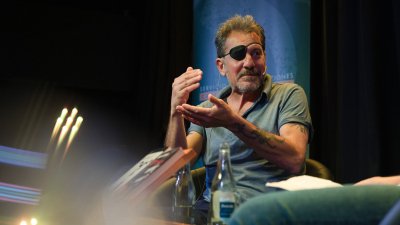
A meeting organized by the Cultural Association Picón Narrativas, with the support of the Tías City Council, Publications Service of the Cabildo de Lanzarote, Yaiza, Arrecife and Teguise City Councils, the Lanzarote Centers of Art, Culture and Tourism (CACT) and Caja7.
Strangeness can be a way of being in the world. And also a way of starting to write. With this idea as a backdrop, Ray Loriga inaugurated this Thursday, October 8, the IV Lanzarote Literature Festival (FDLL26) at the CIC El Almacén, before an audience that filled all available seats. The conversation, moderated by writer and festival director Carlos Battaglini, covered different stages of his career and left us with several reflections on writing.
The conversation began with his beginnings and his first novel, Lo peor de todo, which he started writing in Ibiza and finished in Madrid, and a career that now spans almost four decades. In this journey, Loriga questioned the label of generational writer that has accompanied him for years. That supposed generation, he explained, did not necessarily respond to the shared bonds that characterized other literary groups, such as the Beat generation. In his words about labels: "The rain takes them away, the wind takes them away, time takes them away."
This resistance to being pigeonholed is reflected in a body of work that has traversed different genres, styles, and languages, also through his work in cinema. Loriga spoke about his professional relationship with Carlos Saura and his time in New York, a city that changed profoundly after the September 11 attacks.
A propósito de Tim, his most recent novel, the dialogue delved into identity and the different categories with which we try to define ourselves. The writer reflected on the tension between increasingly specific identities and the possibility of understanding them as something open, in constant transformation. "Identity is a work in progress, it's like a bird's flight," he pointed out. An image that also summarizes his way of understanding literature: not as a formula that is repeated, but as a movement that remains open.
In the question and answer session, the audience wanted to know why his characters always seem to be close to unhappiness. Loriga responded with the humor that accompanied different moments of the talk: "Happy, it's not within my reach." And he added that unhappy characters make better novels.
The talk concluded with a look at his current life in Trujillo, where the writer has found a rhythm away from the noise of big cities. Between reading, writing, and tranquility, his day-to-day unfolds accompanied by birds and church bells.
A scene that contrasts with some of the urban landscapes that have run through his work and that put the finishing touch to a conversation about the passage of time, creation, and the need to find one's own place from which to observe.
The session ended with a loud applause from the audience and opened the tour of this fourth edition of the Lanzarote Literature Festival, which once again opts for conversation as a way to bring literature closer to citizens.
The FDLL26 continues touring Lanzarote
After the inaugural meeting with Ray Loriga, the festival will continue on October 20 with Berna González-Harbour, at the El Fondeadero Civic Center, in Puerto del Carmen. The program will bring together until December Juan Gómez Bárcena, Pola Oloixarac, Laura Ferrero, and Manuel Vilas, in addition to two writing workshops and Combustión insular. Literary conversations in Teguise, the new proposal dedicated to literary creation from the islands.
All activities are free with prior registration until full capacity is reached. The program and reservations are available at www.fdll.es.


Add La Voz de Lanzarote as a preferred Google source.
Stay informed with the latest current news.